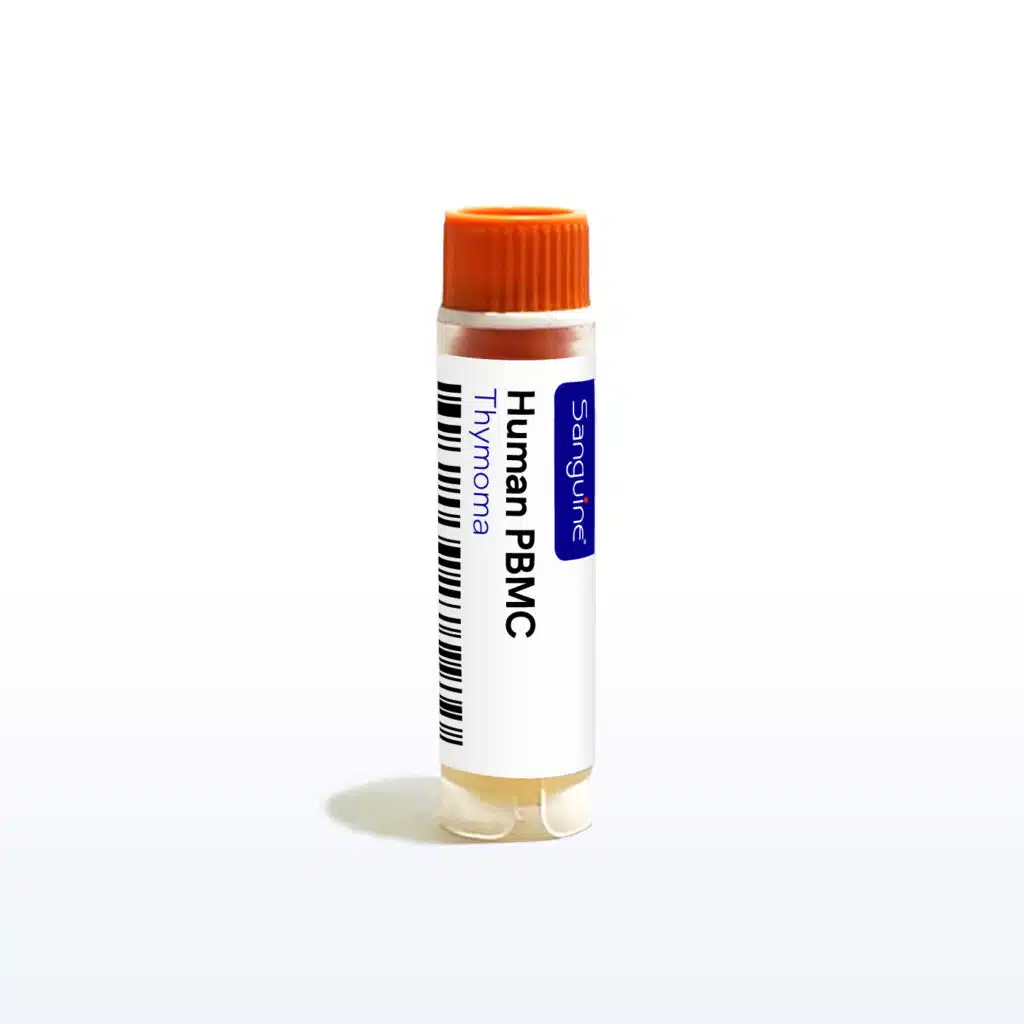
Thymoma PBMC
About: Thymoma PBMC - IRB-consented PBMC samples collected from donors diagnosed with Thymoma. Suitable for understanding immune dysregulation and T cell repertoire changes in thymic tumors.
Thymoma PBMC
Thymoma PBMC is collected from IRB-consented donors diagnosed with clinically confirmed Thymoma. These peripheral blood mononuclear cell (PBMC) samples are ideal for understanding immune dysregulation and T cell repertoire changes in thymic tumors. These PBMCs are useful for immunophenotyping, TCR sequencing, and studying autoimmune paraneoplastic phenomena associated with thymoma.
Product Features
- Cryopreserved, clinically verified Thymoma samples
- Cryopreserved to ensure stability and long-term storage
- Research Use Only (RUO)
De-identified Donor Data
- Clinically confirmed Thymoma diagnosis
- Donor demographics: age, sex assigned at birth, ethnicity
- Medical and treatment history available when applicable
Applications
- Understanding immune dysregulation and T cell repertoire changes in thymic tumors
- Biomarker discovery and validation
- Transcriptomic, proteomic, or functional studies
- Custom assay development and disease modeling
Compliance and Quality
- IRB-approved collection and electronic informed consent
- HIPAA-compliant donor data handling
Ordering and Customization
Thymoma PBMC is available in standard and custom volumes. Contact learnmore@sanguinebio.com for international requests or documentation needs.
Protocols & Documentation
-
Download
PBMC Isolation from Whole Blood
Standard operating procedure for isolating peripheral blood mononuclear cells from whole blood using density-gradient separation.
-
Download
Immune Cell Isolation
Guidelines for isolating immune cell populations with validated enrichment steps, purity checkpoints, and documentation.
-
Download
Choosing the Right PBMC Configuration
Reference guide comparing PBMC formats, cryopreservation states, and study-fit recommendations for your application.
-
Download
Thawing Cryopreserved PBMC
Validated thawing protocol to recover viable cryopreserved PBMCs while minimizing activation and loss of function.
-
Informed Consent Form (ICF)
Available upon request — confirms donor consent for research use and downstream commercialization.
PBMC
Frequently Asked Questions
1 Answer
YES – All collections are conducted under IRB-approved protocols and electronic informed consent. Sanguine utilizes Advarra and WCG IRB for oversight.
1 Answer
YES – with the exception of GMP leukopaks, all our products are research use only (RUO).
1 Answer
Our complete catalog can be found here: https://sanguinebio.com/products/
1 Answer
Storage depends on sample type but often cryopreserved samples stored in liquid nitrogen can be stored for years.
1 Answer
Extensive customization is available. To discuss your project request a quote or email us at learnmore@sanguinebio.com.
1 Answer
Sanguine offers flexible prospective colleciton services to tailored to fit your research. For more information and request a quote, please see: https://sanguinebio.com/prospective-biospecimen-collection-services/
1 Answer
Timelines depend on condition, sample type, and I/E criteria but we often start collection within 2 weeks of signed agreement.
1 Answer
YES – we have in-stock inventory which can be found here https://sanguinebio.com/products/?pro_inventory=inventory. You can also email us at learnmore@sanguinebio.com as we continually get new samples in our inventory.
1 Answer
Each sample from a different individual – Unique donor means each sample comes from a different person, ensuring biological diversity in your study.
1 Answer
YES – Unique donors can be specified and guaranteed based on your requirements.
1 Answer
For information about sample quality, please see: https://sanguinebio.com/quality-and-compliance/
1 Answer
YES – “IRB-approved collection protocols” and IRB approval documentation available upon request. Sanguine utilizes two internationally-recognized IRBs (Advarra and WCG IRB) for review and approval.
Ask a Question
Need a custom PBMC cohort?
Our scientific team can scope prospective collections with donor-specific I/E criteria, typically starting within 2 weeks of agreement.