
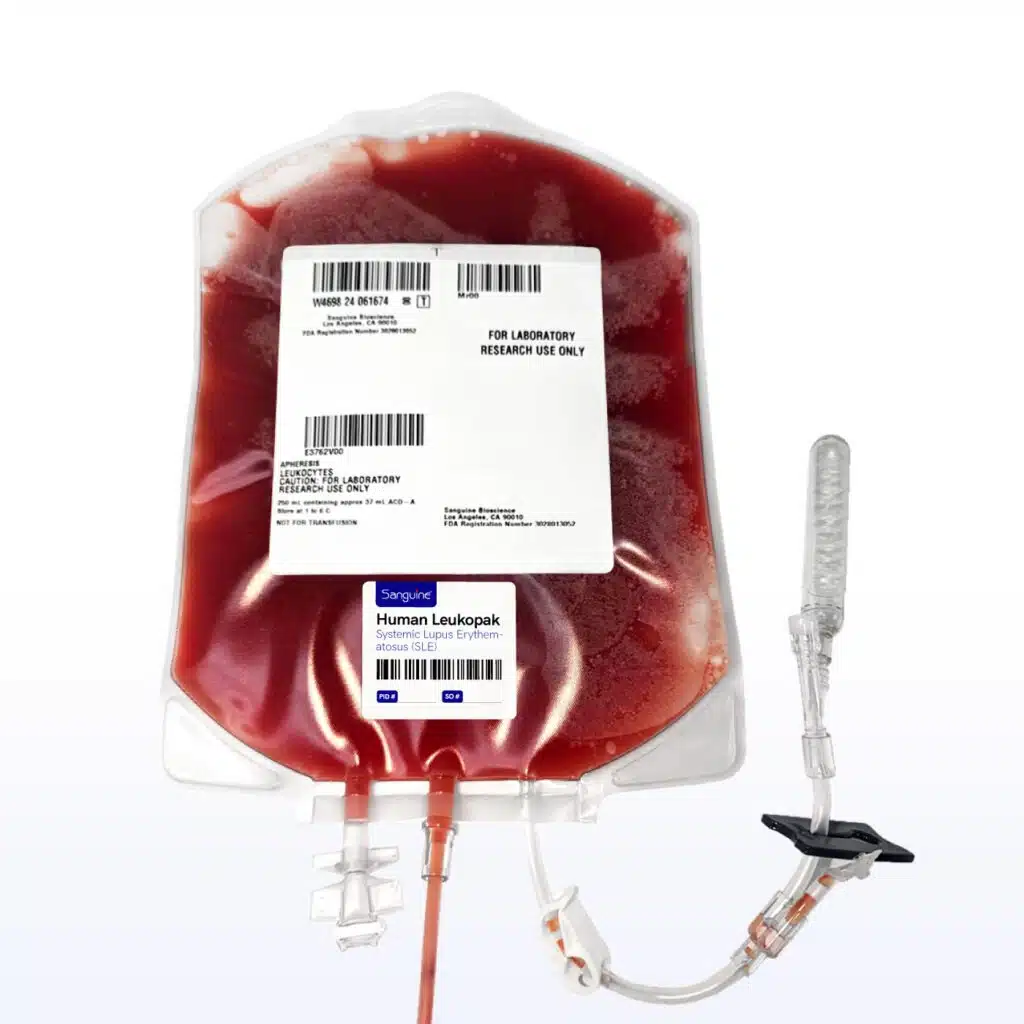
Systemic Lupus Erythematosus Leukopak
Apheresis-derived leukopaks from IRB-consented donors with clinically confirmed systemic lupus erythematosus, a systemic autoimmune disease. Leukopak-scale yields enable isolation of rare lupus-relevant subsets — plasmacytoid dendritic cells, plasmablasts, low-density granulocytes — plus CD19-directed cell therapy development. Fresh or cryopreserved; HLA-A typed.
Systemic Lupus Erythematosus Leukopak for Autoimmunity and Cell Therapy Research
LeukoCore Systemic Lupus Erythematosus Leukopak is collected from donors clinically diagnosed with SLE through IRB-approved apheresis procedures. SLE is a prototypical systemic autoimmune disease: tolerance to nucleic-acid-containing self antigens is lost, autoantibodies form immune complexes, and complement-mediated injury follows across skin, joints, kidney and blood. Each leukopak delivers very large numbers of peripheral blood mononuclear cells from a single characterised donor, making it the right starting material for rare-subset isolation, deep multi-omics and cell-therapy development.
Why a Leukopak for Systemic Lupus Erythematosus
The cell populations that define lupus immunology are rare. A standard blood draw simply does not yield enough plasmacytoid dendritic cells, plasmablasts or low-density granulocytes to interrogate them properly — an apheresis-derived leukopak does.
- Type I interferon axis — SLE is characterised by a well-documented type I interferon signature. Isolating enough plasmacytoid dendritic cells to study TLR7/TLR9 nucleic-acid sensing and interferon production requires leukopak-scale input.
- Autoreactive B-cell compartment — expanded plasmablasts and autoantibody-producing B cells are central to SLE and are the target of approved B-cell-directed therapy; leukopaks provide the numbers needed for sorting, culture and repertoire sequencing.
- CD19-directed cell therapy development — SLE is a leading indication for autologous and allogeneic CAR-T and related approaches. Patient-derived leukopaks support process development, potency assays and T-cell fitness assessment from a genuine lupus starting material.
- Low-density granulocytes and neutrophil extracellular traps — this population, enriched in SLE, co-purifies in the mononuclear fraction and is a recognised source of interferon-inducing nucleic acid.
- Regulatory T-cell and T-cell exhaustion biology — sufficient cells for both phenotyping and functional suppression assays from the same donor and the same collection.
- Longitudinal and multi-assay design — one leukopak can supply flow cytometry, sorted-subset RNA-seq, functional assays and biobanked reserve, eliminating donor-to-donor variance across a study.
Donor Stratification Available
- Disease activity: SLEDAI or physician-assessed activity score where recorded; active flare versus clinical remission
- Autoantibody serology: ANA, anti-dsDNA, anti-Sm/RNP, anti-Ro/SSA and anti-La/SSB status, reported per lot where available
- Complement status: low C3 and/or C4 versus normal complement
- Organ involvement: cutaneous, articular, haematologic, or renal involvement including lupus nephritis
- Treatment status: treatment-naive, hydroxychloroquine, mycophenolate or azathioprine, corticosteroid dose, belimumab, anifrolumab, or B-cell-depleting therapy
- Matched healthy controls available, age- and sex-matched on request
Product Features
- Research Use Only (RUO) human leukopaks
- Clinically confirmed SLE donors
- High cell yield for large-scale studies; yield and viability reported per lot
- Processed and shipped within 24 hours of collection
- Fresh or cryopreserved options available
- IRB-approved and ethically sourced
- Infectious disease testing
- HLA-A typing
- Screen donors with LeukoLot™
De-identified Donor Data
- Verified SLE diagnosis from healthcare providers
- Donor demographics: age, sex assigned at birth, race/ethnicity
- Self-reported medication history and allergies
- Autoantibody serology and complement values where available
- Relevant clinical data and organ involvement history
Applications
- Immune cell characterisation and deep immunophenotyping in SLE
- Rare-subset isolation: plasmacytoid dendritic cells, plasmablasts, regulatory T cells, low-density granulocytes
- Type I interferon and nucleic-acid sensing pathway research
- Autoreactive B-cell and BCR repertoire sequencing
- CD19-directed CAR-T and cell therapy process and potency development
- Cell-based assays, functional suppression assays and cytokine profiling
- Multi-omics studies including single-cell RNA-seq and CITE-seq
- Therapeutic screening and mechanism-of-action research for immunomodulators
Other Systemic Lupus Erythematosus Specimen Types
- Systemic Lupus Erythematosus Serum
- Systemic Lupus Erythematosus Plasma
- Systemic Lupus Erythematosus Whole Blood
- Systemic Lupus Erythematosus PBMC
- Lupus Nephritis Plasma
- Lupus (SLE) Skin Punch Biopsy
Compliance and Quality Assurance
- Collected under IRB oversight with donor e-consent (21 CFR Part 11 compliant)
- HIPAA-compliant handling of donor information
- Rigorous donor screening and documentation
Ordering & Customization
Systemic Lupus Erythematosus Leukopaks are available fresh or cryopreserved. For pricing, availability or a specific stratification request, email learnmore@sanguinebio.com; please also contact us for international shipping or regulatory documentation to confirm regional compliance. Need a different condition, or want to check current availability across our full leukopak inventory? Visit our human leukopak page to browse other disease-state options and live stock status.
Protocols & Documentation
-
Download
Leukopak Cryopreservation
Standard operating procedure for cryopreserving leukopak units with controlled freezing and post-thaw viability targets.
-
Download
Leukopak Thawing
Validated thawing workflow for cryopreserved leukopaks to maximize recovery while maintaining sterility and chain of custody.
-
Download
Choosing the Right PBMC Configuration
Reference guide comparing PBMC formats, cryopreservation states, and study-fit recommendations for your application.
-
Informed Consent Form (ICF)
Available upon request — confirms donor consent for research use and downstream commercialization.
Leukopak
Frequently Asked Questions
1 Answer
YES – All collections are conducted under IRB-approved protocols and electronic informed consent. Sanguine utilizes Advarra and WCG IRB for oversight.
1 Answer
YES – all our products are research use only (RUO).
1 Answer
You can find our full product catalog here.
1 Answer
Storage depends on sample type but often cryopreserved samples stored in liquid nitrogen can be stored for years.
1 Answer
Extensive customization is available. To discuss your project request a quote or email us at learnmore@sanguinebio.com.
1 Answer
Sanguine offers flexible prospective collection services tailored to fit your research. For more information and to request a quote, please see: our prospective biospecimen collection services page.
1 Answer
Timelines depend on condition, sample type, and I/E criteria but we often start collection within 2 weeks of signed agreement.
1 Answer
YES – we have in-stock inventory. You can also email us at learnmore@sanguinebio.com as we continually get new samples in our inventory.
1 Answer
Each sample from a different individual – Unique donor means each sample comes from a different person, ensuring biological diversity in your study.
1 Answer
YES – Unique donors can be specified and guaranteed based on your requirements.
1 Answer
For information about sample quality, please see: Quality and Compliance
1 Answer
YES – “IRB-approved collection protocols” and IRB approval documentation available upon request. Sanguine utilizes two internationally-recognized IRBs (Advarra and WCG IRB) for review and approval.
Ask a Question
Need a custom Leukopak cohort?
Our scientific team can scope prospective collections with donor-specific I/E criteria, typically starting within 2 weeks of agreement.