
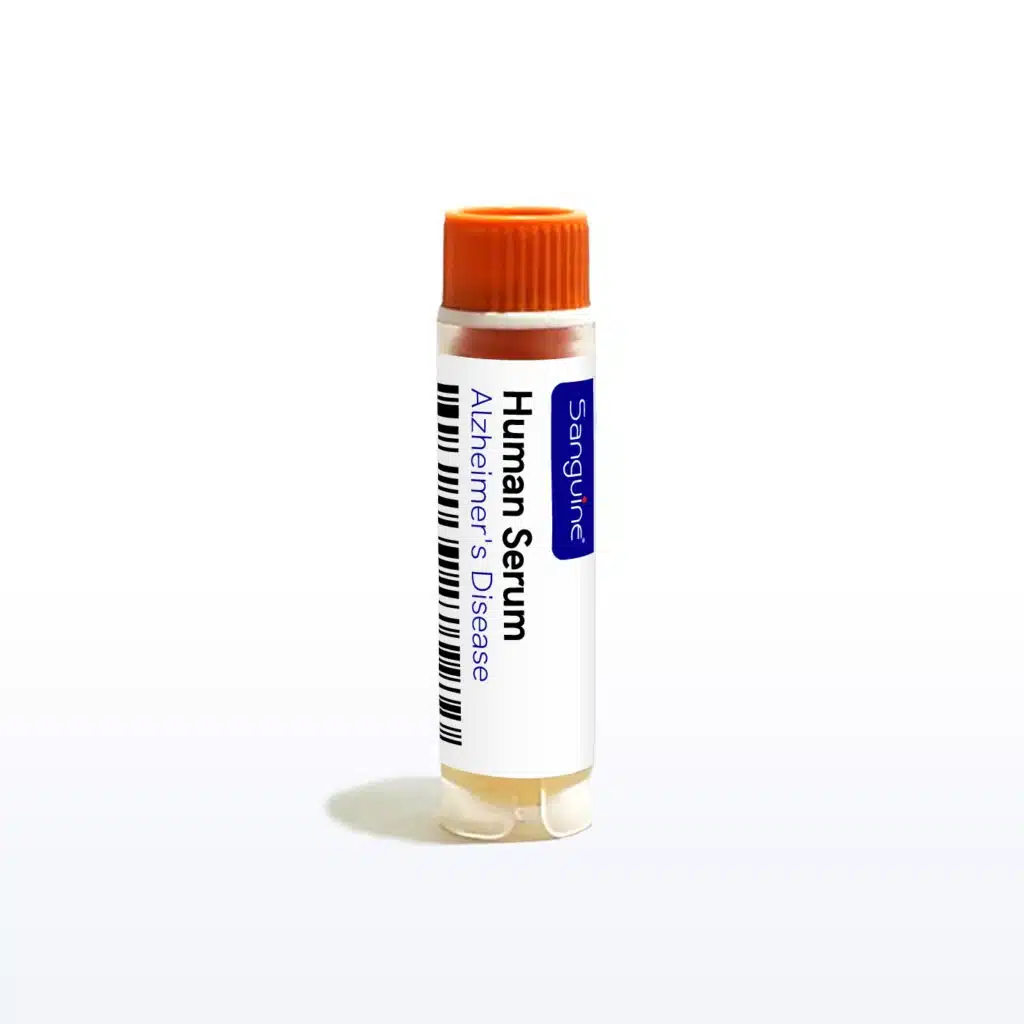
Alzheimer’s Disease Serum
 Powered by Bioz
About:Alzheimer's Disease Serum is sourced from consented donors with documented Alzheimer's disease. These samples support immunoassay and proteomics research, with donor information on condition, demographics, medications and comorbidities.
About Alzheimer’s Disease Serum
Alzheimer’s Disease Serum is sourced from consented donors with documented Alzheimer’s disease. These samples support immunoassay and proteomics research, with donor information on condition, demographics, medications and comorbidities.
Applications
- Alzheimer’s Disease research
- Immunoassay development
- Serum proteomic research
- Metabolomic research
- Soluble-protein studies
Product Features
- Human serum
- Donor condition: Alzheimer’s Disease
- Consented donor collection
- Research Use Only (RUO)
De-identified Donor Data
- Donor condition/diagnosis and documented clinical phenotype
- Age, gender and race/ethnicity
- Medications and comorbidities
- HLA typing and CMV status
- HIV, HBV, HCV and syphilis testing
- ABO/Rh blood type and country of collection
- Tobacco, alcohol, caffeine and recreational drug use
Donor Stratification
Cohort characteristics include diagnosis and documented clinical phenotype, medication history, comorbidities and demographics.
Protocols & Documentation
-
Download
Serum Isolation
Protocol for serum preparation from whole blood, including collection handling, clarification, and quality documentation.
-
Informed Consent Form (ICF)
Available upon request — confirms donor consent for research use and downstream commercialization.
Serum
Where can I find your complete catalog?
You can find our full product catalog here.
How long can samples be stored?
Storage depends on sample type but often cryopreserved samples stored in liquid nitrogen can be stored for years.
What customization options are available?
Extensive customization is available. To discuss your project request a quote or email us at learnmore@sanguinebio.com.
Do you offer prospective collections?
Sanguine offers flexible prospective collection services tailored to fit your research. For more information and to request a quote, please see: our prospective biospecimen collection services page.
What is the turnaround time for custom collections?
Timelines depend on condition, sample type, and I/E criteria but we often start collection within 2 weeks of signed agreement.
Do you have samples in stock?
YES - we have in-stock inventory. You can also email us at learnmore@sanguinebio.com as we continually get new samples in our inventory.
What does unique donor mean?
Each sample from a different individual - Unique donor means each sample comes from a different person, ensuring biological diversity in your study.
Are samples collected under IRB-approved protocols?
YES - "IRB-approved collection protocols" and IRB approval documentation available upon request. Sanguine utilizes two internationally-recognized IRBs (Advarra and WCG IRB) for review and approval.
Frequently Asked Questions
Ask a Question
Pair with a Healthy Control
Match your Alzheimer's Disease Serum with normal donor samples for comparison
Healthy Serum
99 In Stock View InventoryNeed a custom Serum cohort?
Our scientific team can scope prospective collections with donor-specific I/E criteria, typically starting within 2 weeks of agreement.