
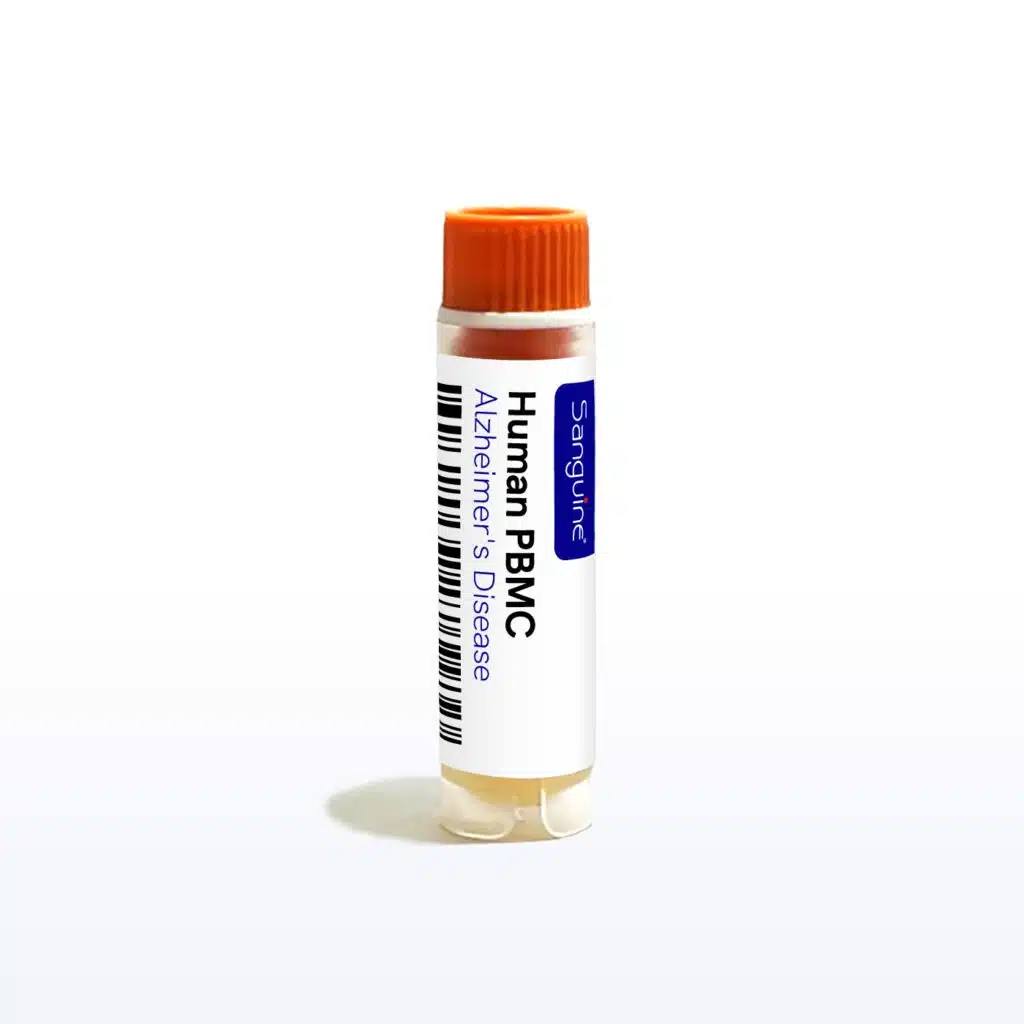
Alzheimer’s Disease PBMC

In Stock Samples

Lot # Condition Cell Count (M) Race/Ethnicity Age Gender Country of Collection Medications Vials Price Action
78501 Alzheimer's Disease 10M 74 Male Ukraine
Acetylsalicylic acid, Amiodarone, Rivastigmine
1
78502 Alzheimer's Disease 10M 74 Male Ukraine
Acetylsalicylic acid, Amiodarone, Rivastigmine
1
78465 Alzheimer's Disease 10M 73 Male Ukraine
Acetylsalicylic acid, Amiodarone, Rivastigmine
1
78503 Alzheimer's Disease 10M 74 Male Ukraine
Acetylsalicylic acid, Amiodarone, Rivastigmine
1
78466 Alzheimer's Disease 10M 73 Male Ukraine
Acetylsalicylic acid, Amiodarone, Rivastigmine
1
78504 Alzheimer's Disease 10M 74 Male Ukraine
Acetylsalicylic acid, Amiodarone, Rivastigmine
1
78480 Alzheimer's Disease 10M 71 Male Ukraine
Acetylsalicylic acid, Bisoprolol, Galantamine
1
78505 Alzheimer's Disease 10M 74 Male Ukraine
Acetylsalicylic acid, Amiodarone, Rivastigmine
1
78467 Alzheimer's Disease 10M 73 Male Ukraine
Acetylsalicylic acid, Amiodarone, Rivastigmine
1
78393 Alzheimer's Disease 10M 73 Female Ukraine
Acetylsalicylic acid, Rivastigmine
1

Alzheimer’s Disease PBMC for Neurodegeneration Research

Alzheimer’s Disease PBMC products are cryopreserved peripheral blood mononuclear cells from IRB-consented donors with a clinically confirmed diagnosis of Alzheimer’s disease. Cells are processed within 24 hours of collection and cryopreserved in CryoStor® CS10 to support neurodegeneration research, host genetics, and peripheral immune studies.

Alzheimer’s Disease Biology and What Peripheral Cells Can Tell You

Alzheimer’s disease is a progressive neurodegenerative disorder, not an autoimmune one. Its defining pathology is extracellular amyloid-beta plaque deposition and intraneuronal neurofibrillary tangles of hyperphosphorylated tau, with synaptic loss, neuroinflammation, and regional atrophy. We are deliberately clear about what a blood-derived cell product can and cannot address:

  • Genotyping. APOE is the strongest common genetic risk factor for late-onset disease, and PBMCs are a convenient source of genomic DNA for APOE and polygenic risk work
  • Transcriptomics and epigenetics. Bulk and single-cell RNA sequencing of circulating immune cells is used to look for peripheral signatures that track with disease status
  • Peripheral immune contribution. Monocyte and T-cell phenotype and function are of active interest given the role of microglia and innate immune genes such as TREM2 in disease risk
  • iPSC derivation. PBMCs are a standard starting material for reprogramming into induced pluripotent stem cells and differentiation into neurons, astrocytes, or microglia-like cells from a genotyped donor
  • Honest limitation: PBMCs do not report central nervous system pathology directly. Fluid biomarkers of amyloid and tau pathology — amyloid-beta, phosphorylated tau (p-tau181, p-tau217), neurofilament light, and GFAP — are measured in the matched plasma, serum, and cerebrospinal fluid products linked below
  • Paired specimens from the same donor allow genotype and cellular phenotype to be read alongside those fluid biomarkers

Donor Stratification Available

  • Disease stage: mild cognitive impairment, mild, moderate, or severe Alzheimer’s disease
  • Age at onset, including early-onset versus late-onset presentation
  • APOE genotype where available
  • Family history of dementia
  • Treatment status, including cholinesterase inhibitors, memantine, or anti-amyloid antibody therapy
  • Age, sex assigned at birth, and race/ethnicity
  • Matched, age-matched healthy controls available

Product Features

  • Research Use Only (RUO), cryopreserved PBMCs
  • Clinically confirmed Alzheimer’s disease donors
  • Processed within 24 hours of collection
  • Stored using CryoStor® CS10 freezing media
  • IRB-approved protocols and electronic informed consent
  • Paired plasma, serum, whole blood, or cerebrospinal fluid available from the same donor
  • Screen LeukoLot™ available prior to bulk orders

De-identified Donor Data

  • Verified Alzheimer’s disease diagnosis
  • Donor demographics: age, sex assigned at birth, race/ethnicity
  • Self-reported allergies and infectious disease history
  • Cognitive assessment results, medication history, and additional Alzheimer’s disease-specific data available upon request

Applications

  • APOE genotyping and polygenic risk score research
  • Bulk and single-cell transcriptomic profiling of circulating immune cells
  • Peripheral monocyte and T-cell immunophenotyping in neurodegeneration
  • iPSC reprogramming and derivation of neurons, astrocytes, and microglia-like cells
  • DNA methylation and epigenetic ageing studies
  • Drug screening and target validation in patient-derived cells
  • Multi-omic integration with matched fluid biomarker data
  • Case-control comparison against age-matched cognitively normal donors

Other Alzheimer’s Disease Specimen Types

Compliance and Quality Assurance

  • IRB-approved collections and protocols
  • 21 CFR Part 11-compliant e-consent system
  • HIPAA-compliant donor data protection

Ordering & Customization

Alzheimer’s Disease PBMC samples are shipped on dry ice and available in custom aliquots. For pricing, international orders, or regulatory requirements, please contact learnmore@sanguinebio.com to confirm documentation and compliance needs. For healthy-donor controls and the full specimen range, see our human PBMCs collection.

Protocols & Documentation

  • PBMC Isolation from Whole Blood

    Standard operating procedure for isolating peripheral blood mononuclear cells from whole blood using density-gradient separation.

    Download
  • Immune Cell Isolation

    Guidelines for isolating immune cell populations with validated enrichment steps, purity checkpoints, and documentation.

    Download
  • Choosing the Right PBMC Configuration

    Reference guide comparing PBMC formats, cryopreservation states, and study-fit recommendations for your application.

    Download
  • Thawing Cryopreserved PBMC

    Validated thawing protocol to recover viable cryopreserved PBMCs while minimizing activation and loss of function.

    Download
  • Informed Consent Form (ICF)

    Available upon request — confirms donor consent for research use and downstream commercialization.

PBMC

Frequently Asked Questions

Showing 1–12 of 30 results

Are samples IRB approved?

1 Answer

YES – All collections are conducted under IRB-approved protocols and electronic informed consent. Sanguine utilizes Advarra and WCG IRB for oversight.

YES – all our products are research use only (RUO).

Storage depends on sample type but often cryopreserved samples stored in liquid nitrogen can be stored for years.

Extensive customization is available. To discuss your project request a quote or email us at learnmore@sanguinebio.com.

Sanguine offers flexible prospective collection services tailored to fit your research. For more information and to request a quote, please see: our prospective biospecimen collection services page.

Timelines depend on condition, sample type, and I/E criteria but we often start collection within 2 weeks of signed agreement.

YES – we have in-stock inventory. You can also email us at learnmore@sanguinebio.com as we continually get new samples in our inventory.

Each sample from a different individual – Unique donor means each sample comes from a different person, ensuring biological diversity in your study.

YES – Unique donors can be specified and guaranteed based on your requirements.

For information about sample quality, please see: Quality and Compliance

YES – “IRB-approved collection protocols” and IRB approval documentation available upon request. Sanguine utilizes two internationally-recognized IRBs (Advarra and WCG IRB) for review and approval.

1
×

Ask a Question

Need a custom PBMC cohort?

Our scientific team can scope prospective collections with donor-specific I/E criteria, typically starting within 2 weeks of agreement.

More Information