
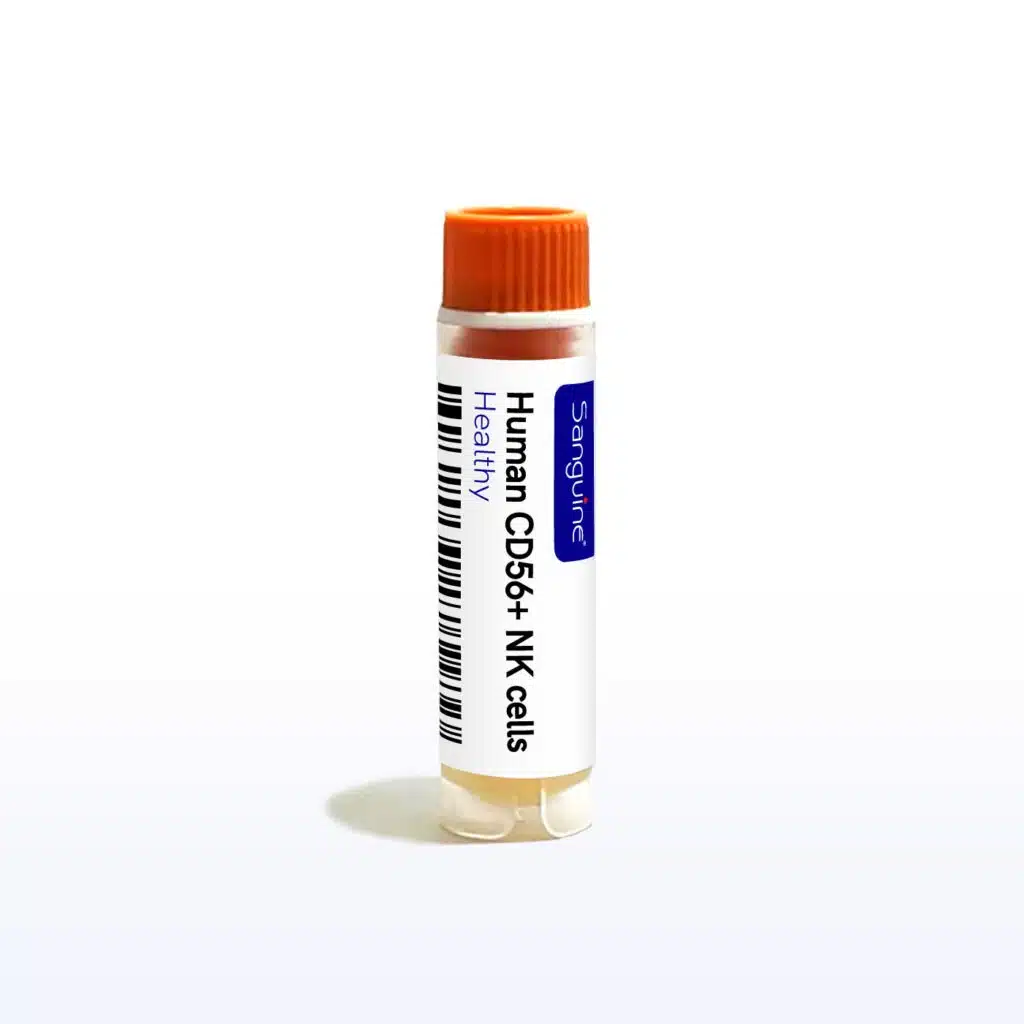
CD56+ NK Cells
About:Human CD56+ NK cells are isolated and cryopreserved from the peripheral blood of rigorously screened, consented donors in CryoStor CS10 with >90% CD56+ purity. These CD56+, CD3-negative innate lymphocytes support cytotoxicity and ADCC assays, CAR-NK and allogeneic cell therapy development, inhibitory receptor blockade studies, and NK subset profiling. Disease-state CD56+ NK cells are available.
About CD56+ NK Cells
High-Purity Human CD56+ NK Cells for Immunology and Oncology Research
Human CD56+ NK cells are isolated from the peripheral blood of rigorously screened, IRB-consented donors and cryopreserved in CryoStor® CS10 media. These natural killer cells support innate immunity research, cancer immunotherapy development, cytotoxicity and ADCC assays, and immune modulation studies. Healthy and disease-stateCD56+ NK cells are available.
What CD56+ Selection Gives You
NK cells are innate lymphocytes defined phenotypically as CD56-positive and CD3-negative. Unlike T cells they carry no rearranged antigen receptor; their activity is set by the integrated balance of germline-encoded activating and inhibitory receptors. That mechanism is what makes them a distinct research tool.
- NK cell activation is governed by the net signal from activating receptors such as NKG2D, the natural cytotoxicity receptors, and CD16, opposed by inhibitory receptors including the KIR family and NKG2A — so target killing can be studied without antigen priming.
- Inhibitory receptor engagement with HLA class I underlies “missing self” recognition, allowing NK cells to lyse tumour or virally infected cells that have downregulated class I to evade CD8+ T cells.
- CD16 (FcγRIIIa) makes CD56+ NK cells the standard effector population for antibody-dependent cellular cytotoxicity, which is why they are used to characterise the Fc engineering of therapeutic antibodies.
- The CD56bright and CD56dim compartments differ functionally, the former biased toward cytokine production and the latter toward cytotoxicity; CD56+ isolation preserves both in donor-native proportions.
- Because NK cell recognition does not require HLA matching in the way TCR-based recognition does, allogeneic donor NK cells are widely used as a starting point for off-the-shelf CAR-NK and adoptive transfer programmes.
- NK cells respond to IL-2, IL-15, and combined IL-12/IL-15/IL-18 stimulation, supporting expansion and cytokine-induced memory-like NK protocols from cryopreserved starting material.
Donor Stratification Available
- Healthy donors or clinically confirmed disease-state donors across oncology, autoimmune, inflammatory, and infectious cohorts
- CMV serostatus, relevant to adaptive/memory-like NK cell frequency, where documented
- Age band and sex assigned at birth for demographic matching
- Race and ethnicity
- HLA typing available on request for selected inventory
- Donor-reported medication and treatment status for disease-state cohorts
- Matched healthy controls available alongside any disease-state cohort
Product Features
- Human CD56+ NK cells for Research Use Only (RUO)
- Human CD56+ NK cells are isolated from healthy adult donors, with disease-state cohorts available
- High-viability human NK cell samples with >90% CD56+ purity
- Cryopreserved in CryoStor® CS10 media
- Processed within 24 hours of collection
- IRB-approved, ethically sourced, and HIPAA-compliant
- Cell counts and purity reported per lot; custom aliquots available on request
De-identified Donor Data
- Comprehensive donor screening: health history and demographics
- Age, sex assigned at birth, race/ethnicity available
- Self-reported allergies and medication use
- Additional donor metadata available on request
Applications
- Cancer immunotherapy development and screening
- Cytotoxicity and target cell killing assays
- Antibody-dependent cellular cytotoxicity and Fc engineering characterisation
- CAR-NK engineering and allogeneic cell therapy process development
- NK cell expansion and cytokine-induced memory-like NK protocols
- Checkpoint and inhibitory receptor blockade studies, including NKG2A and KIR-directed agents
- Single-cell and transcriptomic analysis of NK subsets
- Studies of CD56+ cell–mediated immune modulation and crosstalk with myeloid and T cells
Other Human Immune Cell and Blood Products
- Human CD3+ T Cells
- Human CD4+ T Cells
- Human CD8+ T Cells
- Human CD19+ B Cells
- Human PBMCs
- Human Leukopak
Compliance and Quality Assurance
- Collected with IRB-approved protocols and 21 CFR Part 11–compliant e-consent
- Rigorous donor screening and documentation
- HIPAA-compliant data handling
Buy Human NK Cells for Research
Purchase human NK cell samples for research, including CD56+ natural killer cells from healthy or disease-state donors with flexible aliquots and documentation support. For a biology and applications overview, read our guide to CD56+ NK cells.
Ordering & Customization
Purchase human CD56+ NK cells in standard or custom aliquots. For pricing, availability, international orders, or regulatory compliance documentation, please contact learnmore@sanguinebio.com. If you need to buy NK cells for research with specific donor criteria, Sanguine can support custom sourcing and documentation support. Cells can also be isolated to order from our human leukopak inventory.
Applications
- Immunology and translational research
- Biomarker discovery and validation
- Drug screening and assay development
- Vaccine and infectious disease research
Product Features
- Research Use Only (RUO), CD56+ NK Cells
- Sourced from screened, consented donors
- Processed under validated SOPs
- QC tested for purity, viability, and sterility
- Processed within 24 hours of collection
- IRB-approved protocols with electronic informed consent
Donor Metadata
- Verified diagnosis and clinical history
- Demographic data: age, sex assigned at birth, race/ethnicity
- Medication and treatment background when available
Compliance and Quality Assurance
- IRB-approved collections and standardized procedures
- 21 CFR Part 11-compliant e-consent system
- HIPAA-compliant data management
Ordering & Customization
Human CD56+ NK Cells are available in customizable aliquot sizes. For international orders or documentation needs, please contact learnmore@sanguinebio.com to confirm requirements and availability. We also work with multiple ordering platforms and distributors, learn more here.
Protocols & Documentation
-
Download
Immune Cell Isolation
Guidelines for isolating immune cell populations with validated enrichment steps, purity checkpoints, and documentation.
-
Informed Consent Form (ICF)
Available upon request — confirms donor consent for research use and downstream commercialization.
Where can I find your complete catalog?
You can find our full product catalog here.
How long can samples be stored?
Storage depends on sample type but often cryopreserved samples stored in liquid nitrogen can be stored for years.
What customization options are available?
Extensive customization is available. To discuss your project request a quote or email us at learnmore@sanguinebio.com.
Do you offer prospective collections?
Sanguine offers flexible prospective collection services tailored to fit your research. For more information and to request a quote, please see: our prospective biospecimen collection services page.
What is the turnaround time for custom collections?
Timelines depend on condition, sample type, and I/E criteria but we often start collection within 2 weeks of signed agreement.
Do you have samples in stock?
YES - we have in-stock inventory. You can also email us at learnmore@sanguinebio.com as we continually get new samples in our inventory.
What does unique donor mean?
Each sample from a different individual - Unique donor means each sample comes from a different person, ensuring biological diversity in your study.
Are samples collected under IRB-approved protocols?
YES - "IRB-approved collection protocols" and IRB approval documentation available upon request. Sanguine utilizes two internationally-recognized IRBs (Advarra and WCG IRB) for review and approval.
Frequently Asked Questions
Ask a Question
Need a custom CD56+ NK Cells cohort?
Our scientific team can scope prospective collections with donor-specific I/E criteria, typically starting within 2 weeks of agreement.