
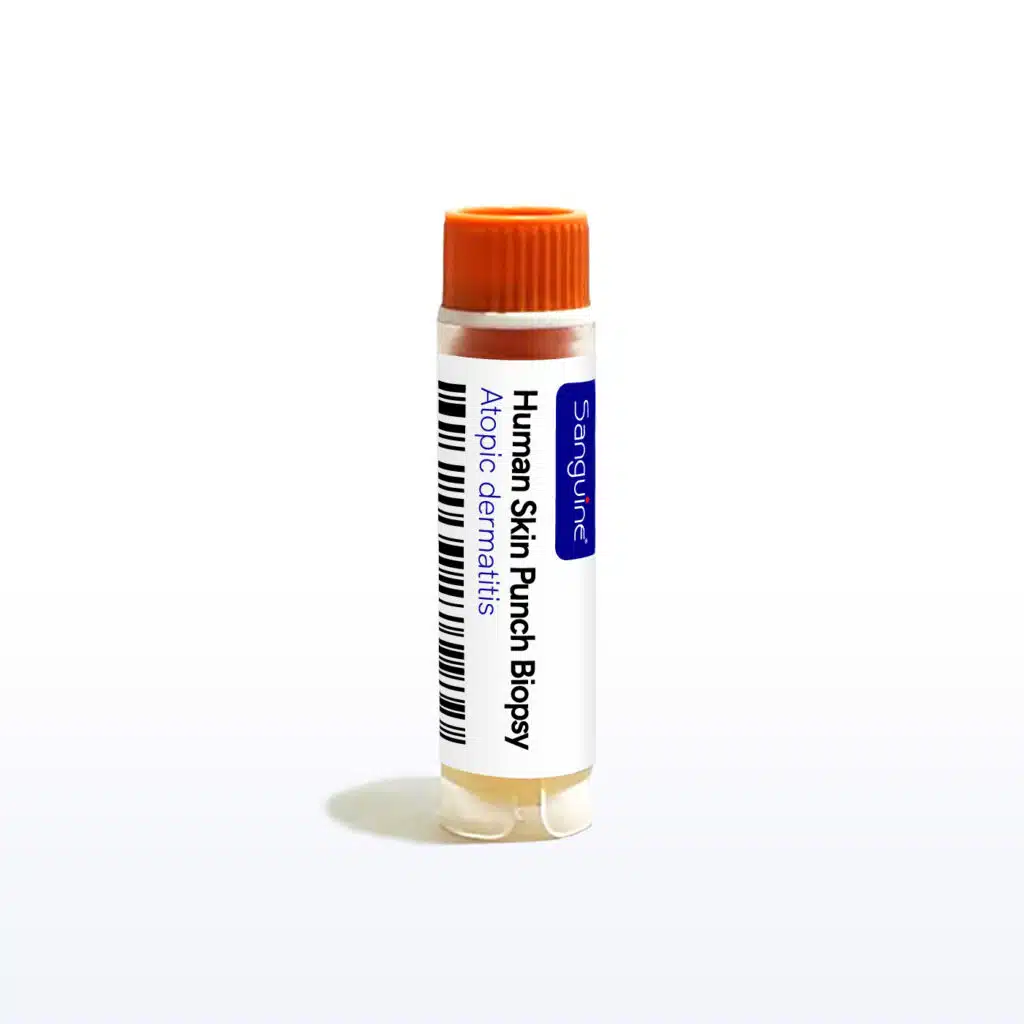
Atopic Dermatitis (Eczema) Skin Punch Biopsy
About:Atopic Dermatitis Skin Punch Biopsy samples are collected from consented donors with clinically confirmed AD, with paired lesional and non-lesional sites available. Support research into epidermal barrier and filaggrin biology, IL-4 and IL-13-driven type 2 inflammation, target engagement for biologics and JAK inhibitors, and lesional skin microbiome. Stratification by severity, lesion character, atopic comorbidity, and treatment status available, with matched healthy controls.
About Atopic Dermatitis (Eczema) Skin Punch Biopsy
Atopic Dermatitis Skin Punch Biopsy for Type 2 Inflammation and Skin Barrier Research
Atopic Dermatitis Skin Punch Biopsy samples are collected from IRB-consented donors with a clinically confirmed diagnosis of atopic dermatitis (AD). Biopsies are taken by licensed clinicians under aseptic conditions and, where frozen material is requested, are frozen within 4 hours of collection. Lesional and clinically uninvolved non-lesional sites can be requested. These specimens support histological, immunological, and molecular research into barrier dysfunction and type 2 inflammation in the skin.
Why Skin Tissue for Atopic Dermatitis Research
Atopic dermatitis is an allergic, type 2-driven inflammatory disease rather than an autoimmune one. Its two defining features — a defective epidermal barrier and a type 2 cytokine response — interact within the skin, and neither can be properly measured outside it.
- Barrier integrity is a structural property of the epidermis. Expression and distribution of filaggrin, loricrin, and other cornified envelope proteins, and the organisation of stratum corneum lipids, are assessable only in intact tissue.
- Loss-of-function variants in the filaggrin gene are the strongest established genetic risk factor for AD, and tissue allows genotype to be related directly to protein expression and barrier structure.
- IL-13 and IL-4 dominate the lesional cytokine profile, and IL-4 receptor and IL-13-directed biologics are approved for AD; lesional biopsy is the standard specimen for demonstrating target engagement and pathway suppression in the skin itself.
- Type 2 cytokines directly downregulate filaggrin and antimicrobial peptide expression in keratinocytes, so the barrier defect and the immune response are mechanistically linked — a relationship only observable where both compartments are present.
- Lesional AD skin shows reduced microbial diversity with relative Staphylococcus aureus overgrowth, and tissue permits microbiome analysis alongside the host response in the same sample.
- Paired lesional and non-lesional biopsies from the same donor are the conventional design in AD mechanistic studies, providing an internally controlled comparison and allowing acute spongiotic and chronic lichenified lesions to be distinguished histologically.
Donor Stratification Available
- Severity: documented EASI, SCORAD, or Investigator Global Assessment where recorded
- Lesion character and biopsy site: acute inflammatory lesion, chronic lichenified lesion, or clinically uninvolved non-lesional skin
- Atopic comorbidities: asthma, allergic rhinitis, or food allergy
- Total serum IgE and blood eosinophil count where documented
- Treatment status: topical corticosteroid, topical calcineurin inhibitor or PDE4 inhibitor, IL-4 receptor or IL-13 biologic, JAK inhibitor, phototherapy, systemic immunosuppressant, or treatment-naive
- Age group (paediatric or adult), age of onset, ancestry, and Fitzpatrick skin type — all relevant to AD endotype
- Matched healthy controls available
Product Features
- Research Use Only (RUO), fresh or frozen skin punch biopsies
- Samples are frozen (if requested) within 4 hours of collection
- Clinically confirmed atopic dermatitis donors
- Collected by licensed clinicians under aseptic conditions
- Lesional and non-lesional sites available from the same donor on request
- Processed and shipped same-day where applicable
- IRB-approved protocols and electronic informed consent
De-identified Donor Data
- Verified diagnosis of atopic dermatitis
- Donor demographics: age, sex assigned at birth, race/ethnicity
- Self-reported medication history and lesion site
- Disease severity, atopic comorbidity, and clinical history available upon request
Applications
- Histopathological grading of spongiosis, acanthosis, and lichenification
- Immunohistochemical and transcriptomic assessment of barrier protein expression
- Quantification of type 2 cytokine and chemokine pathway activity in lesional skin
- Target engagement and pharmacodynamic readouts for IL-4, IL-13, IL-31, and JAK-directed therapeutics
- Spatial and single-cell profiling of keratinocyte, T cell, and dendritic cell compartments
- Skin microbiome sequencing of lesional versus non-lesional sites
- Ex vivo skin explant assays for topical formulation and penetration studies
- Endotype discovery and biomarker research across severity and age groups
Other Atopic Dermatitis Specimen Types
- Atopic Dermatitis Serum
- Atopic Dermatitis Plasma
- Atopic Dermatitis Whole Blood
- Atopic Dermatitis PBMC
- Atopic Dermatitis Leukopak
- Atopic Dermatitis CD4+ T Cells
- Atopic Dermatitis Bulk Plasma
Compliance and Quality Assurance
- IRB-approved collections and SOP-driven processing
- 21 CFR Part 11-compliant electronic informed consent
- HIPAA-compliant donor data management
Ordering & Customization
Atopic Dermatitis Skin Punch Biopsy samples can be shipped ambient, refrigerated, or on dry ice. For pricing, availability, orders outside the United States, or regulatory documentation, please contact learnmore@sanguinebio.com. To browse other disease states and biopsy formats, visit our human skin punch biopsy page.
Applications
- Immunology and translational research
- Biomarker discovery and validation
- Drug screening and assay development
- Vaccine and infectious disease research
Product Features
- Research Use Only (RUO), Skin Punch Biopsy
- Sourced from screened, consented donors
- Processed under validated SOPs
- QC tested for purity, viability, and sterility
- Processed within 24 hours of collection
- IRB-approved protocols with electronic informed consent
Donor Metadata
- Verified diagnosis and clinical history
- Demographic data: age, sex assigned at birth, race/ethnicity
- Medication and treatment background when available
Compliance and Quality Assurance
- IRB-approved collections and standardized procedures
- 21 CFR Part 11-compliant e-consent system
- HIPAA-compliant data management
Ordering & Customization
Human Skin Punch Biopsy are available in customizable aliquot sizes. For international orders or documentation needs, please contact learnmore@sanguinebio.com to confirm requirements and availability. We also work with multiple ordering platforms and distributors, learn more here.
Where can I find your complete catalog?
You can find our full product catalog here.
How long can samples be stored?
Storage depends on sample type but often cryopreserved samples stored in liquid nitrogen can be stored for years.
What customization options are available?
Extensive customization is available. To discuss your project request a quote or email us at learnmore@sanguinebio.com.
Do you offer prospective collections?
Sanguine offers flexible prospective collection services tailored to fit your research. For more information and to request a quote, please see: our prospective biospecimen collection services page.
What is the turnaround time for custom collections?
Timelines depend on condition, sample type, and I/E criteria but we often start collection within 2 weeks of signed agreement.
Do you have samples in stock?
YES - we have in-stock inventory. You can also email us at learnmore@sanguinebio.com as we continually get new samples in our inventory.
What does unique donor mean?
Each sample from a different individual - Unique donor means each sample comes from a different person, ensuring biological diversity in your study.
Are samples collected under IRB-approved protocols?
YES - "IRB-approved collection protocols" and IRB approval documentation available upon request. Sanguine utilizes two internationally-recognized IRBs (Advarra and WCG IRB) for review and approval.
Frequently Asked Questions
Ask a Question
Pair with a Healthy Control
Match your Atopic Dermatitis (Eczema) Skin Punch Biopsy with normal donor samples for comparison
Healthy Skin Punch Biopsy
View InventoryNeed a custom Skin Punch Biopsy cohort?
Our scientific team can scope prospective collections with donor-specific I/E criteria, typically starting within 2 weeks of agreement.