
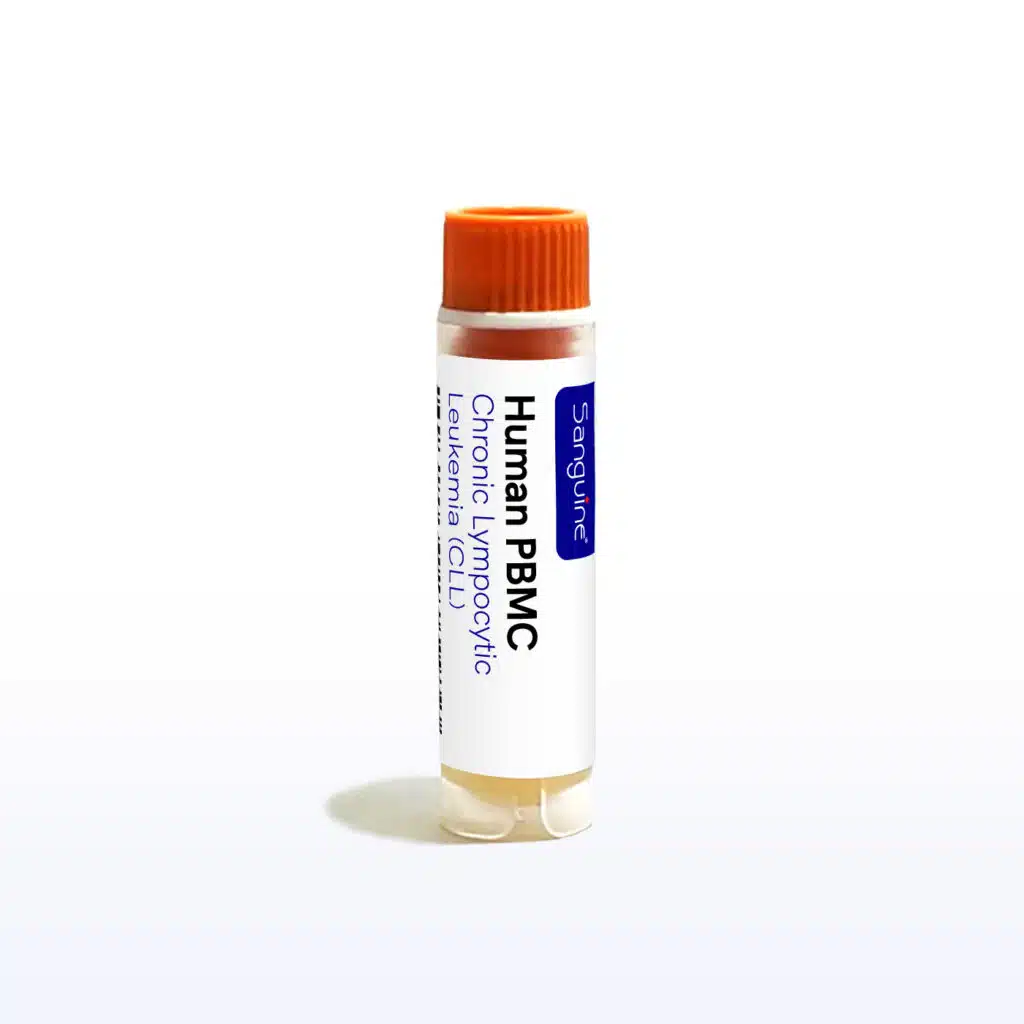
Chronic Lymphocytic Leukemia PBMC
 Powered by Bioz
About:Chronic Lymphocytic Leukemia (CLL) PBMC isolated from consented donors with clinically confirmed CLL and cryopreserved in CryoStor CS10. CLL's high circulating clonal burden makes PBMCs an especially disease-relevant matrix. Suitable for immunophenotyping, IGHV/cytogenetic marker studies, BTK/BCL-2 inhibitor research, and genotype-stratified leukemia research.
About Chronic Lymphocytic Leukemia PBMC
Chronic Lymphocytic Leukemia PBMC for Leukemia Research
Chronic Lymphocytic Leukemia (CLL) PBMC products are sourced from IRB-consented donors clinically diagnosed with CLL and processed within 24 hours of collection under standardised conditions. CLL is unique among the leukemias in that the malignant clone circulates in large numbers in peripheral blood, often accounting for the majority of circulating lymphocytes at diagnosis. This makes PBMCs an especially disease-relevant, non-invasive source of both leukemic and residual normal immune cells for downstream study.
CLL Biology and Why Peripheral Blood
- CLL is characterised by clonal accumulation of mature-appearing, functionally incompetent B lymphocytes that co-express CD5 and CD19/CD20, typically in numbers high enough to make peripheral blood diagnostic on its own via flow cytometry.
- IGHV mutation status and cytogenetic abnormalities detected by FISH – including del(17p), del(11q), trisomy 12 and del(13q) – are the key prognostic and predictive markers routinely assessed from peripheral blood.
- The proportion of circulating clonal cells makes PBMCs efficient for bulk and single-cell studies of the leukemic clone without the need for marrow aspiration.
- Peripheral T cell and NK cell compartments in CLL show well-documented dysfunction, including T cell exhaustion and skewed subset ratios, positioning PBMCs as a useful matrix for immune dysfunction research alongside the leukemic clone itself.
- Targeted therapies including BTK inhibitors (ibrutinib, acalabrutinib) and BCL-2 inhibitors (venetoclax) have driven demand for peripheral blood-derived material in pharmacodynamic, resistance, and minimal residual disease research.
Donor Stratification Available
- IGHV mutation status where documented
- Cytogenetic abnormalities by FISH, including del(17p), del(11q), trisomy 12 and del(13q)
- Disease stage (Rai/Binet) and treatment history
- Prior or current BTK inhibitor/BCL-2 inhibitor exposure where reported
- Age band and sex assigned at birth
- Matched healthy donor PBMCs available
Product Features
- Research Use Only (RUO), cryopreserved PBMCs
- Clinically confirmed CLL donors
- Processed within 24 hours of collection
- Stored using CryoStor® CS10 freezing media
- Custom aliquot sizes available on request
- IRB-approved protocols and electronic informed consent
De-identified Donor Data
- Verified CLL diagnosis
- Donor demographics: age, sex assigned at birth, race/ethnicity
- Self-reported allergies and infectious disease history
- Disease stage and treatment history where documented
- Additional CLL-specific data available upon request
Applications
- Immunophenotyping of the clonal B-cell population and residual T/NK compartments by flow cytometry
- Bulk and single-cell RNA sequencing of leukemic and non-leukemic peripheral immune populations
- IGHV and cytogenetic prognostic marker studies
- BTK inhibitor and BCL-2 inhibitor pharmacodynamic and resistance research
- Minimal residual disease assay development
- T cell exhaustion and immune dysfunction studies in CLL
- Biomarker discovery and drug screening in patient-derived cells
Other Chronic Lymphocytic Leukemia Specimen Types
Compliance and Quality Assurance
- IRB-approved collections and protocols
- 21 CFR Part 11 – compliant e-consent system
- HIPAA-compliant donor data protection
Ordering & Customization
Chronic Lymphocytic Leukemia PBMC samples are shipped on dry ice and available in custom aliquots. For pricing, current availability, international orders or regulatory requirements, please contact learnmore@sanguinebio.com to confirm documentation and compliance needs. To browse donor cohorts across our full inventory, visit our human PBMCs page.
Applications
- Immunology and translational research
- Biomarker discovery and validation
- Drug screening and assay development
- Vaccine and infectious disease research
Product Features
- Research Use Only (RUO), PBMC
- Sourced from screened, consented donors
- Processed under validated SOPs
- QC tested for purity, viability, and sterility
- Processed within 24 hours of collection
- IRB-approved protocols with electronic informed consent
Donor Metadata
- Verified diagnosis and clinical history
- Demographic data: age, sex assigned at birth, race/ethnicity
- Medication and treatment background when available
Compliance and Quality Assurance
- IRB-approved collections and standardized procedures
- 21 CFR Part 11-compliant e-consent system
- HIPAA-compliant data management
Ordering & Customization
Human PBMC are available in customizable aliquot sizes. For international orders or documentation needs, please contact learnmore@sanguinebio.com to confirm requirements and availability. We also work with multiple ordering platforms and distributors, learn more here.
Protocols & Documentation
-
Download
PBMC Isolation from Whole Blood
Standard operating procedure for isolating peripheral blood mononuclear cells from whole blood using density-gradient separation.
-
Download
Immune Cell Isolation
Guidelines for isolating immune cell populations with validated enrichment steps, purity checkpoints, and documentation.
-
Download
Choosing the Right PBMC Configuration
Reference guide comparing PBMC formats, cryopreservation states, and study-fit recommendations for your application.
-
Download
Thawing Cryopreserved PBMC
Validated thawing protocol to recover viable cryopreserved PBMCs while minimizing activation and loss of function.
-
Informed Consent Form (ICF)
Available upon request — confirms donor consent for research use and downstream commercialization.
PBMC
Where can I find your complete catalog?
You can find our full product catalog here.
How long can samples be stored?
Storage depends on sample type but often cryopreserved samples stored in liquid nitrogen can be stored for years.
What customization options are available?
Extensive customization is available. To discuss your project request a quote or email us at learnmore@sanguinebio.com.
Do you offer prospective collections?
Sanguine offers flexible prospective collection services tailored to fit your research. For more information and to request a quote, please see: our prospective biospecimen collection services page.
What is the turnaround time for custom collections?
Timelines depend on condition, sample type, and I/E criteria but we often start collection within 2 weeks of signed agreement.
Do you have samples in stock?
YES - we have in-stock inventory. You can also email us at learnmore@sanguinebio.com as we continually get new samples in our inventory.
What does unique donor mean?
Each sample from a different individual - Unique donor means each sample comes from a different person, ensuring biological diversity in your study.
Are samples collected under IRB-approved protocols?
YES - "IRB-approved collection protocols" and IRB approval documentation available upon request. Sanguine utilizes two internationally-recognized IRBs (Advarra and WCG IRB) for review and approval.
Frequently Asked Questions
Ask a Question
Pair with a Healthy Control
Match your Chronic Lymphocytic Leukemia PBMC with normal donor samples for comparison
Healthy Donor PBMCs
703 In Stock View InventoryNeed a custom PBMC cohort?
Our scientific team can scope prospective collections with donor-specific I/E criteria, typically starting within 2 weeks of agreement.