
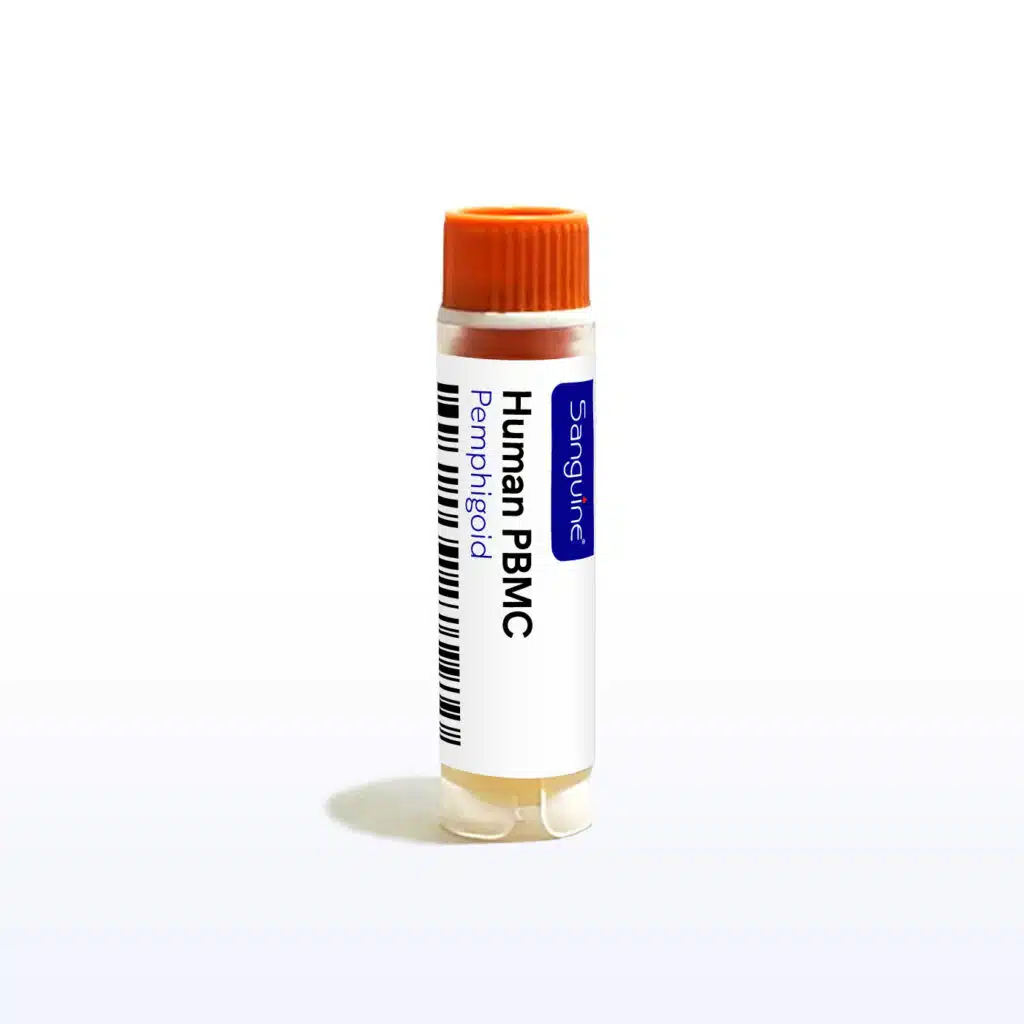
Pemphigoid PBMC
 Powered by Bioz
About:Pemphigoid PBMC samples are isolated from donors with clinically and serologically confirmed pemphigoid, an autoantibody-mediated subepidermal blistering disease targeting hemidesmosomal BP180 (collagen XVII) and BP230. Ideal for B-cell and T-follicular helper immunophenotyping, antigen-specific B-cell sorting, BCR repertoire sequencing, and B-cell-directed drug screening. Matched healthy controls available.
About Pemphigoid PBMC
Pemphigoid PBMC for Autoimmune Blistering Disease Research
Pemphigoid PBMC samples are collected from IRB-consented donors clinically diagnosed with pemphigoid and processed within 24 hours of collection under controlled conditions. Pemphigoid is a genuinely autoantibody-mediated disease of the dermal-epidermal junction, and cryopreserved peripheral blood mononuclear cells (PBMCs) provide the autoreactive B- and T-cell material needed to interrogate how those autoantibodies arise and are sustained.
Pemphigoid Immunology and Why PBMCs
- Pemphigoid is driven by IgG autoantibodies against hemidesmosomal proteins – principally BP180 (collagen XVII, the transmembrane component) and BP230 (a plakin-family intracellular protein) – which anchor basal keratinocytes to the underlying basement membrane.
- Autoantibody binding at the dermal-epidermal junction activates complement and recruits neutrophils, eosinophils, and mast cells, whose proteases cleave the anchoring complex and produce the subepidermal blister that defines the disease histologically.
- Anti-BP180 titres, particularly against the immunodominant NC16A domain, correlate reasonably well with disease activity and are the standard serological readout; anti-BP230 is a useful complementary marker.
- IgE autoantibodies against BP180 and prominent tissue eosinophilia implicate a type 2 immune component alongside the IgG response, which has motivated interest in IL-4/IL-13- and eosinophil-directed therapies.
- Autoreactive B cells require T-follicular helper support to undergo class switching and affinity maturation, so PBMCs are the specimen of choice for antigen-specific B-cell identification, BCR repertoire work, and T-cell help assays.
- PBMCs support flow cytometric immunophenotyping and functional assays that cannot be performed on plasma or serum, making them complementary to the acellular pemphigoid products.
Donor Stratification Available
- Clinical variant: bullous pemphigoid versus mucous membrane pemphigoid, where documented
- Serology status: anti-BP180 and anti-BP230 results where testing is documented
- Disease activity at collection: active blistering versus clinical remission
- Treatment exposure: treatment-naive, topical or systemic corticosteroid, steroid-sparing immunosuppressant, rituximab, or biologic treated
- Presence of associated eosinophilia or elevated total IgE where documented
- Age band, sex, and relevant comorbidities including neurological disease and diabetes
- Matched healthy controls available
Product Features
- Research Use Only (RUO), cryopreserved pemphigoid PBMC samples
- Clinically confirmed pemphigoid donors
- Available in cell counts ranging from 5 million to 2 billion
- Processed within 24 hours of collection
- Preserved using CryoStor® CS10 freezing media
- IRB-approved protocols and electronic informed consent
- Screening (LeukoLot™) available prior to bulk orders
De-identified Donor Data
- Verified pemphigoid diagnosis
- Donor demographics: age, sex assigned at birth, race/ethnicity
- Self-reported allergies and infectious disease history
- Serology results, disease activity, and treatment history where documented
- Additional pemphigoid-specific clinical data available on request
Applications
- Immunophenotyping of B-cell, plasmablast, and T-follicular helper compartments by flow or spectral cytometry
- Antigen-specific B-cell identification and sorting using BP180 and BP230 tetramers or probes
- B-cell receptor repertoire sequencing and monoclonal antibody cloning from autoreactive clones
- T-cell help and autoantigen-specific T-cell response assays
- Single-cell RNA sequencing and CITE-seq of the circulating immune compartment
- Ex vivo drug screening and mechanism-of-action work for B-cell-depleting and type 2-directed therapeutics
- Transcriptomic and proteomic profiling of sorted immune subsets
- Biomarker discovery and validation for disease activity and relapse prediction
Other Pemphigoid Specimen Types
- Pemphigoid Plasma
- Pemphigoid Serum
- Pemphigoid Whole Blood
- Pemphigoid Leukopak
- Bullous Pemphigoid Skin Punch Biopsy
Compliance and Quality Assurance
- IRB-approved collections and protocols
- 21 CFR Part 11-compliant e-consent
- HIPAA-compliant donor data protection
Ordering & Customization
Pemphigoid PBMC samples ship on dry ice in standard or custom aliquots. For pricing, international orders, or regulatory documentation, contact learnmore@sanguinebio.com. Browse all human PBMCs or request a custom disease-state collection.
Applications
- Immunology and translational research
- Biomarker discovery and validation
- Drug screening and assay development
- Vaccine and infectious disease research
Product Features
- Research Use Only (RUO), PBMC
- Sourced from screened, consented donors
- Processed under validated SOPs
- QC tested for purity, viability, and sterility
- Processed within 24 hours of collection
- IRB-approved protocols with electronic informed consent
Donor Metadata
- Verified diagnosis and clinical history
- Demographic data: age, sex assigned at birth, race/ethnicity
- Medication and treatment background when available
Compliance and Quality Assurance
- IRB-approved collections and standardized procedures
- 21 CFR Part 11-compliant e-consent system
- HIPAA-compliant data management
Ordering & Customization
Human PBMC are available in customizable aliquot sizes. For international orders or documentation needs, please contact learnmore@sanguinebio.com to confirm requirements and availability. We also work with multiple ordering platforms and distributors, learn more here.
Protocols & Documentation
-
Download
PBMC Isolation from Whole Blood
Standard operating procedure for isolating peripheral blood mononuclear cells from whole blood using density-gradient separation.
-
Download
Immune Cell Isolation
Guidelines for isolating immune cell populations with validated enrichment steps, purity checkpoints, and documentation.
-
Download
Choosing the Right PBMC Configuration
Reference guide comparing PBMC formats, cryopreservation states, and study-fit recommendations for your application.
-
Download
Thawing Cryopreserved PBMC
Validated thawing protocol to recover viable cryopreserved PBMCs while minimizing activation and loss of function.
-
Informed Consent Form (ICF)
Available upon request — confirms donor consent for research use and downstream commercialization.
PBMC
Where can I find your complete catalog?
You can find our full product catalog here.
How long can samples be stored?
Storage depends on sample type but often cryopreserved samples stored in liquid nitrogen can be stored for years.
What customization options are available?
Extensive customization is available. To discuss your project request a quote or email us at learnmore@sanguinebio.com.
Do you offer prospective collections?
Sanguine offers flexible prospective collection services tailored to fit your research. For more information and to request a quote, please see: our prospective biospecimen collection services page.
What is the turnaround time for custom collections?
Timelines depend on condition, sample type, and I/E criteria but we often start collection within 2 weeks of signed agreement.
Do you have samples in stock?
YES - we have in-stock inventory. You can also email us at learnmore@sanguinebio.com as we continually get new samples in our inventory.
What does unique donor mean?
Each sample from a different individual - Unique donor means each sample comes from a different person, ensuring biological diversity in your study.
Are samples collected under IRB-approved protocols?
YES - "IRB-approved collection protocols" and IRB approval documentation available upon request. Sanguine utilizes two internationally-recognized IRBs (Advarra and WCG IRB) for review and approval.
Frequently Asked Questions
Ask a Question
Pair with a Healthy Control
Match your Pemphigoid PBMC with normal donor samples for comparison
Healthy Donor PBMCs
704 In Stock View InventoryNeed a custom PBMC cohort?
Our scientific team can scope prospective collections with donor-specific I/E criteria, typically starting within 2 weeks of agreement.