
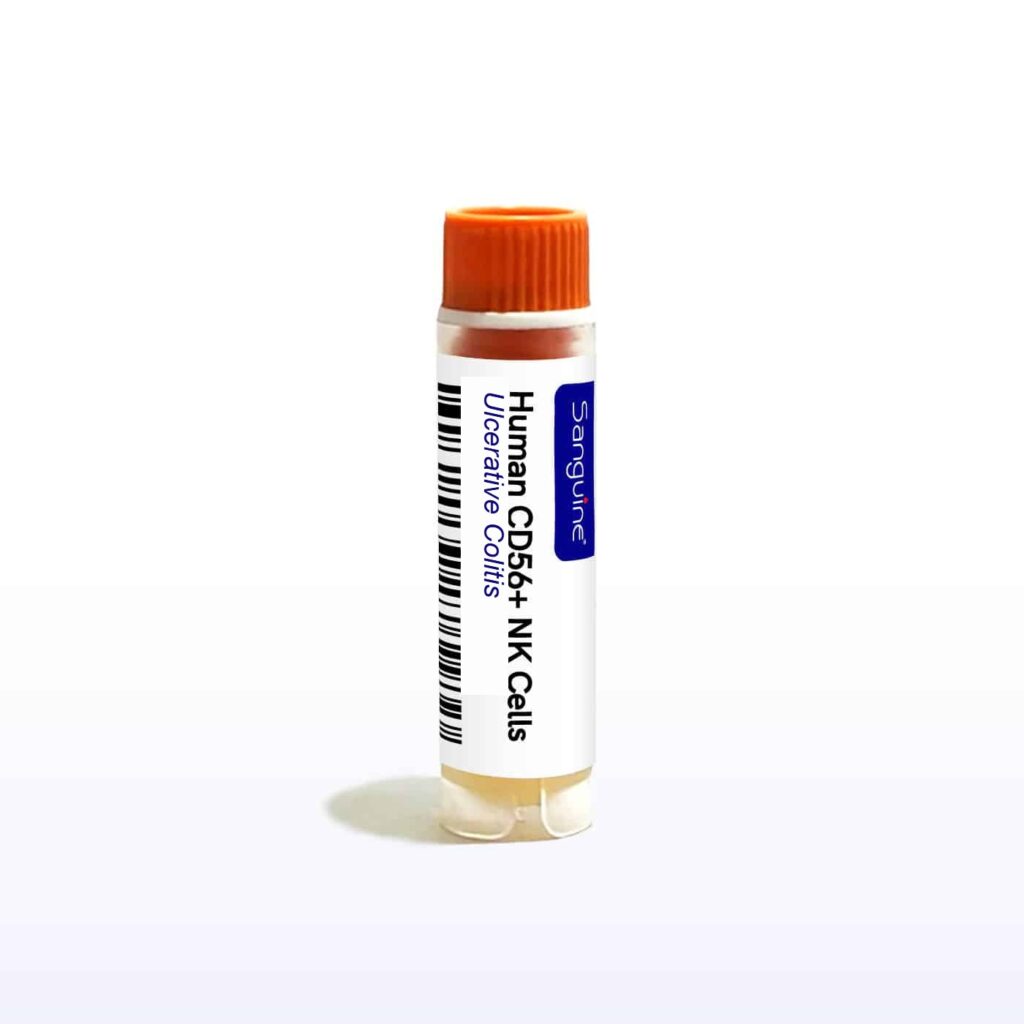
Ulcerative Colitis CD56+ NK Cells
About:Ulcerative Colitis CD56+ NK Cells come from consented donors with ulcerative colitis. Relevant for exploring innate lymphocyte involvement in colonic mucosal immune surveillance, ILC plasticity, and inflammation.
About Ulcerative Colitis CD56+ NK Cells
Ulcerative Colitis CD56+ NK Cells for Mucosal Immunology Research
Ulcerative Colitis CD56+ NK Cells are cryopreserved from peripheral blood of IRB-consented adult donors diagnosed with ulcerative colitis. These CD56+ CD3− natural killer cells reflect disease-associated innate immune alterations and support studies of immune surveillance, inflammation, and cytotoxicity.
NK Cells in Ulcerative Colitis
Ulcerative colitis is an immune-mediated inflammatory bowel disease characterised by continuous mucosal inflammation confined to the colon, driven by a dysregulated response to intestinal microbiota rather than autoimmunity against a defined self-antigen. The innate lymphocyte compartment is closely involved:
- ILC plasticity — the innate lymphoid compartment shifts toward IFN-γ-producing ILC1-like and IL-17-producing ILC3 phenotypes in inflamed mucosa, and NK cells overlap phenotypically with ILC1
- Altered cytotoxicity and receptor repertoire in circulating NK cells
- Pro-inflammatory cytokine production — IFN-γ and TNF-α contributing to epithelial damage
- Dual regulatory and inflammatory roles, depending on subset and mucosal context
- Epithelial barrier interaction — relevant to the colonic-restricted pattern that distinguishes UC from Crohn’s
- Trafficking-directed therapy — vedolizumab blocks α4β7 integrin, altering circulating lymphocyte populations in treated donors
Donor Stratification Available
- Disease activity — Mayo score, UCEIS, or partial Mayo where recorded; active flare vs remission
- Disease extent — proctitis, left-sided colitis, or pancolitis
- Inflammatory markers — CRP and faecal calprotectin where available
- pANCA serology where tested
- Treatment status — 5-ASA, thiopurine, anti-TNF, anti-integrin, or JAK inhibitor
- Matched healthy controls, and Crohn’s disease donors for differential IBD comparison
Product Features
- Research Use Only (RUO), CD56+ enriched NK cells
- Isolated from clinically diagnosed ulcerative colitis donors
- High viability and enrichment
- Cryopreserved in CryoStor® CS10 media
- Processed within 24 hours of collection
- Flow cytometry purity and viability data per lot
- Ethically sourced with IRB approval and HIPAA compliance
De-identified Donor Data
- Confirmed diagnosis of ulcerative colitis
- Demographics: age, sex assigned at birth, race/ethnicity
- Self-reported clinical history and medication use
Applications
- NK cell phenotype and function studies in ulcerative colitis
- ILC plasticity and ILC1/ILC3 differentiation research
- Cytotoxicity, degranulation, and CD56-bright/dim subset analysis
- Mucosal immune surveillance and epithelial interaction studies
- Differential IBD studies — UC vs Crohn’s disease
- Biologic mechanism-of-action research
- Single-cell analysis and biomarker identification
- Preclinical immunotherapy development
Other Ulcerative Colitis Specimen Types
Matched material is available as UC CD19+ B cells and UC leukopak. For the broader category see inflammatory bowel disease CD56+ NK cells.
Compliance and Quality Assurance
- IRB-approved collection and 21 CFR Part 11-compliant e-consent
- Standardized processing and quality protocols
- HIPAA-compliant data handling
Ordering & Customization
Ulcerative Colitis CD56+ NK Cells are offered in standard or custom aliquot sizes. For pricing, regulatory documentation, or international support, contact learnmore@sanguinebio.com. For the full range, see our human CD56+ NK cells collection.
Applications
- Immunology and translational research
- Biomarker discovery and validation
- Drug screening and assay development
- Vaccine and infectious disease research
Product Features
- Research Use Only (RUO), CD56+ NK Cells
- Sourced from screened, consented donors
- Processed under validated SOPs
- QC tested for purity, viability, and sterility
- Processed within 24 hours of collection
- IRB-approved protocols with electronic informed consent
Donor Metadata
- Verified diagnosis and clinical history
- Demographic data: age, sex assigned at birth, race/ethnicity
- Medication and treatment background when available
Compliance and Quality Assurance
- IRB-approved collections and standardized procedures
- 21 CFR Part 11-compliant e-consent system
- HIPAA-compliant data management
Ordering & Customization
Human CD56+ NK Cells are available in customizable aliquot sizes. For international orders or documentation needs, please contact learnmore@sanguinebio.com to confirm requirements and availability. We also work with multiple ordering platforms and distributors, learn more here.
Protocols & Documentation
-
Download
Immune Cell Isolation
Guidelines for isolating immune cell populations with validated enrichment steps, purity checkpoints, and documentation.
-
Informed Consent Form (ICF)
Available upon request — confirms donor consent for research use and downstream commercialization.
Where can I find your complete catalog?
You can find our full product catalog here.
How long can samples be stored?
Storage depends on sample type but often cryopreserved samples stored in liquid nitrogen can be stored for years.
What customization options are available?
Extensive customization is available. To discuss your project request a quote or email us at learnmore@sanguinebio.com.
Do you offer prospective collections?
Sanguine offers flexible prospective collection services tailored to fit your research. For more information and to request a quote, please see: our prospective biospecimen collection services page.
What is the turnaround time for custom collections?
Timelines depend on condition, sample type, and I/E criteria but we often start collection within 2 weeks of signed agreement.
Do you have samples in stock?
YES - we have in-stock inventory. You can also email us at learnmore@sanguinebio.com as we continually get new samples in our inventory.
What does unique donor mean?
Each sample from a different individual - Unique donor means each sample comes from a different person, ensuring biological diversity in your study.
Are samples collected under IRB-approved protocols?
YES - "IRB-approved collection protocols" and IRB approval documentation available upon request. Sanguine utilizes two internationally-recognized IRBs (Advarra and WCG IRB) for review and approval.
Frequently Asked Questions
Ask a Question
Pair with a Healthy Control
Match your Ulcerative Colitis CD56+ NK Cells with normal donor samples for comparison
Healthy CD56+ NK Cells
18 In Stock View InventoryNeed a custom CD56+ NK Cells cohort?
Our scientific team can scope prospective collections with donor-specific I/E criteria, typically starting within 2 weeks of agreement.