DELAYING DRUG RESISTANCE AND PROLONGING SURVIVAL IN MELANOMA
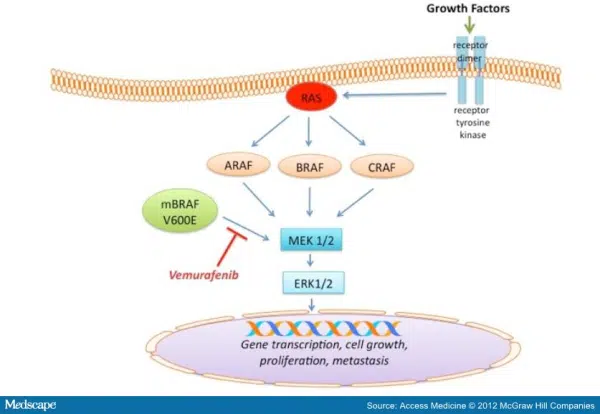
Researchers now understand more about how the V600E B-RAF mutation drives melanoma progression, and they’ve worked to target and inhibit this kinase and its downstream signaling. The ATP-competitive type I B-RAF inhibitors vemurafenib and dabrafenib (GSK2118436) show remarkable anti-cancer activity in patients with V600E B-RAF mutant melanomas. Targeted inhibition of BRAF with vemurafenib causes tumor regression and extends survival in many patients with BRAF-mutant metastatic melanoma. In 2011, the Food and Drug Administration (FDA) approved vemurafenib tablets (ZELBORAF) to treat patients with unresectable or metastatic melanoma carrying the V600E BRAF mutation. Doctors do not recommend vemurafenib for patients with wild-type BRAF melanoma.
A very high percentage of patients respond to vemurafenib, but resistance to the drug develops relatively quickly. With continued treatment, resistance can emerge as soon as 6-8 weeks after the initial response. However, a subset of patients maintains drug responsiveness beyond 18 months, and the median duration of responsiveness to vemurafenib overall is 8 months. Some studies have described molecular mechanisms associated with vemurafenib resistance in melanoma, including reactivation of the MAPK pathway, NRAS mutation, overexpression of platelet-derived growth factor beta receptor, activation of PI3K/AKT signaling, and genomic amplification of V600E BRAF (for more detail, see our post “RESISTANCE TO B-RAF INHIBITORS IN MELANOMA”). Because cancer cells are so heterogeneous, understanding these underlying drug-resistance mechanisms is crucial if we want to develop strategies that circumvent resistance and achieve longer-lasting responses.
A study published in the journal Nature by Das Thakur and colleagues reported that intermittent vemurafenib treatment prevented resistance in primary human melanoma xenografts. To study resistance mechanisms, Das Thakur et al. developed an animal model: they continuously treated mice bearing a vemurafenib-naive, patient-derived BRAF-mutant melanoma with vemurafenib until drug resistance developed. Exome sequence analysis did not detect any secondary mutations in the coding sequences of BRAF, NRAS, KRAS, HRAS, or MEK1 in the resistant tumors, nor did it detect an alternatively spliced isoform of V600E BRAF — another known mechanism of vemurafenib resistance in melanoma.
However, the researchers did note increased expression of V600E BRAF protein in the resistant tumors, and inhibiting the V600E BRAF gene with RNA interference suppressed proliferation. This suggests the tumor cells were BRAF oncogene-dependent, and that the drug resistance resulted from increased expression of the V600E BRAF protein. The researchers also made another interesting observation while trying to establish cell lines from the drug-resistant tumors: they could not develop these cell lines without vemurafenib, and withdrawing vemurafenib from the newly established cell lines changed cell morphology and decreased proliferation. This suggests that vemurafenib-resistant tumor cells in melanoma suffer a fitness deficit when vemurafenib is absent.
The researchers observed a similar vemurafenib dependency in SK-MEL239-C3 melanoma cells, where resistance stems from expression of a splice variant of V600E BRAF, and also in tumor cells isolated from a BRAF-mutated, vemurafenib-resistant melanoma patient. Consistent with these findings, Das Thakur et al. observed tumor regression within 10 days in mice bearing vemurafenib-resistant melanoma after stopping vemurafenib treatment, although the tumors eventually started regrowing. Together, these results suggest that withdrawing vemurafenib might create a hostile environment for drug-resistant cells and delay the onset of drug resistance.
A comparison study between continuous and intermittent vemurafenib treatment in human melanoma xenograft-bearing mice further validated these observations. Mice on continuous treatment developed drug resistance within 100 days, while none of the mice on the intermittent treatment schedule developed drug resistance even after 200 days of treatment. These findings suggest that discontinuous vemurafenib treatment may select against drug-resistant cells and prolong treatment responses in melanoma. Future studies, especially clinical trials, are needed to validate this approach.
References:
1. Das Thakur M, Salangsang F, Landman AS, et al. Modelling vemurafenib resistance in melanoma reveals a strategy to forestall drug resistance. Nature. 2013;494(7436):251-255.
2. Sullivan RJ, Flaherty KT. Resistance to BRAF-targeted therapy in melanoma. Eur J Cancer. 2013;49(6):1297-1304.