NRAS MUTATION IN MELANOMA

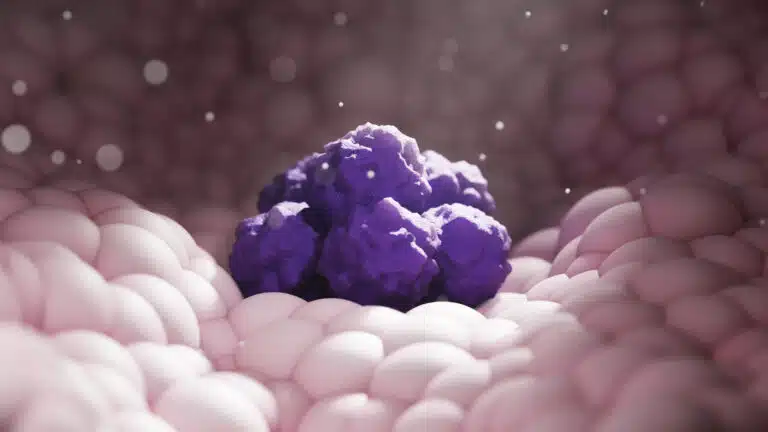
Melanoma is the most dangerous type of skin cancer and the leading cause of death from skin disease (see our previous post, “Targeting B-RAF in melanoma”). It develops when pigment-producing melanocytes undergo cancerous transformation. Most cases arise in the skin’s outer layer (stratified epithelium).
Melanoma has traditionally been hard to treat and resistant to standard therapies. But recent progress — including the FDA-approved B-RAF inhibitor vemurafenib — has shown real promise in shrinking tumors and improving survival.
Melanoma is a complex disease that arises through multiple pathways. A lasting response to treatment requires understanding the molecular mechanisms behind how melanoma develops and resists drugs.
Over the past decade, researchers have identified several key oncogenes in melanoma, including BRAF, KIT, NRAS, cyclin D, and cyclin-dependent kinase 4, along with changes in the ERBB4 gene.
The most common genetic change is an activating mutation in B-RAF serine/threonine kinase, occurring in about 50% of melanomas (see our post “Targeting B-RAF in melanoma” for details). Beyond B-RAF, researchers have also found NRAS (neuroblastoma RAS) mutations in 15-20% of melanomas.
How NRAS Drives Melanoma
About one-third of all human cancers have mutations in the RAS oncogene.
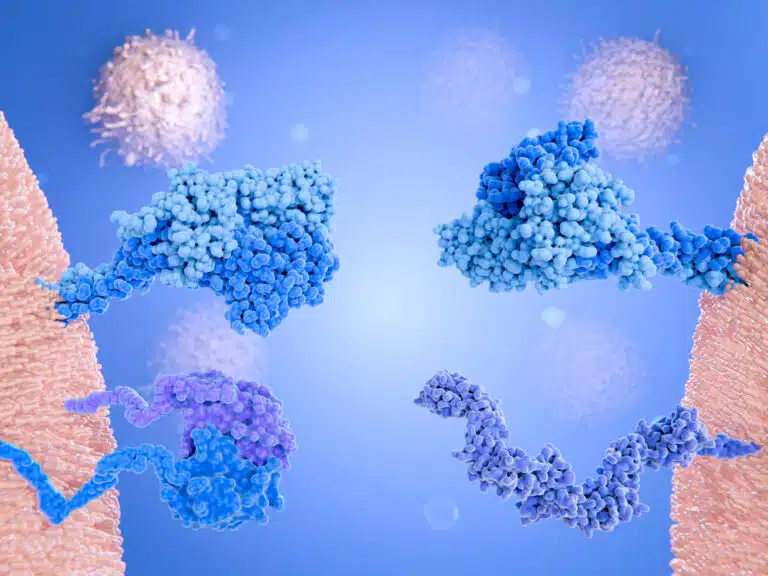
RAS is a small protein attached to the cell membrane that binds GTP. The RAS family has three members: KRAS, HRAS, and NRAS.
These proteins act as a molecular switch that controls cell growth.
They relay signals from cell-surface receptors to transcription factors and cell-cycle proteins inside the nucleus. RAS proteins switch between an active, GTP-bound state and an inactive, GDP-bound state.
In normal cells, a ligand binds to a receptor tyrosine kinase (RTK), which activates RAS. Active RAS then triggers several signaling pathways, including:
- The mitogen-activated protein kinase (MAPK) pathway
- The phosphoinositide 3-kinase/AKT (PI3K/AKT) pathway
KRAS mutations are the most common RAS mutations across cancer overall. But in melanoma specifically, NRAS point mutations are most frequent — and NRAS was the first oncogene identified in melanoma.
The most common NRAS mutation occurs at codon 61, where a glutamine residue is replaced by lysine or arginine.
This mutation keeps the MAPK pathway constantly switched on, driving cell growth and tumor formation. RAS also activates the Rho GTPase Rac1, which can drive growth, survival, and cell movement.
What the Research Shows
Several studies have examined how NRAS mutations affect melanoma. Key findings include:
- Ball et al. (1994) studied 100 primary and metastatic melanoma samples and found RAS mutations in 36% of them; 69% of those occurred at codon 61.
- Patients with NRAS-mutated tumors tend to be older at diagnosis than patients with BRAF mutations (median age 55.7 vs. 49.8 years), and more often develop melanoma from chronic sun damage.
- Two large studies (each with more than 240 samples) found that NRAS-mutated melanomas behave more aggressively — shorter overall survival, higher mitosis rates, and greater tumor thickness at diagnosis.
- A meta-analysis of studies from 1989 to 2010 linked NRAS mutations to nodular histology and tumors on the extremities.
Together, these findings point to NRAS as a key oncogene in melanoma, and suggest it’s worth targeting therapeutically for advanced, high-risk disease.
Treatment Challenges
Targeted therapy for melanoma has advanced substantially — but only for BRAF-mutated tumors. Patients with NRAS-mutated melanoma still have no approved targeted therapies.
Fully blocking NRAS signaling has proven difficult, partly because feedback loops can reactivate the NRAS-MEK-ERK (MAPK) pathway. Researchers have proposed several alternative strategies:
- Blocking RAS’s attachment to the cell membrane (required for its activity) using inhibitors of farnesyl transferase or galectin 1
- Targeting NRAS mRNA with interfering RNAs
- Targeting signaling downstream of the NRAS protein with PI3K/Akt inhibitors
In in vitro studies, some NRAS-mutated cell lines also responded to MEK inhibition. These approaches all show promise, but none have reached the clinic yet. More research is needed to develop effective treatment strategies for NRAS-mutated melanoma.
References:
1.Devitt B, Liu W, Salemi R, Wolfe R, Kelly J, Tzen CY, Dobrovic A, McArthur G: Clinical outcome and pathological features associated with NRAS mutation in cutaneous melanoma. Pigment Cell Melanoma Res 2011, 24:666-672.
2. Ball NJ, Yohn JJ, Morelli JG, Norris DA, Golitz LE, Hoeffler JP: Ras mutations in human melanoma: a marker of malignant progression. J Invest Dermatol 1994, 102:285-290.