Overcoming Resistance to Tyrosine Kinase Inhibitors in CML
Chronic myeloid leukemia (CML) is a slowly progressing blood and bone marrow disease that develops from the neoplastic transformation of hematopoietic stem cells. These transformed stem cells give rise to abnormal white blood cells, known as leukemia cells. As the body produces excess leukemia cells, it has fewer healthy white blood cells, red blood cells, and platelets — leaving the body more susceptible to infection, anemia, and easy bleeding. CML is a triphasic disease that starts with a relatively benign chronic phase, which can last for several years. If left untreated, CML progresses to an accelerated phase and/or blast phase, bringing worsening symptoms and hematologic parameters. CML mainly affects adults during or after middle age, with a median diagnosis age around 65. In the US, the annual incidence rate of CML is approximately 4,800 cases.
The Genetic Driver Behind CML
The chief molecular marker involved in CML’s origin is the BCR-ABL fused gene. This gene forms when the tyrosine kinase gene ABL1 fuses with the BCR gene through a reciprocal translocation between chromosomes 9 and 22, forming the Philadelphia (Ph) chromosome. Doctors identify the Ph-chromosome in over 95% of CML patients, making it the genetic hallmark of the disease. Several in vitro studies have shown that the tyrosine kinase chimeric protein Bcr-Abl, encoded by the BCR-ABL gene, is constitutively active in leukemia cells and has oncogenic properties. Researchers have also linked the Bcr-Abl chimeric protein to genomic instability, suggesting it drives progression to advanced phases of CML.
From Imatinib to Second-Generation Inhibitors
Discovering the BCR-ABL gene and its corresponding protein led to the development of small-molecule drugs designed to inhibit Bcr-Abl’s tyrosine kinase activity by competitively binding at the ATP-binding site. Imatinib mesylate (Gleevec) was the first tyrosine kinase inhibitor (TKI), and the FDA approved it in 2001 to treat chronic phase CML. Patients treated with imatinib showed hematological and cytogenetic responses with no progression to the advanced phase.
However, a significant proportion of CML patients didn’t achieve a satisfactory long-term response to imatinib, often due to acquired resistance caused by mutations in the BCR-ABL gene. Both in vitro and in vivo studies have discovered more than 90 mutations associated with imatinib resistance. Among these, the “gatekeeper” mutation T315I is the most common, appearing in up to 20% of CML patients. This mutation occurs when a threonine (T) residue is replaced by isoleucine (I) at amino acid position 315. Crystallographic analysis revealed that BCR-ABL gene mutations cause conformational changes in the ABL-kinase domain that interfere with imatinib binding, producing 30 to 40% resistance to the drug.
These findings led to the development of more potent second-generation TKIs — dasatinib (Sprycel) and nilotinib (Tasigna™). Clinical studies found major cytogenetic responses in 35 to 63% of patients treated with dasatinib or nilotinib, and in 2010, both drugs received FDA approval to treat CML patients who are resistant or intolerant to imatinib. However, even though dasatinib and nilotinib proved effective against many imatinib-resistant mutants in CML, they remain ineffective against certain mutant subsets — including the T315I mutant. Until recently, this left T315I a significant clinical challenge for patients with primary or secondary resistance to dasatinib or nilotinib, regardless of whether their disease was newly diagnosed or imatinib-resistant.
A New Option for T315I-Resistant Patients
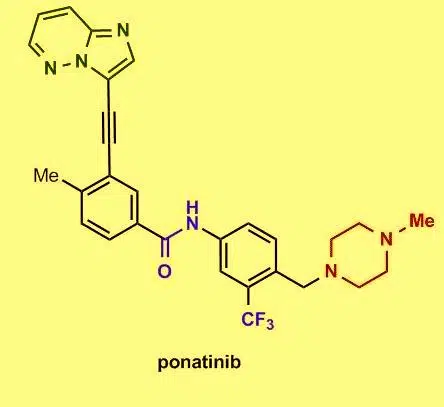
A study published in The New England Journal of Medicine (November 29, 2012) by Cortes et al. reported success in overcoming BCR-ABL T315I mutation-mediated resistance to TKIs in CML, using a new small-molecule TKI called ponatinib (AP24534). In in vitro studies, ponatinib showed potent activity against all mutant forms of BCR-ABL (including T315I) at concentrations as low as 40 nM.
In the phase I dose-escalation study of ponatinib, Cortes et al. observed complete cytogenetic response and major molecular response in CML patients with non-T315I mutations. Among chronic-phase CML patients with the T315I mutation, 100% showed a hematologic response, 92% had a major cytogenetic response, 75% showed a complete cytogenetic response, and 67% had a major molecular response. The most common side effects reported in the study included hypertension, rash, abdominal pain, fatigue, headache, dry skin, constipation, fever, joint pain, and nausea. The PACE trial — a multicenter, international, single-arm clinical trial of 449 patients with disease resistant or intolerant to prior tyrosine kinase inhibitor therapy — showed similarly promising results. On December 14, 2012, the FDA approved ponatinib (Iclusig tablets) to treat adult patients with all phases of CML who are resistant or intolerant to prior tyrosine kinase inhibitor therapy.
References:
1. O’Hare T, Deininger MW, Eide CA, et al. Targeting the BCR-ABL signaling pathway in therapy-resistant Philadelphia chromosome-positive leukemia. Clin Cancer Res. 2011;17:212-221.
2. Cortes JE, Kantarjian H, Shah NP, et al. Ponatinib in refractory Philadelphia chromosome-positive leukemias. N Engl J Med. 2012;367:2075-2088.
3. Huang X, Cortes J, Kantarjian H. Estimations of the increasing prevalence and plateau prevalence of chronic myeloid leukemia in the era of tyrosine kinase inhibitor therapy. Cancer. 2012;118:3123-3127.
4. O’Hare T, Shakespeare WC, Zhu X, et al. AP24534, a pan-BCR-ABL inhibitor for chronic myeloid leukemia, potently inhibits the T315I mutant and overcomes mutation-based resistance. Cancer Cell. 2009;16:401-412.
5. https://www.fda.gov/Drugs/InformationOnDrugs/ApprovedDrugs/ucm332368.htm