Remodeling of the Tumor Extracellular Matrix Activates YAP in Fibroblasts to Produce Cancer Associated Fibroblasts
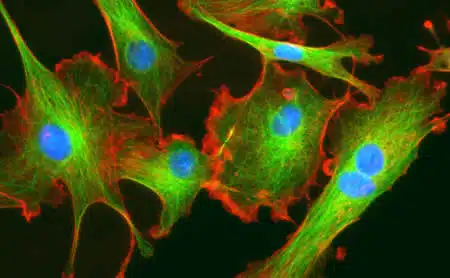
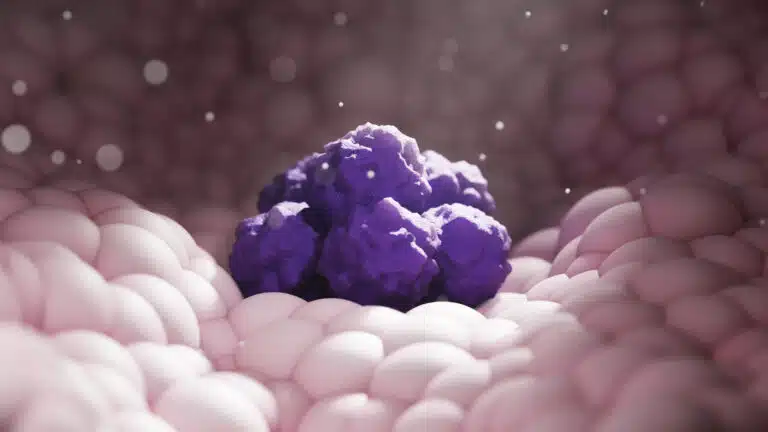
When cells transform and begin forming a solid tumor, they trigger major changes in the surrounding cells1. The extracellular matrix (ECM) changes too, as the tumor forms1.
Most solid tumors show increased ECM stiffness. This stiffness may boost pro-tumor signaling through pathways such as Src, FAK, and RhoA2-4.
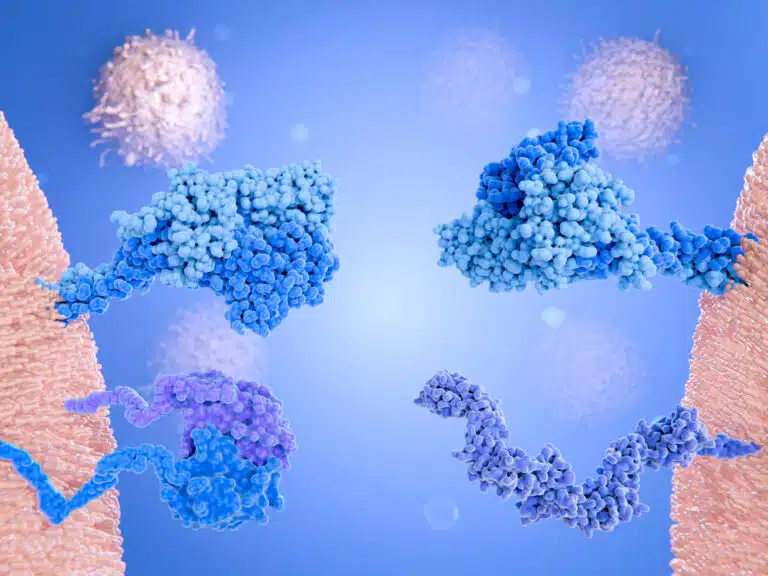
Researchers have also found that increased matrix stiffness can activate the oncogenic YAP/TAZ complex, part of the Hippo signaling pathway. YAP/TAZ are transcriptional regulators that increase cell proliferation, reduce contact inhibition, boost cancer stem cell traits, and increase metastasis5.
 In a recent edition of Nature Cell Biology, Calvo et al. showed that YAP/TAZ is active in cancer-associated fibroblasts (CAFs) — and that YAP/TAZ is required for CAFs to develop6.
They also found that active CAFs remodel the matrix toward increased stiffness by boosting myosin light chain 2 (MYL9/MLC) expression. This creates a feed-forward loop in which the ECM plays a central role6.
Mechanical Signaling Drives CAF Development
The authors isolated fibroblasts at different stages of becoming a CAF. As fibroblasts became more CAF-like, they found increases in:
- Mechanical-responsive signaling machinery (SMA, FN1, Paxillin, MYL9, MYH10, DIAH1 & F-actin)
- Mechanical tension
- Tumor cell invasion and angiogenesis in the tumor microenvironment (measured via endomucin and second-harmonic microscopy)6
These changes tracked with higher levels of vimentin, a marker of tumor-associated fibroblasts.
Cell-cell and cell-ECM contact both feed into the Hippo pathway, so the authors checked whether this pathway is active in CAFs. They found that YAP and its partner TAZ were both upregulated, and localized only in the nucleus of transformed fibroblasts — where the active YAP-TAZ complex does its work6.
When the researchers removed YAP, CAFs lost some ability to stiffen the matrix through contraction, build collagen networks, and support blood vessel growth. Removing TAZ, however, caused no change — suggesting YAP has some functions independent of TAZ.
YAP’s Role in Matrix Remodeling and Invasion
Using microarray analysis of YAP-silenced CAFs (via siRNA that targets YAP), Calvo et al. found lower expression of many genes involved in mechanosensing and cell movement6. Silencing these genes individually led to an overall decrease in tumor cell invasion. Many of the YAP-driven genes — including ANLN and DIAPH3 — are involved in matrix remodeling and invasion.
Notably, overexpressing just one protein — myosin regulatory light polypeptide 9 (MYL9) — was enough to drive substantial matrix remodeling and invasion on its own. YAP/TAZ doesn’t control MYL9 at the transcription level, but it does control MYL9 through post-translational modifications. This makes YAP a key regulator of matrix remodeling and invasion via MYL96.
YAP Activation Beyond CAFs
Calvo et al. then asked whether YAP/TAZ activation happens only in CAFs, or also in normal fibroblasts placed in a cancer-like environment6.
They found that normal fibroblasts grown in tumor-conditioned media showed more nuclear YAP and more gel contraction (a sign of matrix stiffening) — similar to the effect of two known pro-contractile signals: L-alpha-lysophosphatidic acid (LPA) and transforming growth factor-beta (TGFβ).
However, blocking actomyosin activity (with blebbistatin) couldn’t be reversed by adding LPA and TGFβ. This suggests that soluble factors can trigger matrix contraction, but only if the cytoskeleton is intact and functional.
Since the cytoskeleton is essential here, the authors tested whether blocking RhoA kinase (ROCK) — which controls the cytoskeleton’s structure — would affect where YAP localizes6. Blocking ROCK reduced both YAP’s nuclear localization and matrix stiffness.
Blocking Src had a similar effect on YAP localization and its binding to TEAD1 and TEAD4. But Src appears to act downstream of cytoskeletal tension changes, since blocking Src didn’t affect stress fibers6.
A Feed-Forward Loop in CAF Biology
Put together, these findings describe a loop: matrix stiffness activates YAP, YAP activation drives MYL9 expression, and MYL9 expression drives further matrix stiffening. The authors propose this forms a feed-forward loop6 that keeps YAP signaling switched on in CAFs, locking in the CAF phenotype.
Open questions remain: what other mechanisms regulate YAP in this process, and does the YAP-ECM tension pathway also play a role in normal fibroblasts?
References:
1. Boudreau, A., van’t Veer, L. J. & Bissell, M. J. An “elite hacker”: breast tumors exploit the normal microenvironment program to instruct their progression and biological diversity. Cell adhesion & migration 6, 236-248, doi:10.4161/cam.20880 (2012).
2. Levental, K. R. et al. Matrix crosslinking forces tumor progression by enhancing integrin signaling. Cell 139, 891-906, doi:10.1016/j.cell.2009.10.027 (2009).
3. Guilluy, C. et al. The Rho GEFs LARG and GEF-H1 regulate the mechanical response to force on integrins. Nature cell biology 13, 722-727, doi:10.1038/ncb2254 (2011).
4. Sawada, Y. et al. Force sensing by mechanical extension of the Src family kinase substrate p130Cas. Cell 127, 1015-1026, doi:10.1016/j.cell.2006.09.044 (2006).
5. Harvey, K. F., Zhang, X. & Thomas, D. M. The Hippo pathway and human cancer. Nature reviews. Cancer 13, 246-257, doi:10.1038/nrc3458 (2013).
6. Calvo, F. et al. Mechanotransduction and YAP-dependent matrix remodelling is required for the generation and maintenance of cancer-associated fibroblasts. Nature cell biology 15, 637-646, doi:10.1038/ncb2756 (2013).