TRASTUZUMAB-DM1 FOR HER-2 POSITIVE METASTATIC BREAST CANCER
Breast cancer is the most common cancer in women, and the second-leading cause of cancer death among women worldwide. Despite progress treating early-stage disease, about one-third of patients will develop metastatic breast cancer (MBC). The National Cancer Institute estimated 232,340 new breast cancer cases and 39,620 deaths in the US in 2013.
HER-2 and Its Role in Breast Cancer
About 20-30% of breast cancers overexpress human epidermal growth factor receptor 2 (HER-2/neu), caused by amplification of the erb-B2 oncogene. Doctors call these tumors “HER2-positive.” HER2-positive cancers behave more aggressively. Patients with these tumors face a worse prognosis and lower chance of survival than patients whose tumors don’t overexpress HER-2.
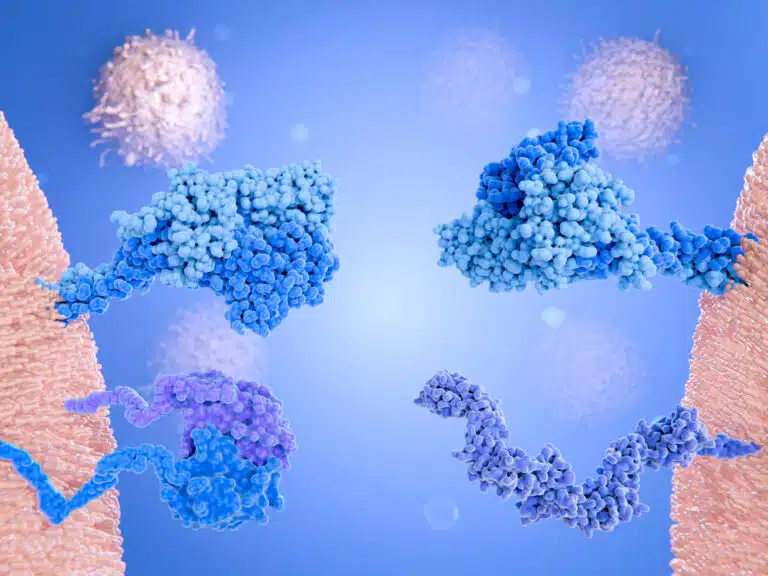
HER-2 is a 185-kDa orphan transmembrane receptor tyrosine kinase. When it dimerizes with a ligand-bound HER-3 or HER-4 receptor, it turns on signaling inside the cell. This HER-2 signaling drives cell proliferation and survival through the MAPK and PI3K/Akt/mTOR pathways. Together, these pathways fuel uncontrolled tumor growth.
Several studies suggest that HER-2 overexpression/amplification may drive both pre-malignant breast disease and tumor metastasis. Because of HER-2’s role in breast cancer and tumor aggressiveness, this receptor makes a strong target for tumor-specific therapies.
Targeting HER-2 With Trastuzumab
Researchers have developed several strategies to block HER-2 signaling, including the tyrosine kinase inhibitor lapatinib and the recombinant humanized monoclonal antibody trastuzumab (Herceptin®). This post focuses only on trastuzumab-mediated therapy in breast cancer.
Trastuzumab binds to the HER-2 receptor’s extracellular domain, blocking HER-2 signaling through the MAPK and PI3K/Akt cascades. Trastuzumab binding also increases membrane localization of the tumor suppressor gene phosphatase and tensin homolog (PTEN). This inhibits the PI3K/Akt pathway.
The FDA approved trastuzumab in 1998 to treat metastatic breast cancer. It approved the drug again in 2006 for adjuvant treatment of HER2-overexpressing breast cancer. In early-stage breast cancer, adding trastuzumab to neoadjuvant chemotherapy substantially improves overall survival (OS) and reduces recurrence risk, both by 33%. In MBC, combining trastuzumab with chemotherapy increases time to disease progression by 49% and improves OS by 20%.
The Challenge of Resistance
However, trastuzumab treatment substantially improves outcomes in both early-stage and metastatic breast cancer. Even so, researchers have observed both de novo and acquired resistance after initial response. Most patients with HER2-positive MBC will eventually develop resistance and experience disease progression following trastuzumab treatment.
Several factors can contribute to resistance against HER2-targeted therapy:
- Hindrance to HER-2-trastuzumab binding
- Signaling through alternative pathways, such as insulin-like growth factor receptor 1 or vascular endothelial growth factor receptor
- Upregulation of signaling pathways downstream of HER-2
- Increased expression of heat shock protein 90 (HSP90)
- Loss of PTEN, which leads to constitutive activation of the PI3K/Akt pathway
- Failure to trigger an appropriate immune response
Researchers have developed various treatment strategies to overcome trastuzumab resistance. One approach continues trastuzumab treatment in combination with a chemotherapeutic agent. In multiple preclinical and clinical studies, combining trastuzumab with the taxanes docetaxel (Taxotere®) and paclitaxel (Taxol®) produced promising responses in HER-2-overexpressing metastatic breast cancer.
A New Approach: Antibody-Drug Conjugates
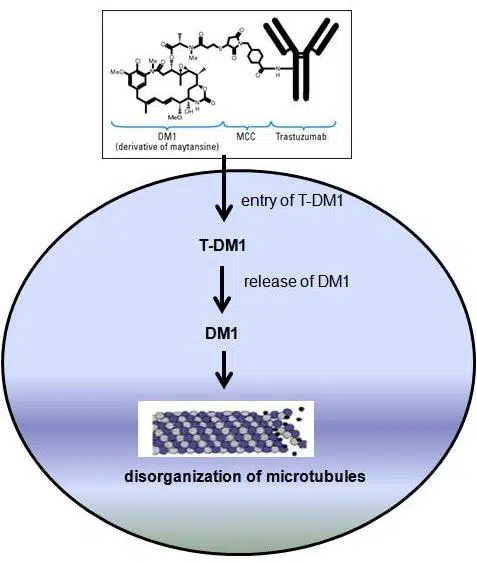
Researchers have also developed a new strategy to increase trastuzumab’s efficacy using antibody-drug conjugate (ADC) technology. The antibody-drug conjugate trastuzumab emtansine (T-DM1, Kadcyla) consists of trastuzumab bound to maytansinoid (DM1, a potent microtubule inhibitor) through a nonreducible thioether linkage.
T-DM1 binds to HER-2-positive tumor cells and is thought to inhibit HER-2 signaling. It’s also thought to trigger the body’s immune response to attack cancer cells. Once inside tumor cells, T-DM1 is designed to kill them by releasing DM1, a potent inhibitor of microtubule assembly that causes cell death.
In in vitro and preclinical studies, T-DM1 inhibited growth in breast cancer cells that were cross-resistant to trastuzumab. Researchers found T-DM1 well tolerated in a phase I clinical study of breast cancer patients whose disease had progressed on earlier trastuzumab-based treatment. In a phase II study, patients treated with T-DM1 showed increased progression-free survival (PFS) compared to those treated with trastuzumab plus docetaxel.
A clinical study published by Verma et al. (2012) reported that T-DM1 significantly prolonged PFS and OS in patients with HER-2-positive MBC. These patients had previously been treated with trastuzumab and a taxane. The most common side effects of T-DM1 treatment include low platelet count, low red blood cell count, nerve problems, and fatigue.
Based on T-DM1’s clinical efficacy in phase I and II trials, researchers conducted a multicenter phase III trial known as the EMILIA trial. This trial also found increased PFS, reduced risk of death, and fewer adverse events in T-DM1-treated patients. The comparison group was treated with capecitabine plus lapatinib (another first-line treatment option for HER-2-positive MBC).
On February 22nd, 2013, the FDA approved T-DM1 (Kadcyla) to treat HER-2-positive MBC that had progressed following treatment with trastuzumab and a taxane.
Suggested reading:
[1] M.F. Barginear, V. John, D.R. Budman, Trastuzumab-DM1: A Clinical Update of the Novel Antibody-Drug Conjugate for HER2-Overexpressing Breast Cancer, Mol Med, 18 (2013) 1473-1479.
[2] M. Barok, M. Tanner, K. Könki, J. Isola, Trastuzumab-DM1 causes tumour growth inhibition by mitotic catastrophe in trastuzumab-resistant breast cancer cells in vivo, Breast Cancer Res, 13 (2011) R46.
[3] M.S. Mohd Sharial, J. Crown, B.T. Hennessy, Overcoming resistance and restoring sensitivity to HER2-targeted therapies in breast cancer, Ann Oncol, 23 (2012) 3007-3016.
[4] S. Verma, D. Miles, L. Gianni, I.E. Krop, M. Welslau, J. Baselga, M. Pegram, D.Y. Oh, V. Diéras, E. Guardino, L. Fang, M.W. Lu, S. Olsen, K. Blackwell, E.S. Group, Trastuzumab emtansine for HER2-positive advanced breast cancer, N Engl J Med, 367 (2012) 1783-1791.
[5]https://www.cancer.gov/cancertopics/understandingcancer/targetedtherapies/breastcancer_htmlcourse/page3