
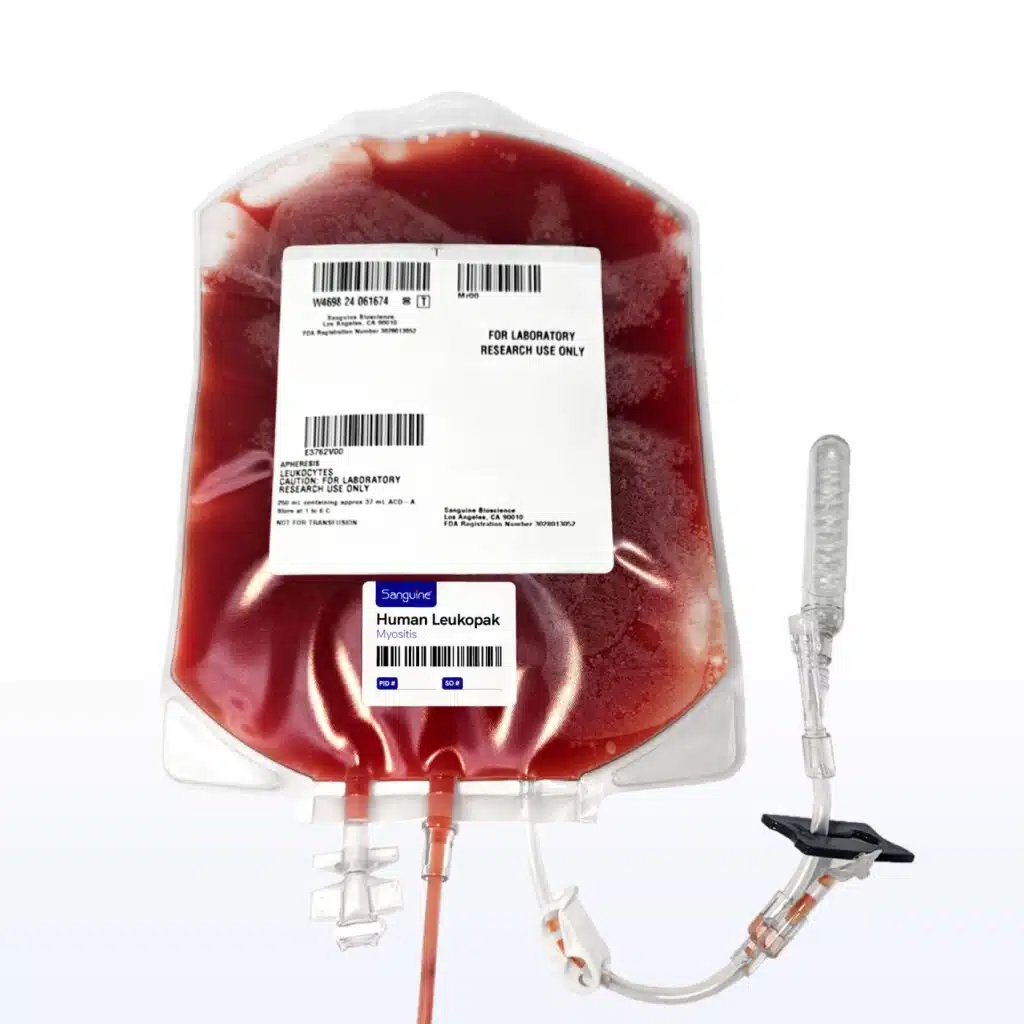
Myositis Leukopak
 Powered by Bioz
About:LeukoCore Myositis Leukopak — apheresis-collected concentrated immune cells from consented idiopathic inflammatory myopathy donors, stratifiable by autoantibody serotype and clinical subtype. Built for yield-limited work: cytotoxic T cell sorting, interferon signature studies, and BCR/TCR repertoire sequencing.
About Myositis Leukopak
High-Yield LeukoCore Myositis Leukopak for Autoimmune Myopathy Research
LeukoCore Myositis Leukopak is collected from IRB-consented donors clinically diagnosed with an idiopathic inflammatory myopathy through IRB-approved apheresis procedures. Each leukopak contains large quantities of peripheral blood mononuclear cells (PBMCs), supporting studies of the immune response driving muscle inflammation at scale.
Why a Leukopak for Myositis Research
The idiopathic inflammatory myopathies are systemic autoimmune diseases in which lymphocytes attack skeletal muscle. Muscle biopsy shows the destination of that attack, but the effector and helper populations driving it are studied in blood — and the informative populations are rare enough that a standard draw is limiting.
- Highly differentiated cytotoxic T cells — expanded, terminally differentiated CD8 T cell populations are a recognised feature of the inflammatory myopathies, particularly inclusion body myositis, and their characterisation and sorting are yield-dependent
- Type I interferon axis in dermatomyositis — a prominent interferon signature is well established in dermatomyositis and underlies interest in JAK-STAT inhibition; interrogating interferon-responsive cells requires sufficient cells for stimulation and sorting experiments
- B cells and plasmablasts produce the defining autoantibodies — the myositis-specific autoantibodies that define clinical subsets originate in B lineage cells, whose clonality and repertoire need high input for meaningful sequencing depth
- Serotype-stratified cohorts need volume — because autoantibody serotype defines clinical phenotype in myositis, subgroup analyses divide the cohort quickly, and adequate material per donor keeps subgroup studies viable
- Multi-assay designs from one donor — immunophenotyping, functional assays, sorting, and multi-omics can all be run on a single apheresis collection, removing inter-donor variability
- Cell therapy feasibility — engineered cell approaches for refractory autoimmune disease are assessed at manufacturing-relevant scale, which apheresis material makes possible
Donor Stratification Available
- Autoantibody serotype — myositis-specific and myositis-associated antibody status where measured
- Clinical subtype — dermatomyositis, polymyositis, antisynthetase syndrome, immune-mediated necrotising myopathy, or inclusion body myositis
- Disease activity and muscle enzymes — active versus quiescent disease; creatine kinase where recorded
- Extramuscular involvement — interstitial lung disease, cutaneous involvement, or arthritis where documented
- Treatment status — treatment-naive, corticosteroids, immunosuppressants, IVIG, or biologic therapy
- HLA type — HLA-A typing included; extended typing available on request
- Matched healthy controls available — demographically matched healthy donor leukopaks
Product Features
- Research Use Only (RUO) human leukopaks
- Clinically confirmed myositis donors
- High cell yield for large-scale studies
- Processed and shipped within 24 hours of collection
- Fresh or cryopreserved options available
- Cell yield and viability reported per lot
- IRB-approved and ethically sourced
- Infectious disease testing
- HLA-A typing
- Screen donors with LeukoLot™
De-identified Donor Data
- Verified myositis diagnosis from healthcare providers
- Donor demographics: age, sex assigned at birth, race/ethnicity
- Self-reported medication history and allergies
- Relevant clinical data including myositis subtype and severity (if available)
Applications
- Cytotoxic CD8 T cell characterisation and sorting
- Type I interferon signature and JAK-STAT pathway research
- B cell, plasmablast, and B cell receptor repertoire analysis
- Deep immunophenotyping stratified by autoantibody serotype
- Cell-based assays and cytokine profiling at scale
- Multi-omics studies including single-cell and TCR repertoire sequencing
- Cell therapy feasibility studies for refractory autoimmune disease
- Therapeutic development, screening, and mechanism-of-action work
Other Myositis Specimen Types
Matched material from the same myositis donor pool is available as myositis serum, plasma, whole blood, and PBMC. Subtype-specific cohorts are available as dermatomyositis leukopak, polymyositis PBMC, and inclusion body myositis PBMC.
Compliance and Quality Assurance
- Collected under IRB oversight with donor e-consent (21 CFR Part 11 compliant)
- HIPAA-compliant handling of donor information
- Rigorous donor screening and documentation
Ordering & Customization
Myositis Leukopak is available fresh or cryopreserved. For pricing, or to check current availability across our full leukopak inventory, visit our human leukopak page to browse other disease-state options and live stock status. For international shipping or regulatory documentation, please contact learnmore@sanguinebio.com to confirm regional compliance and shipping availability.
Applications
- Immunology and translational research
- Biomarker discovery and validation
- Drug screening and assay development
- Vaccine and infectious disease research
Product Features
- Research Use Only (RUO), Leukopak
- Sourced from screened, consented donors
- Processed under validated SOPs
- QC tested for purity, viability, and sterility
- Processed within 24 hours of collection
- IRB-approved protocols with electronic informed consent
Donor Metadata
- Verified diagnosis and clinical history
- Demographic data: age, sex assigned at birth, race/ethnicity
- Medication and treatment background when available
Compliance and Quality Assurance
- IRB-approved collections and standardized procedures
- 21 CFR Part 11-compliant e-consent system
- HIPAA-compliant data management
Ordering & Customization
Human Leukopak are available in customizable aliquot sizes. For international orders or documentation needs, please contact learnmore@sanguinebio.com to confirm requirements and availability. We also work with multiple ordering platforms and distributors, learn more here.
Protocols & Documentation
-
Download
Leukopak Cryopreservation
Standard operating procedure for cryopreserving leukopak units with controlled freezing and post-thaw viability targets.
-
Download
Leukopak Thawing
Validated thawing workflow for cryopreserved leukopaks to maximize recovery while maintaining sterility and chain of custody.
-
Download
Choosing the Right PBMC Configuration
Reference guide comparing PBMC formats, cryopreservation states, and study-fit recommendations for your application.
-
Informed Consent Form (ICF)
Available upon request — confirms donor consent for research use and downstream commercialization.
Leukopak
Where can I find your complete catalog?
You can find our full product catalog here.
How long can samples be stored?
Storage depends on sample type but often cryopreserved samples stored in liquid nitrogen can be stored for years.
What customization options are available?
Extensive customization is available. To discuss your project request a quote or email us at learnmore@sanguinebio.com.
Do you offer prospective collections?
Sanguine offers flexible prospective collection services tailored to fit your research. For more information and to request a quote, please see: our prospective biospecimen collection services page.
What is the turnaround time for custom collections?
Timelines depend on condition, sample type, and I/E criteria but we often start collection within 2 weeks of signed agreement.
Do you have samples in stock?
YES - we have in-stock inventory. You can also email us at learnmore@sanguinebio.com as we continually get new samples in our inventory.
What does unique donor mean?
Each sample from a different individual - Unique donor means each sample comes from a different person, ensuring biological diversity in your study.
Are samples collected under IRB-approved protocols?
YES - "IRB-approved collection protocols" and IRB approval documentation available upon request. Sanguine utilizes two internationally-recognized IRBs (Advarra and WCG IRB) for review and approval.
Frequently Asked Questions
Ask a Question
Pair with a Healthy Control
Match your Myositis Leukopak with normal donor samples for comparison
Healthy Donor Leukopaks
5 In Stock View InventoryNeed a custom Leukopak cohort?
Our scientific team can scope prospective collections with donor-specific I/E criteria, typically starting within 2 weeks of agreement.