What Are CD4+ T Cells? A Guide to CD4 Helper T Cells
What Are CD4+ T Cells? A Guide to CD4 Helper T Cells
CD4+ T cells — commonly called CD4 helper T cells — are among the most important and versatile cells in the human immune system. They coordinate nearly every arm of the adaptive immune response. They activate cytotoxic T cells, license antigen-presenting cells, help B cells make high-quality antibodies, and regulate the intensity and duration of immune responses to prevent collateral tissue damage.
When CD4 cells are lost or dysfunctional — as in HIV infection, which selectively depletes them — the whole adaptive immune system collapses. When they are dysregulated — as in autoimmune disease — they drive chronic, self-directed tissue destruction with the same precision they would otherwise aim at pathogens.
Understanding CD4 positive T cells is foundational to immunology, oncology, virology, vaccine development, and cell therapy research. This guide answers the key questions about CD4 lymphocytes: what they are, how they are defined, what they do, and why researchers depend on primary human CD4+ T cells.
What Does CD4 Stand For?
CD4 stands for Cluster of Differentiation 4. It is a glycoprotein on the surface of a major subset of T lymphocytes that acts as a co-receptor for the T cell receptor (TCR). The CD4 molecule binds the non-polymorphic α3 domain of MHC Class II molecules on antigen-presenting cells. This stabilizes the interaction between the TCR and the peptide-MHC II complex and amplifies the signaling cascade that drives T cell activation.
Key fact: CD4+ T cells are defined by three things: expression of the CD4 surface marker, recognition of antigen on MHC Class II molecules, and a primary role as coordinators — rather than direct executors — of adaptive immune responses. This sets them apart from CD8+ cytotoxic T cells, which recognize antigen on MHC Class I and directly kill infected and malignant cells.
What Are CD4+ T Cells?
CD4+ T cells are a major subset of T lymphocytes — white blood cells that develop in the thymus and circulate in peripheral blood as part of the adaptive immune system. They are also called CD4 helper T cells, CD4 positive T cells, CD4 lymphocytes, or simply helper T cells. These names reflect their role as coordinators of immune responses rather than direct effector cells.
In peripheral blood from a healthy adult, CD4 cells are usually 30–60% of total T lymphocytes, at about 500–1,500 cells per microliter. The CD4:CD8 ratio — CD4+ T cells to CD8+ cytotoxic T cells — is normally about 2:1 and is a clinically meaningful marker of immune health. A falling CD4:CD8 ratio is a hallmark of HIV disease progression, and an inverted ratio (below 1:1) is linked to immune dysregulation in many conditions.
What Do CD4 Helper T Cells Do?
CD4 helper T cells do not kill directly, at least not as their primary function. Instead, they act as master coordinators of adaptive immunity. They provide the signals that determine whether other immune effectors mount a response that is fast, strong, specific, and durable. Their core functions are below.
Licensing Antigen-Presenting Cells
When a CD4+ T cell recognizes its cognate antigen on a dendritic cell, it upregulates CD40 ligand (CD40L). CD40L binds CD40 on the dendritic cell and delivers an activating signal. This sharply increases the dendritic cell’s expression of MHC Class I, co-stimulatory molecules (B7 family), and IL-12.
This “licensing” step is required for dendritic cells to prime naïve CD8+ cytotoxic T cells well. Without CD4+ helper licensing, CD8+ responses are weaker, shorter-lived, and more prone to exhaustion. That is why CD4 cells are indispensable even in responses that ultimately depend on CD8+ killing.
Supporting B Cell Responses
T follicular helper (Tfh) cells — a specialized subset of CD4 helper T cells — migrate to germinal centers in lymph nodes. There they provide the signals (CD40L engagement and IL-21 secretion) that B cells need for somatic hypermutation and affinity maturation. Without Tfh help, B cells make low-affinity, poorly isotype-switched antibodies with limited durability. The quality of antibody responses to vaccines and infections — including broadly neutralizing antibodies — depends directly on Tfh-mediated CD4+ help.
Cytokine Production and Immune Polarization
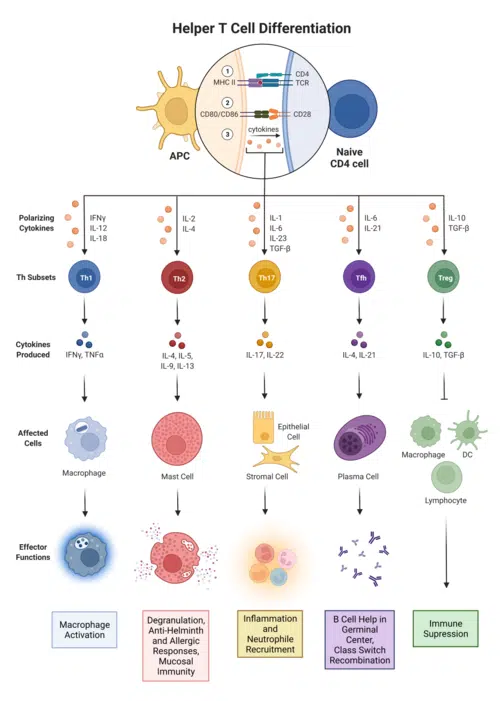
CD4 positive T cells produce a wide range of cytokines that shape the immune response to the threat at hand. IFN-γ and TNF-α from Th1 cells activate macrophages for intracellular pathogen killing. IL-4, IL-5, and IL-13 from Th2 cells drive B cell responses and anti-parasitic immunity. IL-17A and IL-22 from Th17 cells recruit neutrophils and reinforce mucosal barriers against extracellular bacteria and fungi. This cytokine output is a primary determinant of immune response character and a key readout in many immunology assays.
Immune Memory
CD4+ T cells form durable memory populations after antigen clearance. This gives long-lived recall capacity for faster, stronger responses on re-exposure. CD4+ memory T cells also maintain CD8+ memory and prevent exhaustion during immune quiescence — a function with direct implications for vaccine design and therapeutic immunization.
Immune Suppression
Not all CD4 helper T cells amplify responses. Regulatory T cells (Tregs), a distinct CD4+ subset defined by Foxp3 expression, suppress immune activation to maintain self-tolerance and prevent autoimmunity. In cancer, tumors co-opt Tregs to suppress anti-tumor CD8+ responses. So the Treg/effector CD4+ balance is a critical variable in cancer immunotherapy research.
CD4+ T Cell Subsets: What Are the Different Types of Helper T Cells?
A defining feature of CD4 lymphocytes is their ability to differentiate into multiple specialized subsets after activation. Naïve CD4+ T cells integrate signals from the TCR, co-stimulatory molecules, and the cytokine environment to commit to one of several effector fates.
| Subset | Inducing Cytokines | Master TF | Key Cytokines Produced | Primary Function |
|---|---|---|---|---|
| Th1 | IL-12, IFN-γ | T-bet | IFN-γ, TNF-α, IL-2 | Intracellular pathogen clearance; anti-tumor immunity |
| Th2 | IL-4 | GATA3 | IL-4, IL-5, IL-13 | Humoral immunity; anti-parasitic; allergy |
| Th17 | TGF-β, IL-6, IL-23 | RORγt | IL-17A, IL-17F, IL-22 | Mucosal defense; autoimmunity |
| Tfh | IL-6, IL-21 | Bcl6 | IL-21, IL-4, IFN-γ | Germinal center B cell help; antibody quality |
| Treg | TGF-β, IL-2 | Foxp3 | TGF-β, IL-10, IL-35 | Peripheral tolerance; immune suppression |
| Th9 | TGF-β, IL-4 | IRF4, PU.1 | IL-9 | Mast cell activation; anti-tumor (context-dependent) |
Key fact: The subset a naïve CD4+ T cell becomes is set mainly by the cytokine environment at activation, not by the antigen itself. So in vitro polarization experiments with primary CD4 cells can recreate each subset under defined conditions. This makes CD4 positive T cells uniquely suited to subset-specific functional research.
Explore Sanguine’s CD4+ T Cell Product product page for current specifications and availability.
CD4+ T Cells vs. CD8+ T Cells: What Is the Difference?
| Parameter | CD4+ T Cells (Helper) | CD8+ T Cells (Cytotoxic) |
|---|---|---|
| Surface marker | CD4+ | CD8+ |
| MHC restriction | MHC Class II (on APCs) | MHC Class I (on all nucleated cells) |
| Primary role | Coordinating / helping | Direct cytotoxic killing |
| Killing mechanism | Indirect (cytokines, licensing); limited direct killing | Direct (perforin/granzyme, Fas/FasL) |
| Subset diversity | High: Th1, Th2, Th17, Tfh, Treg, Th9 | Lower: naïve, effector, memory, exhausted |
| % of PBMCs in healthy adult | ~30–45% | ~15–25% |
| HIV target | ✅ Yes — HIV uses CD4 as primary receptor | No |
Why CD4+ T Cells Are Critical for Research
CD4 cells are a primary research subject across many disease areas, precisely because of their functional centrality. Key contexts where primary human CD4+ T cells are essential include the following.
Cancer Immunotherapy
CD4 helper T cells are increasingly seen as co-determinants of immunotherapy response. In the tumor microenvironment, Th1-polarized CD4 positive T cells amplify anti-tumor CD8+ responses and enhance dendritic cell cross-presentation. Tregs do the opposite, actively suppressing anti-tumor immunity. The Th1/Treg balance within the tumor is a meaningful predictor of checkpoint inhibitor response, and modeling it requires well-characterized primary CD4 lymphocytes.
In CAR-T therapy, defined-ratio co-infusion of CD4+ and CD8+ CAR-T cells consistently outperforms either subset alone. In patients with long-term remission from chronic lymphocytic leukemia after CD19 CAR-T therapy, durable control has been maintained by oligoclonal cytotoxic CD4+ T cells rather than CD8+ cells — a striking sign of how versatile this population is. CD4+ T cells are also being engineered directly as cellular delivery platforms for therapeutic proteins, using their comparatively fast expansion and lower baseline cytolytic activity relative to CD8+ T cells.
Autoimmune Disease
Dysregulated CD4+ T cells drive the pathology of rheumatoid arthritis (Th17), multiple sclerosis (Th1/Th17), psoriasis (Th17), type 1 diabetes (Th1), and systemic lupus erythematosus (Tfh/Th17). In vitro polarization and functional assays using primary CD4 cells are the standard platform for disease modeling, target validation, and drug screening in autoimmunity.
HIV and Infectious Disease
HIV depletes CD4 lymphocytes by using the CD4 molecule itself as its primary entry receptor. It targets the very cells most able to coordinate the anti-HIV response. Monitoring CD4+ T cell counts remains a cornerstone of HIV clinical management. HIV cure research, including latency-reversing strategies, depends on primary CD4 positive T cells as the cellular model for the HIV latent reservoir.
Vaccine Development
The durability and breadth of vaccine-induced antibody responses depend on Tfh-mediated CD4 helper T cell support in germinal centers. Vaccines that fail to elicit strong CD4+ T cell responses generate lower-affinity antibodies with reduced longevity. Primary CD4+ T cells are the key substrate for measuring vaccine-induced T cell help and modeling germinal center dynamics in vitro.
Frequently Asked Questions About CD4+ T Cells
What are CD4+ T cells also called?
CD4+ T cells are also called CD4 helper T cells, helper T cells, T helper cells, CD4 positive T cells, CD4 lymphocytes, and CD4 cells. All refer to the same MHC Class II-restricted T lymphocytes that express the CD4 co-receptor and coordinate adaptive immune responses.
What is the normal CD4+ T cell count in a healthy adult?
In a healthy adult, the normal CD4+ T cell count in peripheral blood is about 500–1,500 cells per microliter. A count below 200 cells/μL is the threshold at which HIV-infected individuals are diagnosed with AIDS. The CD4:CD8 ratio in healthy adults is about 1.5–2.5:1.
What is the difference between CD4+ T cells and helper T cells?
Helper T cells and CD4+ T cells are the same population. “Helper T cells” describes their function; “CD4+ T cells” or “CD4 positive T cells” describes their surface phenotype. The terms are used interchangeably. Not all CD4 cells are strictly “helpers” — Tregs, for example, are CD4+ but function suppressively.
What diseases are associated with CD4+ T cell dysfunction?
Diseases linked to CD4 lymphocyte dysfunction or dysregulation include HIV/AIDS (depletion), rheumatoid arthritis, multiple sclerosis, inflammatory bowel disease, psoriasis, type 1 diabetes, systemic lupus erythematosus (dysregulated activation), and many solid tumors (Treg-mediated immunosuppression).
How are CD4+ T cells used in research?
Primary human CD4+ T cells are used for Th subset polarization assays, Treg suppression experiments, cytokine profiling, T cell activation and proliferation studies, HIV latency modeling, vaccine immunogenicity research, CAR-T manufacturing, and co-culture with CD8+ cytotoxic T cells and other immune populations.
Are CD4+ T cells the same as T helper cells (Th cells)?
Yes. T helper cells (Th cells) are CD4 positive T cells that have been activated and differentiated into an effector subset (Th1, Th2, Th17, Tfh, etc.). “CD4+ T cell” covers both naïve CD4 cells that have not yet met antigen and the full range of differentiated CD4 helper T cell subsets.
What should I look for when sourcing primary CD4+ T cells?
Four parameters matter most. Purity — contaminating subsets like Tregs or activated memory cells can confound differentiation and cytokine assays. Activation state — naïve and memory CD4+ T cells have different differentiation potentials, so the starting population should match the model. Donor characterization — defined health status, demographics, and ideally HLA typing support controls across lots. Functional validation — confirmed CD4 expression, viability, and responsiveness to stimulation, since cells stressed during isolation or shipping will not respond normally.
Summary: Key Facts About CD4+ Helper T Cells
- CD4+ T cells (also called CD4 helper T cells, helper T cells, CD4 lymphocytes, and CD4 positive T cells) are T lymphocytes that express the CD4 co-receptor and recognize antigen on MHC Class II molecules.
- Normal peripheral blood CD4 cell count in healthy adults is 500–1,500 cells/μL; the CD4:CD8 ratio is ~2:1.
- CD4 helper T cells coordinate immunity by licensing dendritic cells, supporting B cell antibody responses, producing polarizing cytokines, and regulating responses via Treg suppression.
- Major CD4+ T cell subsets include Th1, Th2, Th17, Tfh, and Tregs — each defined by distinct transcription factors, cytokine profiles, and effector functions.
- CD4 cells are central research targets in cancer immunotherapy, autoimmunity, HIV/AIDS, vaccine development, and CAR-T cell therapy — including as engineered delivery platforms for therapeutic proteins.
- Primary human CD4+ T cells — not cell lines — are required where functional fidelity to in vivo biology is essential.
Explore Sanguine’s Human CD4+ T Cells product page for current specifications and availability.