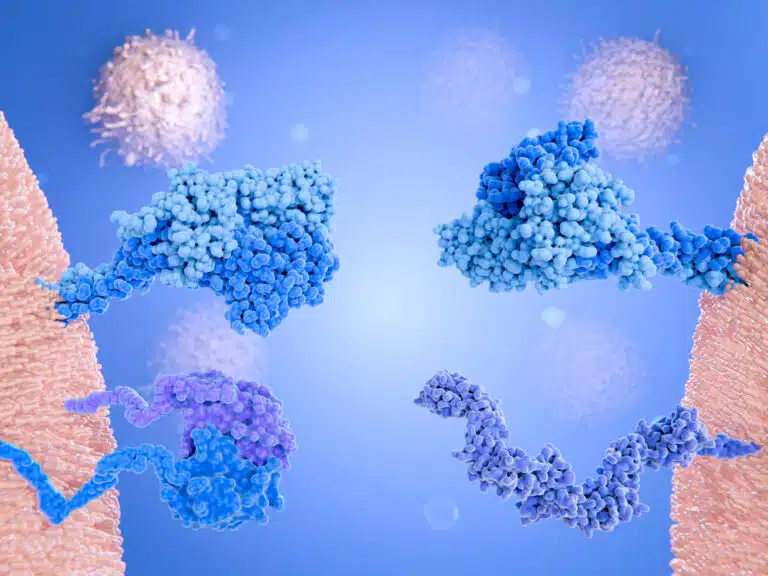
Multidrug-Resistance in Cancer: ABC-Transporters
Multidrug-resistance (MDR) is the main reason chemotherapy fails. The National Cancer Institute defines MDR as a process where cancer cells adapt to anti-tumor drugs, making the drugs less effective.
Studies show that 40% of all human cancers develop MDR. Most cancer deaths happen after a tumor metastasizes (spreads). At that stage, chemotherapy is often the only treatment option — and that’s exactly what MDR blocks.
Related reading: Resistance to anti-EGFR therapies in colorectal cancer
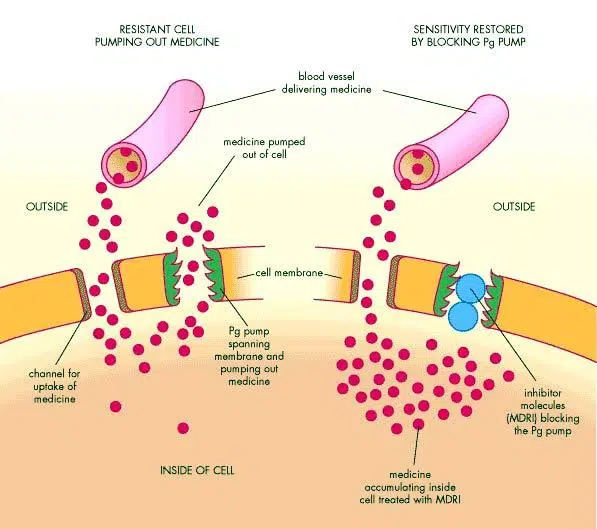
As shown in Figure 1, tumor cells use several tricks to survive anti-tumor drugs. They can:
- Change their apoptotic (cell death) pathways
- Activate cell-cycle checkpoints to boost DNA repair
- Increase expression of multidrug-resistant proteins
- Alter how anti-tumor drugs move in and out of the cell
Members of the ABC transporter (ATP-binding cassette) family drive many of these changes. The human genome has over 48 genes in this family. These proteins bind ATP and use that energy to move molecules across the cell membrane — hence the name ABC proteins.
Three ABC transporters are chiefly responsible for drug resistance in tumor cells:
- P-glycoprotein (Pgp, ABCB1)
- Multidrug resistance-associated protein 1 (MRP1, ABCC1)
- Breast cancer resistance protein (BCRP, ABCG2)
Researchers still need to determine what role other family members — including MRP2, MRP3, MRP4, MRP5, ABCA2, and BSEP — play in drug resistance.
MDR1 (Pgp)
Plasma membrane glycoprotein (Pgp) was the first ABC transporter found in cancer cells. It causes resistance to many unrelated cytotoxic drugs, including doxorubicin, vinblastine, ritonavir, indinavir, and paclitaxel. Pgp works as an energy-dependent pump that recognizes a wide range of substrates and pushes them out of the cell.
Normally, Pgp protects the body by removing toxins from cells. But during chemotherapy, this same pump removes anti-tumor drugs before they can work — lowering the drug’s effective dose inside tumor cells.
Clinical Significance
Pgp changes how the body absorbs and eliminates many drugs. Because it sits at key sites of drug absorption and elimination, it acts as a major barrier to drug delivery. Tumors with detectable Pgp are 3-4 times more likely to fail chemotherapy than Pgp-negative tumors.
Because Pgp plays such a large role in MDR, researchers are targeting it to reverse resistance. Several Pgp inhibitors are in clinical trials, including verapamil, cyclosporin A, quinine, and tamoxifen.
Multidrug Resistance Protein 1 (MRP1)
Like Pgp, MRP1 is overexpressed in tumor cells and is a major obstacle to drug delivery. In humans, MRP1 is expressed throughout the body, including the lung, testis, kidney, and peripheral blood mononuclear cells.
Clinical Significance
Researchers have found high levels of MRP1 in non-small-cell lung cancer. Breast cancer also shows significant MRP1 expression, which may raise the risk of treatment failure. In colorectal cancer, MRP overexpression causes resistance to methotrexate (MTX) and antifolates such as ZD1694.
Researchers are developing MRP1 inhibitors. Preclinical studies show that MK571 and ethacrynic acid can effectively block MRP1.
Breast Cancer Resistance Protein (BCRP)
BCRP belongs to a distinct branch of the ABC transporter family. Members of this subfamily are about half the size of full-length ABC transporters, so researchers call them half-transporters.
Researchers have found BCRP overexpressed in drug-resistant ovarian, breast, colon, and gastric cancer, as well as in fibrosarcoma cell lines. BCRP’s normal function is still unclear, but it likely helps control how drugs move through the body.
When overexpressed, BCRP reduces the buildup of chemotherapy drugs such as mitoxantrone, irinotecan, SN-38, topotecan, and flavopiridol inside cells.
Clinical Significance
BCRP is expressed in the gastrointestinal tract, so it may affect how well drugs are absorbed. Because it’s overexpressed in several cancer types, BCRP is a promising target for overcoming multidrug resistance. Potent BCRP inhibitors include Fumitremorgin C, reserpine, and tryprostatin A.
Cancer defends itself against chemotherapy through several mechanisms, including MDR. Understanding how ABC transporters drive drug resistance can help researchers find ways to overcome it.
Researchers are screening new ABC-transporter inhibitors, and drugs that these transporters can’t pump out of the cell. One such drug, ixabepilone, is already approved in the United States for breast cancer patients who’ve already received an anti-tumor agent.
Other strategies being explored include:
- Drug delivery using liposomes or nanoparticles
- Blocking MDR-associated ABC transporters with monoclonal antibodies
Early experimental data suggest these approaches could overcome key causes of MDR and significantly improve cancer treatment.
References:
1. Türk D, Hall MD, Chu BF, et al. Identification of compounds selectively killing multidrug-resistant cancer cells. Cancer Res. 2009;69(21):8293-8301.
2. Litman T, Druley TE, Stein WD, Bates SE. From MDR to MXR: new understanding of multidrug resistance systems, their properties and clinical significance. Cell Mol Life Sci. 2001;58(7):931-959.
3. Gottesman MM, Fojo T, Bates SE. Multidrug resistance in cancer: role of ATP-dependent transporters. Nat Rev Cancer. 2002;2(1):48-58.
4. Gottesman MM, Ludwig J, Xia D, Szakács G. Defeating drug resistance in cancer. Discov Med. 2006;6(31):18-23.
5. Nobili S, Landini I, Mazzei T, Mini E. Overcoming tumor multidrug resistance using drugs able to evade P-glycoprotein or to exploit its expression. Med Res Rev. 2012;32(6):1220-1262.