
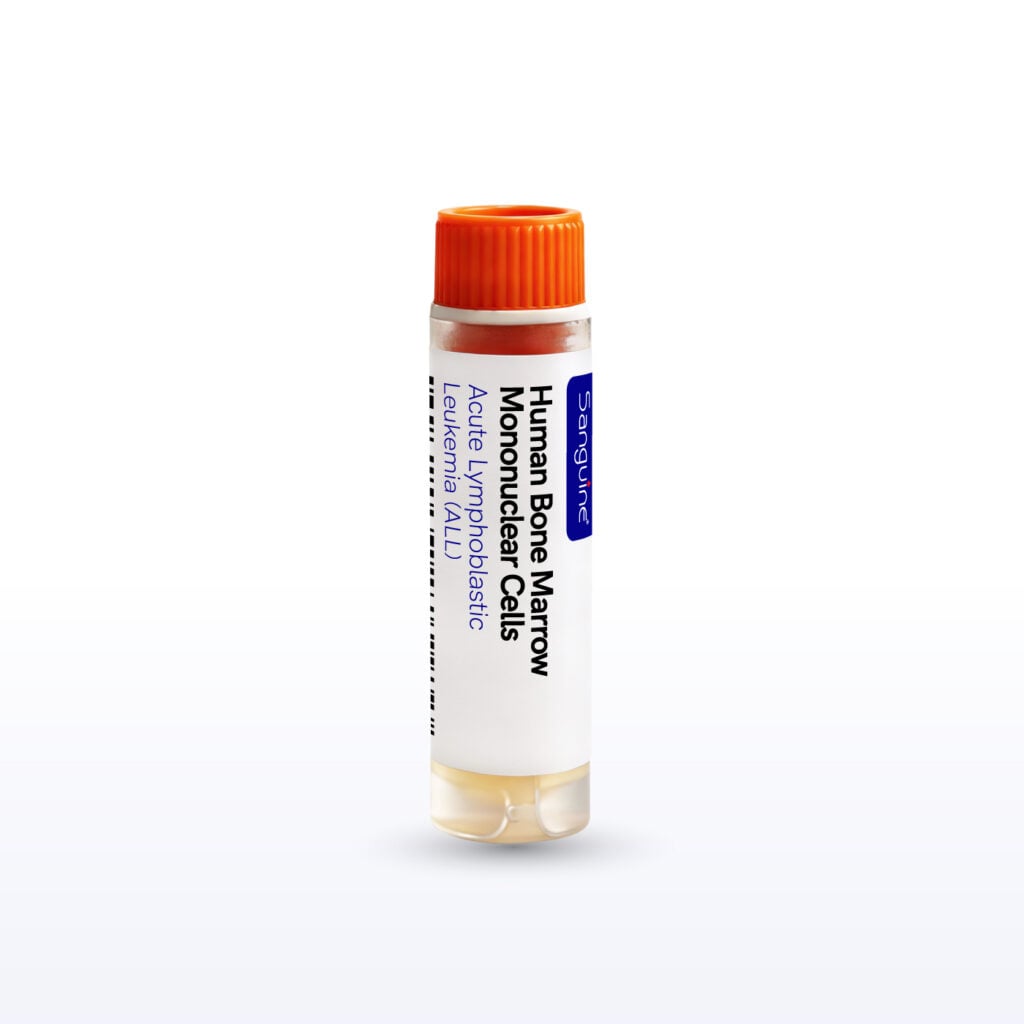
Acute Lymphoblastic Leukemia (ALL) Bone Marrow Mononuclear Cells
About:Acute Lymphoblastic Leukemia (ALL) Bone Marrow Mononuclear Cells - cryopreserved BMMCs isolated from clinically confirmed ALL donors. ALL originates from lymphoid progenitors in the bone marrow, making marrow the primary diagnostic and monitoring site. Ideal for minimal residual disease (MRD) studies, blast immunophenotyping, and CAR-T target antigen (CD19) research. Stratification by lineage, cytogenetics, and treatment phase.
About Acute Lymphoblastic Leukemia (ALL) Bone Marrow Mononuclear Cells
Acute Lymphoblastic Leukemia (ALL) Bone Marrow Mononuclear Cells for Leukemia Research
Acute lymphoblastic leukemia (ALL) bone marrow mononuclear cells (BMMCs) are isolated by density-gradient separation from bone marrow aspirate, capturing the full spectrum of marrow-resident hematopoietic stem, progenitor, and precursor cells that peripheral blood samples do not contain. Samples come from consented donors under IRB-approved protocols, each clinically diagnosed with ALL — an aggressive leukemia arising from lymphoid progenitors within the marrow itself.
ALL Biology and Why Bone Marrow
- ALL arises from malignant transformation of B- or T-lymphoid progenitors within the bone marrow, where the disease originates and where diagnostic blast counts are established (typically ≥20% lymphoblasts).
- Because ALL is a marrow-based disease, bone marrow aspirate – not peripheral blood – is the reference-standard specimen for diagnosis, lineage assignment by immunophenotyping, and cytogenetic/molecular risk stratification (including Philadelphia chromosome-positive subtypes).
- Minimal residual disease (MRD) monitoring by multiparameter flow cytometry or next-generation sequencing is performed on marrow aspirate and is one of the strongest prognostic indicators in both pediatric and adult ALL.
- CD19 and CD22 are validated immunotherapy targets in B-ALL, and marrow-derived blasts are the standard substrate for CAR-T and bispecific antibody target-expression and functional studies.
- Marrow microenvironment interactions with leukemic blasts are increasingly studied for their role in chemoresistance and relapse.
Donor Stratification Available
- Lineage: B-cell versus T-cell ALL
- Cytogenetic and molecular subtype, including Philadelphia chromosome (BCR-ABL1) status
- Disease phase: newly diagnosed, post-induction, relapsed/refractory
- Blast percentage at collection where available
- Treatment history, including prior immunotherapy or stem cell transplant
- Age band and sex assigned at birth
- Matched healthy bone marrow controls available
Product Features
- Isolated from clinically confirmed ALL donor bone marrow aspirate
- Density-gradient purified and cryopreserved
- Research Use Only (RUO)
- IRB-approved protocols with documented consent
- Standard and custom cell quantities available
De-identified Donor Data
- ALL diagnosis confirmation, lineage, and cytogenetic subtype where documented
- Age, sex assigned at birth, and ethnicity
- Donor-reported allergy and infectious disease history
- Treatment history and disease phase where documented
- Additional ALL-specific metadata available on request
Applications
- Minimal residual disease (MRD) detection and monitoring assay development
- Blast immunophenotyping and lineage marker studies
- CAR-T and bispecific antibody target-expression and functional studies (CD19, CD22)
- Marrow microenvironment and chemoresistance research
- Cytogenetic and molecular risk-stratification studies
Other Specimen Types
For matched marrow-derived material across conditions, see our human bone marrow mononuclear cells collection, and our AML BMMCs for myeloid-lineage comparisons.
Compliance and Quality Assurance
- IRB-approved and HIPAA-compliant protocols
- Electronic informed consent with 21 CFR Part 11-compliant e-signatures
- Documentation support available for regulatory review
Ordering & Customization
ALL BMMCs are available in standard and custom cell quantities. For pricing, international orders, or documentation requirements, please contact our team to confirm compatibility with your country’s regulations.
Applications
- Immunology and translational research
- Biomarker discovery and validation
- Drug screening and assay development
- Vaccine and infectious disease research
Product Features
- Research Use Only (RUO), Bone Marrow Mononuclear Cells
- Sourced from screened, consented donors
- Processed under validated SOPs
- QC tested for purity, viability, and sterility
- Processed within 24 hours of collection
- IRB-approved protocols with electronic informed consent
Donor Metadata
- Verified diagnosis and clinical history
- Demographic data: age, sex assigned at birth, race/ethnicity
- Medication and treatment background when available
Compliance and Quality Assurance
- IRB-approved collections and standardized procedures
- 21 CFR Part 11-compliant e-consent system
- HIPAA-compliant data management
Ordering & Customization
Human Bone Marrow Mononuclear Cells are available in customizable aliquot sizes. For international orders or documentation needs, please contact learnmore@sanguinebio.com to confirm requirements and availability. We also work with multiple ordering platforms and distributors, learn more here.
Protocols & Documentation
-
Informed Consent Form (ICF)
Available upon request — confirms donor consent for research use and downstream commercialization.
Where can I find your complete catalog?
You can find our full product catalog here.
How long can samples be stored?
Storage depends on sample type but often cryopreserved samples stored in liquid nitrogen can be stored for years.
What customization options are available?
Extensive customization is available. To discuss your project request a quote or email us at learnmore@sanguinebio.com.
Do you offer prospective collections?
Sanguine offers flexible prospective collection services tailored to fit your research. For more information and to request a quote, please see: our prospective biospecimen collection services page.
What is the turnaround time for custom collections?
Timelines depend on condition, sample type, and I/E criteria but we often start collection within 2 weeks of signed agreement.
Do you have samples in stock?
YES - we have in-stock inventory. You can also email us at learnmore@sanguinebio.com as we continually get new samples in our inventory.
What does unique donor mean?
Each sample from a different individual - Unique donor means each sample comes from a different person, ensuring biological diversity in your study.
Are samples collected under IRB-approved protocols?
YES - "IRB-approved collection protocols" and IRB approval documentation available upon request. Sanguine utilizes two internationally-recognized IRBs (Advarra and WCG IRB) for review and approval.
Frequently Asked Questions
Ask a Question
Need a custom Bone Marrow Mononuclear Cells cohort?
Our scientific team can scope prospective collections with donor-specific I/E criteria, typically starting within 2 weeks of agreement.