
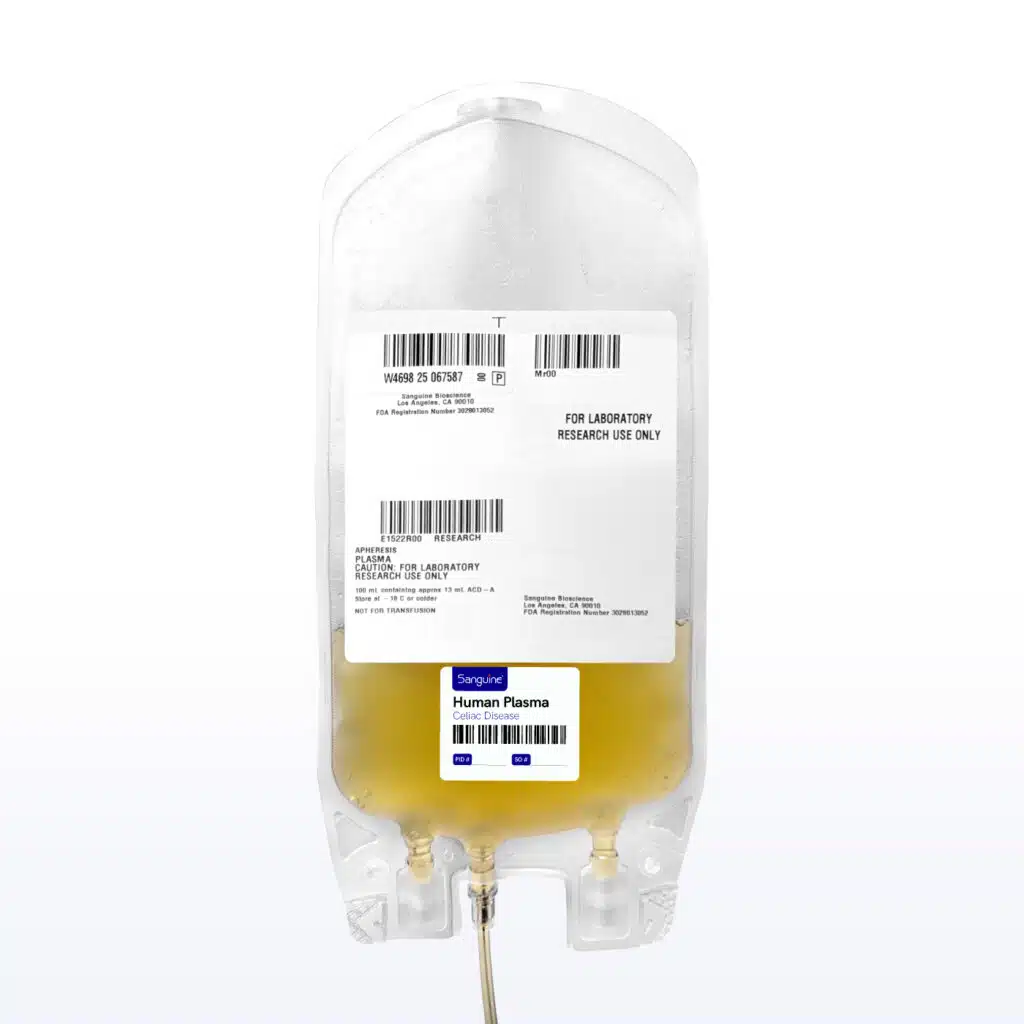
Celiac Disease Bulk Plasma
About:Celiac Disease Bulk Plasma collected by apheresis in Acid-Citrate-Dextrose Formula A (ACDA) from consented donors with confirmed celiac disease. Tested negative for HIV, HBV and HCV. Ideal for anti-tissue transglutaminase assay development, serological reference panels and autoimmune biomarker discovery at scale.
About Celiac Disease Bulk Plasma
Celiac Disease Bulk Plasma for Autoimmune and Gluten-Related Disease Research
Celiac Disease Bulk Plasma is collected from IRB-consented donors diagnosed with celiac disease using apheresis, with ACDA (Acid-Citrate-Dextrose Formula A) as the anticoagulant. Celiac disease is an autoimmune enteropathy in which dietary gluten peptides, presented in the context of HLA-DQ2 or HLA-DQ8, drive a T cell-mediated response against the small intestinal mucosa together with characteristic autoantibody production against tissue transglutaminase. This high-volume, disease-state plasma supports immunology, biomarker discovery, assay development and therapeutic discovery.
Gluten-Driven Autoimmunity and Why Bulk Plasma
- Celiac disease is genuinely autoimmune: the hallmark serological finding is IgA autoantibody against tissue transglutaminase 2 (tTG), accompanied in many patients by anti-endomysial and deamidated gliadin peptide antibodies.
- Susceptibility is tightly restricted by HLA class II. Nearly all patients carry HLA-DQ2 or HLA-DQ8, which present deamidated gluten peptides to CD4+ T cells and initiate the mucosal immune response.
- Gluten exposure and gluten-free dietary adherence directly modulate autoantibody titre, making treatment and diet status a critical variable when selecting donors.
- Bulk apheresis plasma yields the litre-scale volumes needed for antibody purification, reference and calibrator panel manufacture, and repeated-use control material — work that single-donor tubes cannot support.
- ACDA anticoagulation and apheresis collection give a consistent, high-volume matrix suited to immunoassay development and to proteomic and metabolomic discovery.
- Plasma is acellular. It supports autoantibody quantification, cytokine and mucosal damage marker immunoassay and multi-omic profiling, but not cell-based or immunophenotyping assays.
Donor Stratification Available
- Serological status: tTG-IgA positive versus normalised titre
- Gluten-free diet adherence: newly diagnosed and untreated, adherent, or non-adherent
- HLA-DQ2 or HLA-DQ8 genotype where documented
- Biopsy-confirmed diagnosis with documented histological grade where available
- Presence of associated autoimmune conditions such as type 1 diabetes or autoimmune thyroid disease
- Matched healthy controls available
Product Features
- High-volume plasma collected via apheresis
- Anticoagulated using ACDA
- Tested and confirmed negative for HIV, HBV, and HCV
- Available fresh with custom volumes upon request
- Research Use Only (RUO)
- IRB-approved informed consent and HIPAA-compliant handling
De-identified Donor Data
- Clinically confirmed diagnosis of celiac disease with diagnostic method
- Donor demographics: age, sex assigned at birth, race/ethnicity
- Clinical history and medication data available
- Serology results and dietary status where documented
Applications
- Anti-tissue transglutaminase and deamidated gliadin peptide immunoassay development
- Serological reference, calibrator and control panel manufacture
- Autoantibody purification and characterisation at scale
- Disease-specific biomarker discovery and validation
- Cytokine and inflammatory mediator profiling
- Intestinal permeability and mucosal damage marker research
- Proteomic and metabolomic profiling of gluten-related disease
- Therapeutic development and validation studies, including gluten-degrading enzyme and immune tolerance programmes
Other Celiac Disease Specimen Types
- Celiac Disease Plasma
- Celiac Disease Serum
- Celiac Disease Whole Blood
- Celiac Disease PBMC
- Celiac Disease Leukopak
- Celiac Disease CD4+ T Cells
Compliance and Quality Assurance
- Screened negative for HIV, HBV, and HCV
- IRB-approved collection with 21 CFR Part 11–compliant consent
- Standardized processing and cryopreservation protocols
Ordering & Customization
Celiac Disease Bulk Plasma is available in standard or custom volumes. For pricing, current availability, documentation or international shipping, please contact learnmore@sanguinebio.com. To browse donor cohorts across our full inventory, visit our human plasma page.
Applications
- Immunology and translational research
- Biomarker discovery and validation
- Drug screening and assay development
- Vaccine and infectious disease research
Product Features
- Research Use Only (RUO), Bulk Plasma
- Sourced from screened, consented donors
- Processed under validated SOPs
- QC tested for purity, viability, and sterility
- Processed within 24 hours of collection
- IRB-approved protocols with electronic informed consent
Donor Metadata
- Verified diagnosis and clinical history
- Demographic data: age, sex assigned at birth, race/ethnicity
- Medication and treatment background when available
Compliance and Quality Assurance
- IRB-approved collections and standardized procedures
- 21 CFR Part 11-compliant e-consent system
- HIPAA-compliant data management
Ordering & Customization
Human Bulk Plasma are available in customizable aliquot sizes. For international orders or documentation needs, please contact learnmore@sanguinebio.com to confirm requirements and availability. We also work with multiple ordering platforms and distributors, learn more here.
Where can I find your complete catalog?
You can find our full product catalog here.
How long can samples be stored?
Storage depends on sample type but often cryopreserved samples stored in liquid nitrogen can be stored for years.
What customization options are available?
Extensive customization is available. To discuss your project request a quote or email us at learnmore@sanguinebio.com.
Do you offer prospective collections?
Sanguine offers flexible prospective collection services tailored to fit your research. For more information and to request a quote, please see: our prospective biospecimen collection services page.
What is the turnaround time for custom collections?
Timelines depend on condition, sample type, and I/E criteria but we often start collection within 2 weeks of signed agreement.
Do you have samples in stock?
YES - we have in-stock inventory. You can also email us at learnmore@sanguinebio.com as we continually get new samples in our inventory.
What does unique donor mean?
Each sample from a different individual - Unique donor means each sample comes from a different person, ensuring biological diversity in your study.
Are samples collected under IRB-approved protocols?
YES - "IRB-approved collection protocols" and IRB approval documentation available upon request. Sanguine utilizes two internationally-recognized IRBs (Advarra and WCG IRB) for review and approval.
Frequently Asked Questions
Ask a Question
Pair with a Healthy Control
Match your Celiac Disease Bulk Plasma with normal donor samples for comparison
Healthy Bulk Plasma
View InventoryNeed a custom Bulk Plasma cohort?
Our scientific team can scope prospective collections with donor-specific I/E criteria, typically starting within 2 weeks of agreement.