
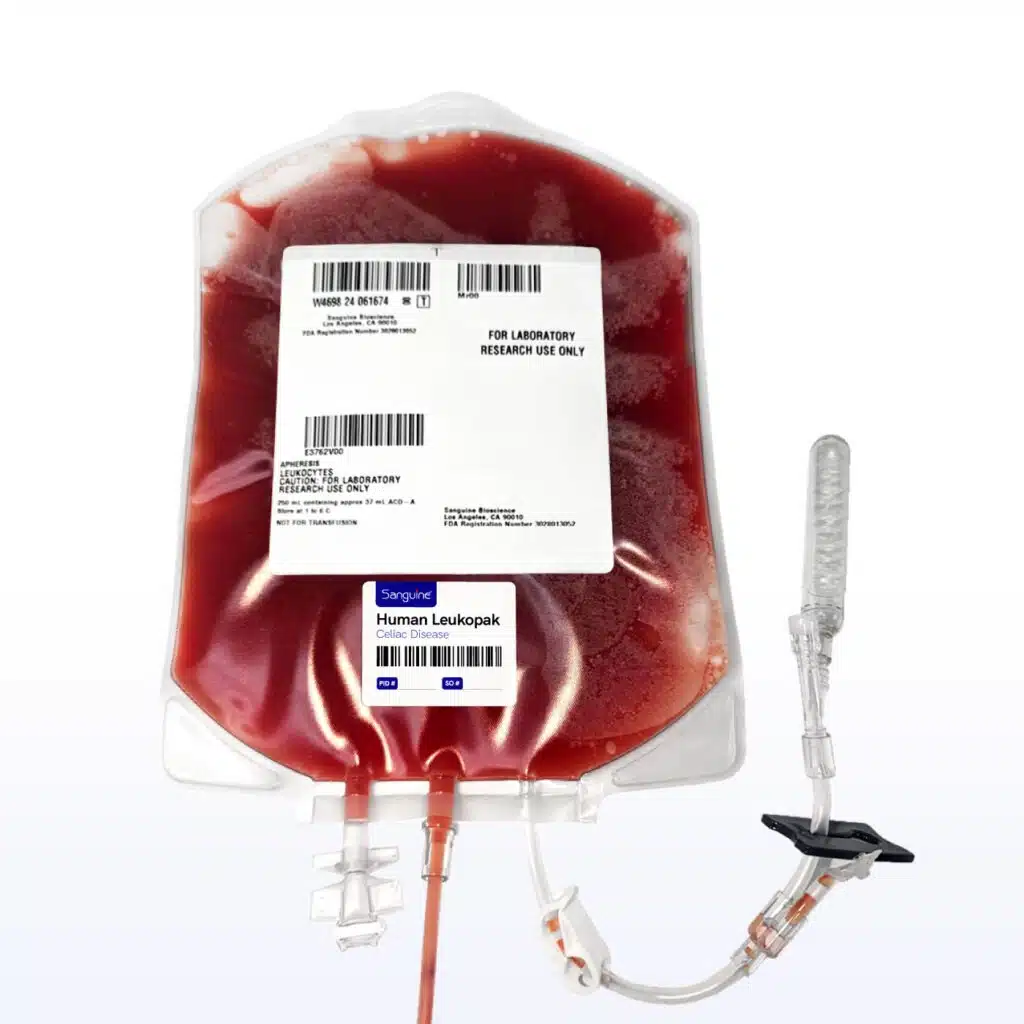
Celiac Disease Leukopak
 Powered by Bioz
About:LeukoCore Celiac Disease Leukopak products contain concentrated immune cells collected by apheresis from donors with clinically confirmed celiac disease, an autoimmune enteropathy restricted to HLA-DQ2 and DQ8. The high cell yield makes it suited to detecting rare gluten-specific CD4+ T cells by tetramer staining, antigen-specific and tolerance assays, and TCR repertoire sequencing. Stratification by HLA type, serology, and dietary status available.
About Celiac Disease Leukopak
High-Yield LeukoCore Celiac Disease Leukopaks for Autoimmune Immunology Research
LeukoCore Celiac Disease Leukopak biospecimens are collected from IRB-consented donors clinically diagnosed with celiac disease through IRB-approved apheresis procedures. Each leukopak contains large quantities of peripheral blood mononuclear cells (PBMCs), making it suited to antigen-specific immune profiling, cytokine analysis, and drug development research in celiac disease. Cell counts and viability are reported per lot.
Why a Leukopak for Celiac Disease Research
Celiac disease is an autoimmune enteropathy triggered by dietary gluten in genetically susceptible people. The cellular immunology is unusually well defined, and it is precisely that definition which makes cell number the limiting factor — the population of interest is rare, and a leukopak is how you get enough of it.
- Susceptibility is almost entirely restricted to HLA-DQ2 and HLA-DQ8. Gluten peptides deamidated by tissue transglutaminase 2 bind these molecules with high affinity and are presented to gluten-specific CD4+ T cells, so donor HLA genotype is a first-order variable in any celiac T cell experiment.
- Gluten-specific CD4+ T cells circulate at very low frequency. Detecting and phenotyping them with HLA-DQ tetramers or antigen-specific assays requires far more cells than a standard venepuncture provides, which is the core rationale for apheresis-derived material.
- The disease is autoimmune because the antibody response targets a self antigen: autoantibodies against tissue transglutaminase 2, alongside antibodies to deamidated gliadin peptides, are the serological hallmark and the basis of clinical diagnosis.
- Intestinal damage is mediated by intraepithelial cytotoxic lymphocytes activated in an IL-15-rich environment through NK-type receptors, giving a defined innate-like effector arm alongside the CD4+ T cell response.
- Because pathology depends on continuing antigen exposure, gluten intake at the time of collection materially affects the frequency of circulating gluten-reactive cells — dietary status is a study design variable, not donor trivia.
- Therapeutic programmes in celiac disease target transglutaminase 2, gluten degradation, and antigen-specific tolerance induction, all of which require large numbers of primary patient cells with known HLA restriction for mechanistic and potency work.
Donor Stratification Available
- HLA typing, including DQ2 and DQ8 status, available on request for selected inventory
- Serology: anti-tissue transglutaminase IgA and deamidated gliadin peptide antibody status, current or normalised, where documented
- Biopsy-confirmed diagnosis and histological grade where recorded
- Dietary status at collection: gluten-free diet with duration, partial adherence, or gluten-containing diet
- Refractory or persistently symptomatic disease, and dermatitis herpetiformis where present
- Associated autoimmune conditions such as type 1 diabetes or autoimmune thyroid disease, and selective IgA deficiency
- Matched healthy controls available, including HLA-DQ2-positive non-celiac donors on request
Product Features
- Research Use Only (RUO) human celiac disease leukopaks
- Clinically confirmed celiac disease donors
- High cell yield for large-scale studies
- Processed and shipped within 24 hours of collection
- Fresh or cryopreserved options available
- IRB-approved and ethically sourced
- Infectious disease testing
- HLA-A typing
- Screen donors with LeukoLot™
De-identified Donor Data
- Verified celiac disease diagnosis from healthcare providers
- Donor demographics: age, sex assigned at birth, race/ethnicity
- Self-reported medication history and allergies
- Dietary status and serology where available
- Relevant clinical data (if available)
Applications
- HLA-DQ tetramer staining and gluten-specific CD4+ T cell detection and phenotyping
- Antigen-specific proliferation, cytokine, and tolerance-induction assays
- Immune cell characterisation and immunophenotyping in celiac disease
- Isolation of T cell, B cell, NK cell, and monocyte subsets at scale from a single donor
- Therapeutic development, screening, and potency assays for celiac-directed candidates
- T cell receptor repertoire sequencing of gluten-reactive populations
- Multi-omics studies including single-cell RNA sequencing
- Comparative autoimmunity research alongside other autoimmune donor cohorts
Other Celiac Disease Specimen Types
- Celiac Disease Serum
- Celiac Disease Plasma
- Celiac Disease Whole Blood
- Celiac Disease PBMC
- Celiac Disease CD4+ T Cells
- Celiac Disease CD3+ T Cells
- Celiac Disease Bulk Plasma
Compliance and Quality Assurance
- Collected under IRB oversight with donor e-consent (21 CFR Part 11 compliant)
- HIPAA-compliant handling of donor information
- Rigorous donor screening and documentation
Ordering & Customization
Celiac disease leukopak samples are available fresh or cryopreserved. For pricing and current availability, or if you need a different condition, visit our human leukopak page to browse other disease-state options and live stock status. For international shipping or regulatory documentation, please contact learnmore@sanguinebio.com to confirm regional compliance and shipping availability.
Applications
- Immunology and translational research
- Biomarker discovery and validation
- Drug screening and assay development
- Vaccine and infectious disease research
Product Features
- Research Use Only (RUO), Leukopak
- Sourced from screened, consented donors
- Processed under validated SOPs
- QC tested for purity, viability, and sterility
- Processed within 24 hours of collection
- IRB-approved protocols with electronic informed consent
Donor Metadata
- Verified diagnosis and clinical history
- Demographic data: age, sex assigned at birth, race/ethnicity
- Medication and treatment background when available
Compliance and Quality Assurance
- IRB-approved collections and standardized procedures
- 21 CFR Part 11-compliant e-consent system
- HIPAA-compliant data management
Ordering & Customization
Human Leukopak are available in customizable aliquot sizes. For international orders or documentation needs, please contact learnmore@sanguinebio.com to confirm requirements and availability. We also work with multiple ordering platforms and distributors, learn more here.
Protocols & Documentation
-
Download
Leukopak Cryopreservation
Standard operating procedure for cryopreserving leukopak units with controlled freezing and post-thaw viability targets.
-
Download
Leukopak Thawing
Validated thawing workflow for cryopreserved leukopaks to maximize recovery while maintaining sterility and chain of custody.
-
Download
Choosing the Right PBMC Configuration
Reference guide comparing PBMC formats, cryopreservation states, and study-fit recommendations for your application.
-
Informed Consent Form (ICF)
Available upon request — confirms donor consent for research use and downstream commercialization.
Leukopak
Where can I find your complete catalog?
You can find our full product catalog here.
How long can samples be stored?
Storage depends on sample type but often cryopreserved samples stored in liquid nitrogen can be stored for years.
What customization options are available?
Extensive customization is available. To discuss your project request a quote or email us at learnmore@sanguinebio.com.
Do you offer prospective collections?
Sanguine offers flexible prospective collection services tailored to fit your research. For more information and to request a quote, please see: our prospective biospecimen collection services page.
What is the turnaround time for custom collections?
Timelines depend on condition, sample type, and I/E criteria but we often start collection within 2 weeks of signed agreement.
Do you have samples in stock?
YES - we have in-stock inventory. You can also email us at learnmore@sanguinebio.com as we continually get new samples in our inventory.
What does unique donor mean?
Each sample from a different individual - Unique donor means each sample comes from a different person, ensuring biological diversity in your study.
Are samples collected under IRB-approved protocols?
YES - "IRB-approved collection protocols" and IRB approval documentation available upon request. Sanguine utilizes two internationally-recognized IRBs (Advarra and WCG IRB) for review and approval.
Frequently Asked Questions
Ask a Question
Pair with a Healthy Control
Match your Celiac Disease Leukopak with normal donor samples for comparison
Healthy Donor Leukopaks
5 In Stock View InventoryNeed a custom Leukopak cohort?
Our scientific team can scope prospective collections with donor-specific I/E criteria, typically starting within 2 weeks of agreement.