
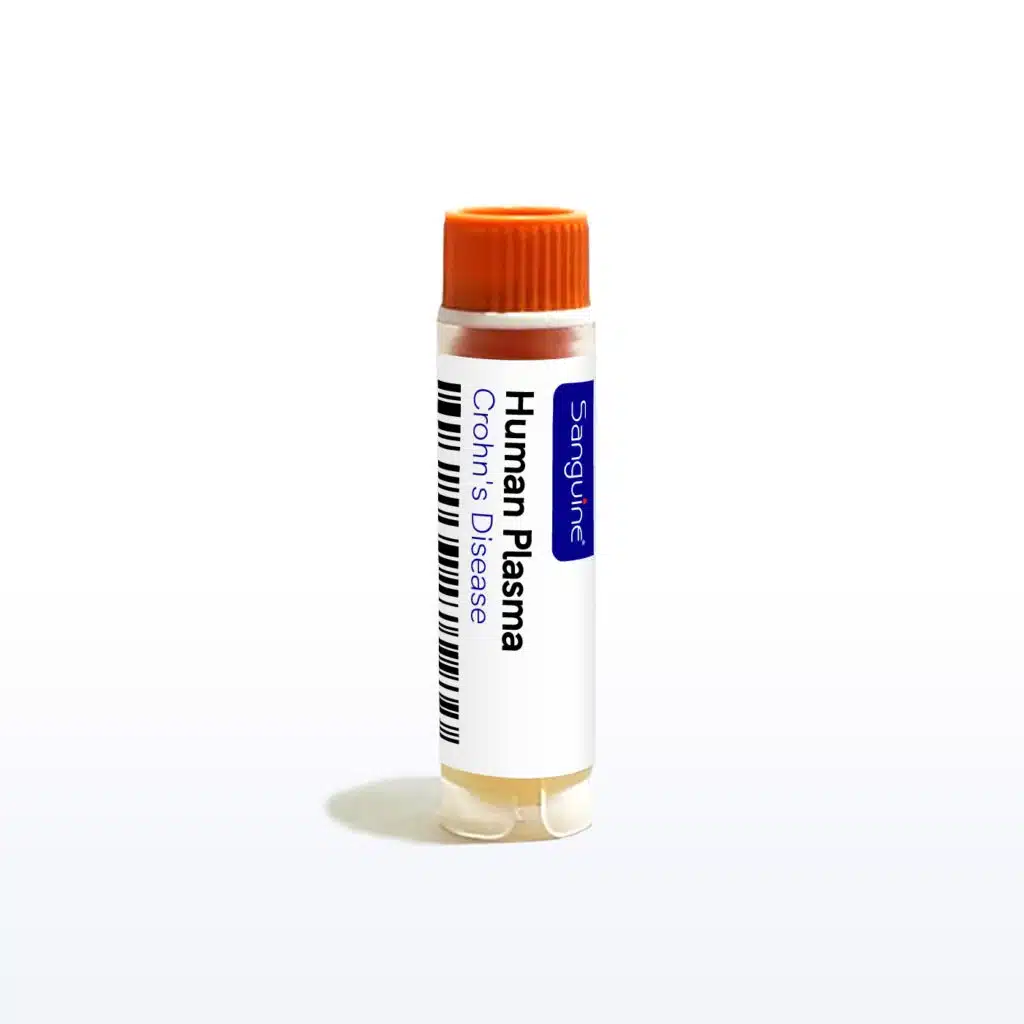
Crohn’s Disease Plasma
 Powered by Bioz
About:Crohn's Disease Plasma from consented donors with clinically confirmed Crohn's disease, processed within one day of collection. Supports TNF and IL-23/Th17 cytokine profiling, ASCA and inflammatory serology, plasma proteomics, fibrosis marker work, and therapeutic drug monitoring assay development in immune-mediated inflammatory bowel disease. Donors can be stratified by disease activity, Montreal location and behaviour, and biologic treatment status. Bulk plasma is available.
About Crohn’s Disease Plasma
Crohn’s Disease Plasma for Immune-Mediated Inflammatory Bowel Disease Research
Crohn’s Disease Plasma is collected from IRB-consented donors with a clinically confirmed diagnosis of Crohn’s disease and processed within one day of collection to preserve labile analytes such as cytokines, proteases, and metabolites. Crohn’s disease is an immune-mediated inflammatory bowel disease: a dysregulated mucosal immune response to the intestinal microbiota in a genetically susceptible host, rather than a classical autoantibody-driven autoimmune disease. Bulk plasma is available for higher-volume programs.
What Crohn’s Disease Plasma Reveals
- Crohn’s disease inflammation runs through the IL-12/IL-23, Th1/Th17 and TNF axis. Plasma is the practical matrix for the soluble mediators these pathways release into circulation, including TNF, IL-6, IL-17A, IL-22 and oncostatin M.
- Barrier failure and impaired intracellular bacterial handling, reflected in risk loci such as NOD2, ATG16L1 and IL23R, generate circulating markers of microbial translocation and innate immune activation that tissue-only assays do not capture.
- Anti-Saccharomyces cerevisiae antibodies (ASCA) are frequently present in Crohn’s disease. These are anti-microbial antibodies, not autoantibodies, and ASCA reactivity is used to help separate Crohn’s disease from ulcerative colitis serologically.
- Matrix metalloproteinases and extracellular matrix turnover fragments measurable in plasma reflect the transmural and fibrostenosing behaviour that distinguishes Crohn’s disease from mucosa-limited colitis.
- EDTA or citrate plasma preserves complement fragments, platelet-derived mediators and cell-free DNA that are degraded or artefactually shifted during the clotting step required to make serum.
- Trough biologic concentrations and anti-drug antibodies against anti-TNF, anti-IL-23 and anti-integrin agents are quantified in plasma or serum, supporting therapeutic drug monitoring assay development.
Donor Stratification Available
- Disease activity, including clinical remission versus active flare, with Harvey-Bradshaw Index or CDAI where documented
- Montreal classification: age at diagnosis, disease location (ileal, colonic, ileocolonic, upper GI) and behaviour (non-stricturing, stricturing, penetrating)
- Laboratory and serology results where available, including CRP, faecal calprotectin and ASCA status
- Treatment status: biologic-naive, anti-TNF, anti-IL-12/23 or anti-IL-23, anti-integrin, JAK inhibitor, corticosteroid or immunomodulator
- Surgical and complication history, including prior resection, ostomy and perianal fistulising disease
- Matched healthy controls available, as well as ulcerative colitis donors for IBD subtype comparison
Product Features
- Research Use Only (RUO)
- Plasma collected from clinically confirmed Crohn’s disease donors
- Processed within one day of collection
- Anticoagulant selection (EDTA, citrate, heparin) available on request
- IRB-approved protocols and informed consent
- Custom aliquot volumes available upon request; volumes and lot details reported per lot
De-identified Donor Data
- Verified Crohn’s disease diagnosis
- Demographic data: age, sex assigned at birth, race/ethnicity
- Donor-reported medications, allergies, and comorbidities
- Additional Crohn’s disease-specific metadata available on request
Applications
- Cytokine and inflammatory mediator profiling across the TNF and IL-23/Th17 axes
- Biomarker discovery and validation for disease activity and mucosal healing
- Plasma proteomics and metabolomics, including bile acid and tryptophan pathway work
- Assay development for therapeutic drug monitoring and anti-drug antibody detection
- Fibrosis and extracellular matrix turnover marker research in stricturing disease
- IBD subtype discrimination studies comparing Crohn’s disease and ulcerative colitis
- Cell-free DNA and extracellular vesicle isolation from plasma
- Reference material and control matrix for immunoassay qualification
Other Crohn’s Disease Specimen Types
- Crohn’s Disease Serum
- Crohn’s Disease Whole Blood
- Crohn’s Disease PBMC
- Crohn’s Disease Leukopak
- Crohn’s Disease Bulk Plasma
- Crohn’s Disease CD19+ B Cells
Compliance and Quality Assurance
- IRB-approved and HIPAA-compliant protocols
- Electronic informed consent with 21 CFR Part 11 – compliant e-signatures
- Documentation support available for regulatory review
Ordering & Customization
Crohn’s disease plasma is available in standard and custom volumes. For pricing, current availability, or a quote on a stratified donor cohort, email learnmore@sanguinebio.com. For international orders or documentation requirements, please contact us to ensure compatibility with your country’s regulations. To browse other disease states in this specimen type, visit our human plasma page.
Applications
- Immunology and translational research
- Biomarker discovery and validation
- Drug screening and assay development
- Vaccine and infectious disease research
Product Features
- Research Use Only (RUO), Plasma
- Sourced from screened, consented donors
- Processed under validated SOPs
- QC tested for purity, viability, and sterility
- Processed within 24 hours of collection
- IRB-approved protocols with electronic informed consent
Donor Metadata
- Verified diagnosis and clinical history
- Demographic data: age, sex assigned at birth, race/ethnicity
- Medication and treatment background when available
Compliance and Quality Assurance
- IRB-approved collections and standardized procedures
- 21 CFR Part 11-compliant e-consent system
- HIPAA-compliant data management
Ordering & Customization
Human Plasma are available in customizable aliquot sizes. For international orders or documentation needs, please contact learnmore@sanguinebio.com to confirm requirements and availability. We also work with multiple ordering platforms and distributors, learn more here.
Protocols & Documentation
-
Download
Plasma Isolation
Protocol for plasma separation from anticoagulated whole blood, including processing, storage, and traceability requirements.
-
Informed Consent Form (ICF)
Available upon request — confirms donor consent for research use and downstream commercialization.
Plasma
Where can I find your complete catalog?
You can find our full product catalog here.
How long can samples be stored?
Storage depends on sample type but often cryopreserved samples stored in liquid nitrogen can be stored for years.
What customization options are available?
Extensive customization is available. To discuss your project request a quote or email us at learnmore@sanguinebio.com.
Do you offer prospective collections?
Sanguine offers flexible prospective collection services tailored to fit your research. For more information and to request a quote, please see: our prospective biospecimen collection services page.
What is the turnaround time for custom collections?
Timelines depend on condition, sample type, and I/E criteria but we often start collection within 2 weeks of signed agreement.
Do you have samples in stock?
YES - we have in-stock inventory. You can also email us at learnmore@sanguinebio.com as we continually get new samples in our inventory.
What does unique donor mean?
Each sample from a different individual - Unique donor means each sample comes from a different person, ensuring biological diversity in your study.
Are samples collected under IRB-approved protocols?
YES - "IRB-approved collection protocols" and IRB approval documentation available upon request. Sanguine utilizes two internationally-recognized IRBs (Advarra and WCG IRB) for review and approval.
Frequently Asked Questions
Ask a Question
Pair with a Healthy Control
Match your Crohn's Disease Plasma with normal donor samples for comparison
Healthy Plasma
206 In Stock View InventoryNeed a custom Plasma cohort?
Our scientific team can scope prospective collections with donor-specific I/E criteria, typically starting within 2 weeks of agreement.