
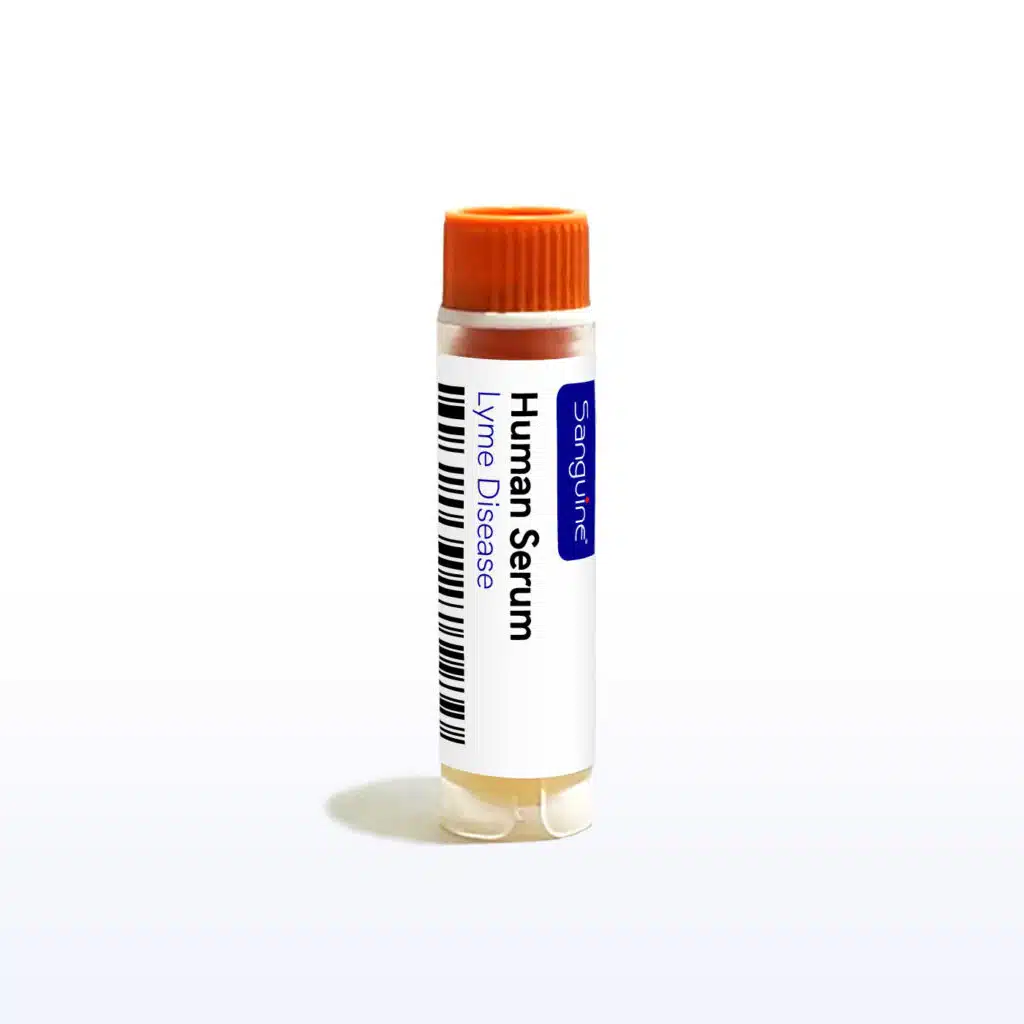
Lyme Disease Serum
 Powered by Bioz
About:Lyme Disease Serum from consented donors with clinically confirmed Borrelia burgdorferi infection. The reference matrix for Lyme serology: two-tier assay development, C6/VlsE, OspC and p41 antibody detection, seroconversion kinetics, and cross-reactivity panels. Stratification by disease stage, serostatus, time from symptom onset and treatment, with matched healthy controls available.
About Lyme Disease Serum
Lyme Disease Serum for Infectious Disease Research
Lyme Disease Serum is collected from IRB-consented donors with a clinically confirmed diagnosis of Lyme disease and processed under standardised SOPs with rigorous donor screening and sample quality checks. Serum is the reference matrix for Lyme serology, and because it is acellular this product is supplied for antibody detection, immunoassay development, proteomic and metabolomic work rather than for any cell-based assay.
Why Lyme Disease Serum for Infectious Disease Research
Lyme disease is a tick-borne bacterial infection caused by Borrelia burgdorferi sensu lato, transmitted to humans by Ixodes ticks. Diagnosis rests almost entirely on the host antibody response to the organism, because the spirochaete is present in blood only transiently and at very low density. That makes well-characterised disease-state serum the central reagent in the field.
- Antibody kinetics to Borrelia antigens — IgM appears first and is followed by IgG, so timing relative to symptom onset determines what a serum sample can demonstrate.
- Key diagnostic antigens — responses to the C6 peptide of VlsE, OspC and flagellar p41 underpin the antigens used in current commercial serology.
- Standard two-tier testing architecture — a sensitive enzyme immunoassay followed by immunoblot, or a modified two-tier EIA/EIA scheme, both of which require characterised positive and negative serum panels to validate.
- Stage-dependent serological maturity — early localised infection with erythema migrans is frequently seronegative, while early disseminated and late disease show broader, higher-titre IgG reactivity.
- Cross-reactivity and specificity challenges — antibodies raised against other spirochaetes and some viral infections can confound Lyme serology, so disease-state and control panels are needed for specificity testing.
- Inflammatory mediators of infection — chemokines such as CXCL13, along with general acute-phase and cytokine responses to bacterial infection, are measurable in the acellular compartment.
Donor Stratification Available
- Disease stage — early localised (including erythema migrans), early disseminated, and late Lyme disease including Lyme arthritis
- Serostatus — two-tier-positive donors, IgM-only donors, IgG-positive donors, and seronegative clinically diagnosed donors
- Time from symptom onset or tick exposure — for antibody kinetic and seroconversion studies, with serial draws where collected
- Organ involvement — dermatological, musculoskeletal, cardiac and neurological (neuroborreliosis) presentations subject to availability
- Treatment status — pre-antibiotic, on-treatment, post-treatment resolved, and donors reporting persistent post-treatment symptoms
- Matched healthy controls available from comparable geographic regions, matched for age, sex and ethnicity
Product Features
- Serum isolated from clinically confirmed Lyme disease donors
- Rigorous donor screening and sample quality checks
- Research Use Only (RUO)
- Standardized collection and processing SOPs
- Suitable for downstream applications such as ELISA, immunoblot, multiplex serology, qPCR and mass spectrometry
- Standard and custom volumes; volumes reported per lot
De-identified Donor Data
- Age, sex, race, medication, diagnosis method, disease severity/stage
- Optional: comorbidities, lab values, and clinical history
- Serology results and time from symptom onset reported per lot where captured
- Additional Lyme-specific clinical fields available on request
Applications
- Two-tier Lyme serology assay development and validation
- C6/VlsE, OspC and p41 antigen-specific immunoassay design
- Seroconversion and antibody kinetic studies across disease stages
- Diagnostic specificity and cross-reactivity panel construction
- Biomarker discovery for persistent post-treatment symptoms
- Inflammatory mediator and chemokine profiling in bacterial infection
- Serum proteomic and metabolomic discovery in tick-borne infection
- Diagnostic reference, calibrator and control material sourcing
Other Lyme Disease Specimen Types
- Lyme Disease Plasma
- Lyme Disease Bulk Plasma
- Lyme Disease PBMC
- Lyme Disease Whole Blood
- Lyme Disease Leukopak
Compliance and Quality Assurance
- IRB-approved protocols
- Informed donor consent
- HIPAA-compliant handling of donor information
- Standardized collection and processing SOPs
Ordering & Customization
Samples are available in both standard and custom volumes to meet your research needs. For pricing, international shipments or country-specific documentation requirements, please contact us at learnmore@sanguinebio.com to ensure compliance with your local regulations. To compare collection formats or check wider availability, visit our human serum page.
Applications
- Immunology and translational research
- Biomarker discovery and validation
- Drug screening and assay development
- Vaccine and infectious disease research
Product Features
- Research Use Only (RUO), Serum
- Sourced from screened, consented donors
- Processed under validated SOPs
- QC tested for purity, viability, and sterility
- Processed within 24 hours of collection
- IRB-approved protocols with electronic informed consent
Donor Metadata
- Verified diagnosis and clinical history
- Demographic data: age, sex assigned at birth, race/ethnicity
- Medication and treatment background when available
Compliance and Quality Assurance
- IRB-approved collections and standardized procedures
- 21 CFR Part 11-compliant e-consent system
- HIPAA-compliant data management
Ordering & Customization
Human Serum are available in customizable aliquot sizes. For international orders or documentation needs, please contact learnmore@sanguinebio.com to confirm requirements and availability. We also work with multiple ordering platforms and distributors, learn more here.
Protocols & Documentation
-
Download
Serum Isolation
Protocol for serum preparation from whole blood, including collection handling, clarification, and quality documentation.
-
Informed Consent Form (ICF)
Available upon request — confirms donor consent for research use and downstream commercialization.
Serum
Where can I find your complete catalog?
You can find our full product catalog here.
How long can samples be stored?
Storage depends on sample type but often cryopreserved samples stored in liquid nitrogen can be stored for years.
What customization options are available?
Extensive customization is available. To discuss your project request a quote or email us at learnmore@sanguinebio.com.
Do you offer prospective collections?
Sanguine offers flexible prospective collection services tailored to fit your research. For more information and to request a quote, please see: our prospective biospecimen collection services page.
What is the turnaround time for custom collections?
Timelines depend on condition, sample type, and I/E criteria but we often start collection within 2 weeks of signed agreement.
Do you have samples in stock?
YES - we have in-stock inventory. You can also email us at learnmore@sanguinebio.com as we continually get new samples in our inventory.
What does unique donor mean?
Each sample from a different individual - Unique donor means each sample comes from a different person, ensuring biological diversity in your study.
Are samples collected under IRB-approved protocols?
YES - "IRB-approved collection protocols" and IRB approval documentation available upon request. Sanguine utilizes two internationally-recognized IRBs (Advarra and WCG IRB) for review and approval.
Frequently Asked Questions
Ask a Question
Pair with a Healthy Control
Match your Lyme Disease Serum with normal donor samples for comparison
Healthy Serum
100 In Stock View InventoryNeed a custom Serum cohort?
Our scientific team can scope prospective collections with donor-specific I/E criteria, typically starting within 2 weeks of agreement.