
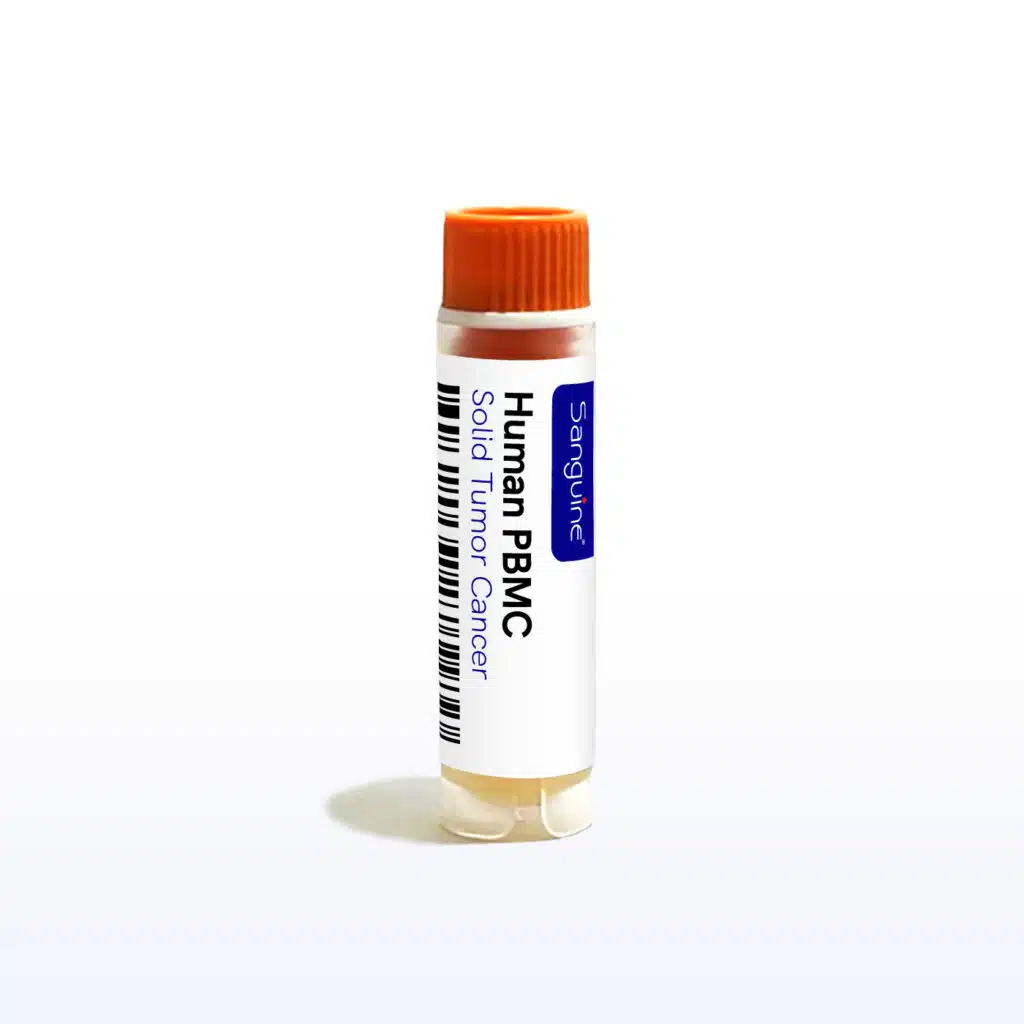
Solid Tumor Cancer PBMC
 Powered by Bioz
About:Solid Tumor Cancer PBMC samples are isolated from donors with clinically diagnosed solid tumours, processed within 24 hours and cryopreserved in CryoStor CS10. Suited to T-cell exhaustion immunophenotyping, checkpoint-inhibitor potency work, MDSC and regulatory T-cell suppression assays, and patient-derived effector cell sourcing for engager and CAR programmes. Stratification by indication, stage, treatment and response, with matched healthy controls.
About Solid Tumor Cancer PBMC
Solid Tumor Cancer PBMC for Immuno-Oncology Research
Solid Tumor Cancer PBMC samples are collected from IRB-consented donors clinically diagnosed with solid-tumour cancers, processed within 24 hours of collection and preserved in CryoStor® CS10 to maintain viability and function. These cryopreserved peripheral blood mononuclear cells support study of tumour-immune interactions, immune-checkpoint regulation and systemic immune responses across a range of solid tumours, in cell counts from 5 million to 2 billion.
Why Solid Tumour PBMC for Immuno-Oncology Research
Solid tumours are neoplastic diseases, and the peripheral immune compartment of a cancer patient is systematically different from that of a healthy donor. Tumours shape host immunity through secreted factors, chronic antigen exposure and expansion of suppressive cell populations, and those changes are detectable in circulating mononuclear cells. Healthy-donor PBMCs cannot reproduce this state, which is why disease-state cells matter for immuno-oncology assay development.
- T-cell exhaustion — chronic tumour antigen exposure drives inhibitory receptor expression including PD-1, TIM-3, LAG-3 and TIGIT, with reduced proliferative and cytotoxic capacity.
- Suppressive myeloid expansion — myeloid-derived suppressor cells expand in the circulation of cancer patients and actively inhibit T-cell function, making them both a confounder and a target.
- Regulatory T-cell expansion — increased Treg frequency and suppressive capacity contribute to peripheral tolerance of the tumour.
- Immune-checkpoint axis — PD-1 and CTLA-4 expression on donor T cells is the direct substrate for checkpoint-inhibitor mechanism-of-action and potency work.
- NK cell and effector function — cytotoxicity and antibody-dependent cellular cytotoxicity capacity in patient-derived effectors is the realistic setting for antibody and engager potency assays.
- Cellular specimen advantage — because PBMCs are viable nucleated cells, flow cytometry, killing and suppression assays, antigen-specific stimulation, single-cell transcriptomics and TCR repertoire sequencing are all available; none are possible in an acellular plasma or serum product.
Donor Stratification Available
- Tumour indication — breast, lung, colorectal, pancreatic, prostate, ovarian, renal and other solid tumours, subject to availability
- Stage and disease extent — localised, locally advanced, and metastatic disease
- Treatment status — treatment-naive, on immune-checkpoint inhibitor therapy, on chemotherapy or targeted therapy, and post-treatment donors
- Response and trajectory — responding versus progressing donors; serial draws from the same donor where collected
- Molecular and biomarker context — indication-specific markers such as HER2, hormone receptor, EGFR/ALK or microsatellite status where documented
- Matched healthy controls available, drawn on the same protocol and matched for age, sex and ethnicity
Product Features
- Research Use Only (RUO), cryopreserved solid-tumour PBMC samples
- Clinically confirmed solid-tumour cancer donors
- Available in cell counts ranging from 5 million to 2 billion
- Processed within 24 hours of collection
- Preserved using CryoStor® CS10 freezing media
- IRB-approved protocols and electronic informed consent
- Screening (LeukoLot™) available prior to bulk orders
De-identified Donor Data
- Verified solid-tumour cancer diagnosis
- Donor demographics: age, sex assigned at birth, race/ethnicity
- Self-reported allergies and infectious disease history
- Indication, stage and treatment context reported per lot where captured
- Additional tumour-type and clinical data available on request
Applications
- T-cell exhaustion and inhibitory receptor immunophenotyping
- Immune-checkpoint inhibitor mechanism-of-action and potency assays
- Myeloid-derived suppressor cell and regulatory T-cell characterisation and suppression assays
- NK cell cytotoxicity and antibody-dependent cellular cytotoxicity assays
- Patient-derived effector cell sourcing for bispecific engager and CAR construct potency work
- Single-cell transcriptomic and TCR repertoire profiling in cancer cohorts
- Drug screening and ex vivo pharmacology in disease-state immune cells
- Biomarker discovery and validation for response and resistance to immunotherapy
Other Solid Tumor Cancer Specimen Types
- Solid Tumor Cancer Plasma
- Solid Tumor Cancer Serum
- Solid Tumor Cancer Whole Blood
- Solid Tumor Cancer Leukopak
Compliance and Quality Assurance
- IRB-approved collections and protocols
- 21 CFR Part 11-compliant e-consent
- HIPAA-compliant donor data protection
Ordering & Customization
Solid Tumor Cancer PBMC samples ship on dry ice in standard or custom aliquots. For pricing, international orders or regulatory documentation, contact learnmore@sanguinebio.com. To compare collection formats, browse all human PBMCs or request a custom disease-state collection.
Applications
- Immunology and translational research
- Biomarker discovery and validation
- Drug screening and assay development
- Vaccine and infectious disease research
Product Features
- Research Use Only (RUO), PBMC
- Sourced from screened, consented donors
- Processed under validated SOPs
- QC tested for purity, viability, and sterility
- Processed within 24 hours of collection
- IRB-approved protocols with electronic informed consent
Donor Metadata
- Verified diagnosis and clinical history
- Demographic data: age, sex assigned at birth, race/ethnicity
- Medication and treatment background when available
Compliance and Quality Assurance
- IRB-approved collections and standardized procedures
- 21 CFR Part 11-compliant e-consent system
- HIPAA-compliant data management
Ordering & Customization
Human PBMC are available in customizable aliquot sizes. For international orders or documentation needs, please contact learnmore@sanguinebio.com to confirm requirements and availability. We also work with multiple ordering platforms and distributors, learn more here.
Protocols & Documentation
-
Download
PBMC Isolation from Whole Blood
Standard operating procedure for isolating peripheral blood mononuclear cells from whole blood using density-gradient separation.
-
Download
Immune Cell Isolation
Guidelines for isolating immune cell populations with validated enrichment steps, purity checkpoints, and documentation.
-
Download
Choosing the Right PBMC Configuration
Reference guide comparing PBMC formats, cryopreservation states, and study-fit recommendations for your application.
-
Download
Thawing Cryopreserved PBMC
Validated thawing protocol to recover viable cryopreserved PBMCs while minimizing activation and loss of function.
-
Informed Consent Form (ICF)
Available upon request — confirms donor consent for research use and downstream commercialization.
PBMC
Where can I find your complete catalog?
You can find our full product catalog here.
How long can samples be stored?
Storage depends on sample type but often cryopreserved samples stored in liquid nitrogen can be stored for years.
What customization options are available?
Extensive customization is available. To discuss your project request a quote or email us at learnmore@sanguinebio.com.
Do you offer prospective collections?
Sanguine offers flexible prospective collection services tailored to fit your research. For more information and to request a quote, please see: our prospective biospecimen collection services page.
What is the turnaround time for custom collections?
Timelines depend on condition, sample type, and I/E criteria but we often start collection within 2 weeks of signed agreement.
Do you have samples in stock?
YES - we have in-stock inventory. You can also email us at learnmore@sanguinebio.com as we continually get new samples in our inventory.
What does unique donor mean?
Each sample from a different individual - Unique donor means each sample comes from a different person, ensuring biological diversity in your study.
Are samples collected under IRB-approved protocols?
YES - "IRB-approved collection protocols" and IRB approval documentation available upon request. Sanguine utilizes two internationally-recognized IRBs (Advarra and WCG IRB) for review and approval.
Frequently Asked Questions
Ask a Question
Pair with a Healthy Control
Match your Solid Tumor Cancer PBMC with normal donor samples for comparison
Healthy Donor PBMCs
705 In Stock View InventoryNeed a custom PBMC cohort?
Our scientific team can scope prospective collections with donor-specific I/E criteria, typically starting within 2 weeks of agreement.