
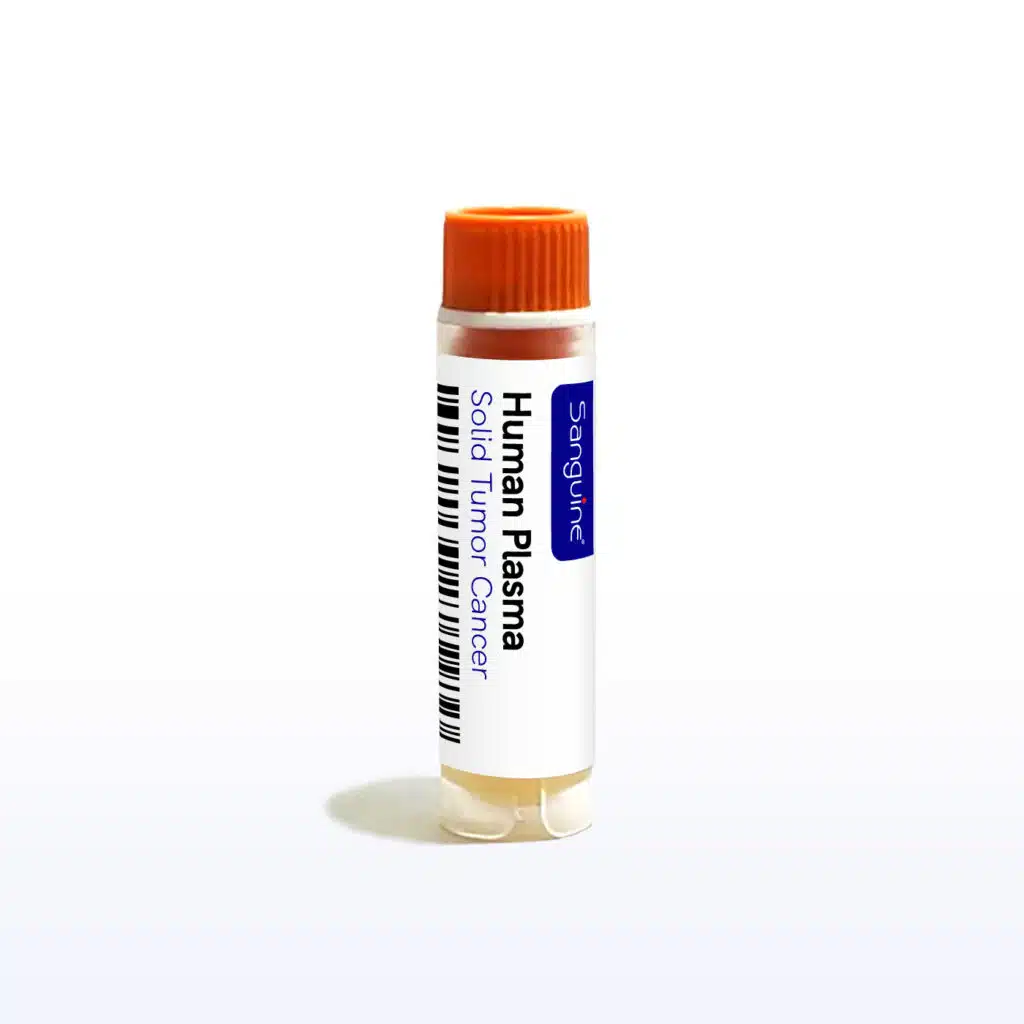
Solid Tumor Cancer Plasma
 Powered by Bioz
About:Human plasma from clinically confirmed solid tumour cancer donors, processed within one day of collection with controlled preanalytics. The accepted matrix for liquid biopsy: circulating tumour DNA, methylation and fragmentomics, extracellular vesicles and cell-free RNA, plus soluble immune mediators. Pan-tumour or single-indication cohorts, with serial collections where available.
About Solid Tumor Cancer Plasma
Solid Tumor Cancer Plasma for Liquid Biopsy and Tumour Immunology Research
Solid Tumor Cancer Plasma is collected from IRB-consented donors with clinically confirmed solid tumour malignancies and processed within one day of collection to preserve cell-free nucleic acids, cytokines, proteins and metabolites. Solid tumours are neoplastic diseases, and plasma is the single most important specimen in modern liquid biopsy: it is the compartment where circulating tumour DNA, cell-free RNA and tumour-derived vesicles are found, and where soluble immune mediators reflecting the tumour-host interaction are measured.
Why Plasma for Solid Tumour Cancer
The distinction between serum and plasma is not cosmetic in oncology. Clot formation causes leukocyte lysis that floods the sample with genomic DNA from white cells, diluting the tumour-derived fraction. Anticoagulated, promptly processed plasma is the accepted matrix for cell-free DNA work for exactly this reason.
- Circulating tumour DNA — tumour-derived fragments make up a variable and often very small fraction of total cell-free DNA. Preserving that fraction depends on the preanalytical variables this product controls: anticoagulant choice, prompt processing and controlled time to freeze.
- Tumour fraction scales with burden — ctDNA levels generally track disease burden, which is why plasma underpins research into minimal residual disease detection, treatment response monitoring and early relapse identification.
- Resistance mutation tracking — plasma allows emergence of resistance alterations under targeted therapy to be studied longitudinally without repeat tissue biopsy, which is often not feasible.
- Methylation and fragmentomics — tissue-of-origin inference from cell-free DNA methylation patterns and fragment-length profiles is a major current direction in multi-cancer early detection, and both require intact, high-quality plasma cfDNA.
- Extracellular vesicles and cell-free RNA — tumour-derived vesicle and cfRNA analysis is compromised in serum by platelet-derived contamination, making plasma the correct choice.
- Soluble immune mediators — cytokines, chemokines and soluble checkpoint proteins measured in plasma support research into checkpoint inhibitor response and immune-related toxicity, alongside the genomic readouts from the same aliquot.
Donor Stratification Available
- Primary tumour type and site, with pan-tumour or single-indication cohorts assembled to request
- Disease extent: localised, locally advanced, or metastatic; stage where recorded
- Treatment status and line of therapy: treatment-naive, chemotherapy, targeted therapy, checkpoint inhibitor, or post-resection
- Molecular and biomarker status where reported in the clinical record, including driver alterations and PD-L1
- Response status and progression events where documented
- Serial or longitudinal collections from the same donor where available
- Matched healthy controls available, age- and sex-matched and processed under identical SOPs
Product Features
- Research Use Only (RUO)
- Plasma collected from clinically confirmed solid tumour cancer donors
- Processed within one day of collection with controlled time to freeze
- Anticoagulant of choice available on request, including EDTA and cell-free DNA preservation tubes
- Double-spin processing available for cell-free nucleic acid applications
- IRB-approved protocols and informed consent
- Custom aliquot volumes available upon request; volumes reported per lot
De-identified Donor Data
- Verified solid tumour cancer diagnosis with primary site and histology where available
- Demographic data: age, sex assigned at birth, race/ethnicity
- Donor-reported medications, allergies and comorbidities
- Stage, molecular status and treatment history where reported
- Additional solid tumour cancer-specific metadata available on request
Applications
- Circulating tumour DNA detection, quantification and sequencing panel development
- Minimal residual disease and treatment response monitoring research
- Resistance mutation emergence and longitudinal tracking studies
- Cell-free DNA methylation and fragmentomics for multi-cancer early detection
- Extracellular vesicle and cell-free RNA isolation and characterisation
- Cytokine, chemokine and soluble checkpoint protein profiling
- Plasma proteomics, metabolomics and multiplex panel development
- Preanalytical variable and assay validation studies for liquid biopsy platforms
Other Solid Tumor Cancer Specimen Types
- Solid Tumor Cancer Serum
- Solid Tumor Cancer Whole Blood — for circulating tumour cell work
- Solid Tumor Cancer PBMC
- Solid Tumor Cancer Leukopak
Compliance and Quality Assurance
- IRB-approved and HIPAA-compliant protocols
- Electronic informed consent with 21 CFR Part 11 – compliant e-signatures
- Documentation support available for regulatory review
Ordering & Customization
Solid Tumor Cancer plasma is available in standard and custom volumes. For pricing, availability or a specific tumour-type or longitudinal cohort request, email learnmore@sanguinebio.com; please also contact us for international orders or documentation requirements to ensure compatibility with your country’s regulations. To browse availability across all disease states, visit our human plasma page.
Applications
- Immunology and translational research
- Biomarker discovery and validation
- Drug screening and assay development
- Vaccine and infectious disease research
Product Features
- Research Use Only (RUO), Plasma
- Sourced from screened, consented donors
- Processed under validated SOPs
- QC tested for purity, viability, and sterility
- Processed within 24 hours of collection
- IRB-approved protocols with electronic informed consent
Donor Metadata
- Verified diagnosis and clinical history
- Demographic data: age, sex assigned at birth, race/ethnicity
- Medication and treatment background when available
Compliance and Quality Assurance
- IRB-approved collections and standardized procedures
- 21 CFR Part 11-compliant e-consent system
- HIPAA-compliant data management
Ordering & Customization
Human Plasma are available in customizable aliquot sizes. For international orders or documentation needs, please contact learnmore@sanguinebio.com to confirm requirements and availability. We also work with multiple ordering platforms and distributors, learn more here.
Protocols & Documentation
-
Download
Plasma Isolation
Protocol for plasma separation from anticoagulated whole blood, including processing, storage, and traceability requirements.
-
Informed Consent Form (ICF)
Available upon request — confirms donor consent for research use and downstream commercialization.
Plasma
Where can I find your complete catalog?
You can find our full product catalog here.
How long can samples be stored?
Storage depends on sample type but often cryopreserved samples stored in liquid nitrogen can be stored for years.
What customization options are available?
Extensive customization is available. To discuss your project request a quote or email us at learnmore@sanguinebio.com.
Do you offer prospective collections?
Sanguine offers flexible prospective collection services tailored to fit your research. For more information and to request a quote, please see: our prospective biospecimen collection services page.
What is the turnaround time for custom collections?
Timelines depend on condition, sample type, and I/E criteria but we often start collection within 2 weeks of signed agreement.
Do you have samples in stock?
YES - we have in-stock inventory. You can also email us at learnmore@sanguinebio.com as we continually get new samples in our inventory.
What does unique donor mean?
Each sample from a different individual - Unique donor means each sample comes from a different person, ensuring biological diversity in your study.
Are samples collected under IRB-approved protocols?
YES - "IRB-approved collection protocols" and IRB approval documentation available upon request. Sanguine utilizes two internationally-recognized IRBs (Advarra and WCG IRB) for review and approval.
Frequently Asked Questions
Ask a Question
Pair with a Healthy Control
Match your Solid Tumor Cancer Plasma with normal donor samples for comparison
Healthy Plasma
207 In Stock View InventoryNeed a custom Plasma cohort?
Our scientific team can scope prospective collections with donor-specific I/E criteria, typically starting within 2 weeks of agreement.