New Research Points the Way Towards Mechanism of Action, Receptor for MS Copolymer Drugs

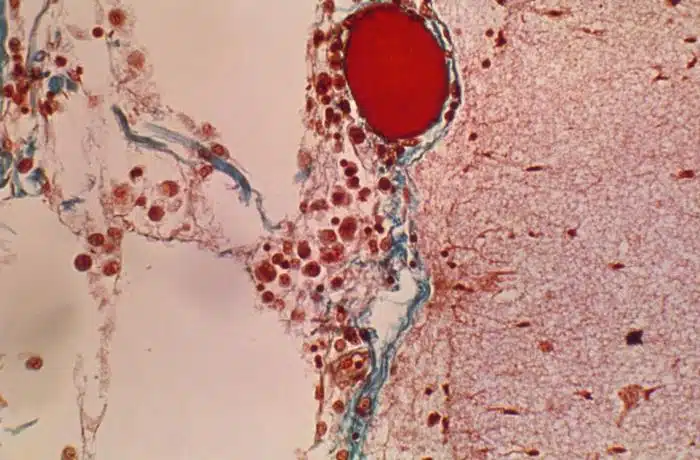
In multiple sclerosis (MS), autoreactive immune cells attack the myelin sheath on axons in the brain and spinal cord. This causes inflammation and myelin loss.
The MS drug Copaxone is a copolymer of glutamic acid, lysine, alanine, and tyrosine (YEAK). Researchers think it blocks myelin attack by stopping MBP self-antigen presentation to autoreactive T cells. A related copolymer swaps in phenylalanine for glutamic acid (YFAK). It was designed based on MBP binding to class II MHC.
However, researchers know little about these drugs’ molecular targets or mechanisms of action. In vitro studies suggest a role for IL-10 secretion by B cells, or by regulatory and Th2-CD4+ T cells. Recent data show that YEAK and YFAK also affect macrophages and dendritic cells independent of MHC — but the receptor behind these effects is still unknown.
In a recent article in The Journal of Immunology, Koenig and colleagues isolated YEAK- and YFAK-interacting proteins from macrophage lysates. They identified the structures needed for the copolymers to interact with cells.
Identifying Copolymer-Interacting Proteins
The researchers incubated RAW264.7 macrophage lysate with biotinylated copolymers. They recovered the copolymers using avidin-coated beads, then identified the attached cellular proteins using mass spectroscopy. Three proteins stood out:
- gp96 — a frequent hit with known surface expression and a role in immune signaling. Cell surface gp96 directly activates innate immune cell cytokine production, acts as a class I MHC antigen chaperone, and has been proposed as a Th2-specific co-stimulatory molecule.
- CD91 — implicated in gp96 stimulation of antigen-presenting cells (APC), and involved in signaling and endocytosis of several ligands.
- App — a surface protein that interacts with YEAK and YFAK. App is a β-amyloid species precursor linked to Alzheimer’s disease, but its role on myeloid cells isn’t well understood.
Macrophages secrete CCL22, a chemoattractant for regulatory and Th2 T cells, in response to YEAK or YFAK. Koenig et al. tested this response in wild-type cells versus cells lacking gp96, CD91, or App, and found no drop in any of the knock-out lines. This means that although gp96, CD91, and App interact with YEAK and YFAK, none of them drive cell signaling for these copolymers.
Copolymers Bind Through Electrostatic Interaction
Lysine gives these copolymers a positive charge. This led Koenig et al. to propose that cellular binding might come from electrostatic attraction rather than shape. Testing this, they found that raising the salt concentration reduced protein interactions with the biotinylated copolymer. Using cell lines that lack specific sulfation enzymes, they then showed that YEAK and YFAK bind to negatively charged heparan sulfate proteoglycans (HSPG).
This interaction matters functionally: RAW264.7 cells stimulated with YFAK did not produce CCL22 when heparin sulfate — a similarly shaped competitor of HSPG — was also present.
HSPG are glycoproteins with one or more attached heparin sulfate (HS) chains. Membrane HSPG act as co-receptors for many growth factors, so they could shape YEAK’s cellular effects in two ways:
- By activating cell signaling through an associated receptor
- By blocking signaling from that receptor’s natural ligand
For example, YEAK binding to HS — a co-receptor for gp96 binding to CD91 — might change how cells take up gp96-peptide complexes through CD91. This could affect self-antigen cross-presentation and T cell activation by APCs.
HSPG can also act as receptors for both constant and ligand-triggered endocytosis. YEAK’s interaction with HSPG might help the drug get taken up and delivered to targets inside the cell, similar to cationic cell-penetrating peptides. Supporting this idea, gene ontology analysis found “RNA binding” as a molecular function among the YEAK- and YFAK-interacting proteins in this study — hinting at a possible site of action inside the cytoplasm or nucleus.
What’s Next
There is still much work to do to pin down the receptors and molecular mechanisms behind these copolymers, and to guide the design of future immune-modulating drugs. This study gives future research a solid foundation: a list of 222 copolymer-interacting proteins, and the identification of sulfated glycosaminoglycans as the key structures behind these copolymers’ effects on innate immune cells.
Further Reading:
Amino acid copolymers that alleviate experimental autoimmune encephalomyelitis in vivo interact with heparan sulfates and glycoprotein 96 in APCs. Koenig PA, Spooner E, Kawamoto N, Strominger JL, Ploegh HL. J Immunol. 2013 Jul 1; 191(1):XXX. Epub ahead of print 2013 June 5.
Heparan sulphate proteoglycans fine-tune mammalian physiology. Bishop JR, Schuksz M, Esko JD. Nature. 2007 Apr 26; 446(7139):1030-7.
Interactions between heparan sulfate and proteins – design and functional implications. Lindahl U, Li JP. Int Rev Cell Mol Biol. 2009; 276:105-59.
Cell surface heparan sulfate proteoglycans influence MHC class II-restricted antigen presentation. Léonetti M, Gadzinski A, Moine G. J Immunol. 2010 Oct 1; 185(7):3847-56.