Highlight: How TNF knocks out Tregs!
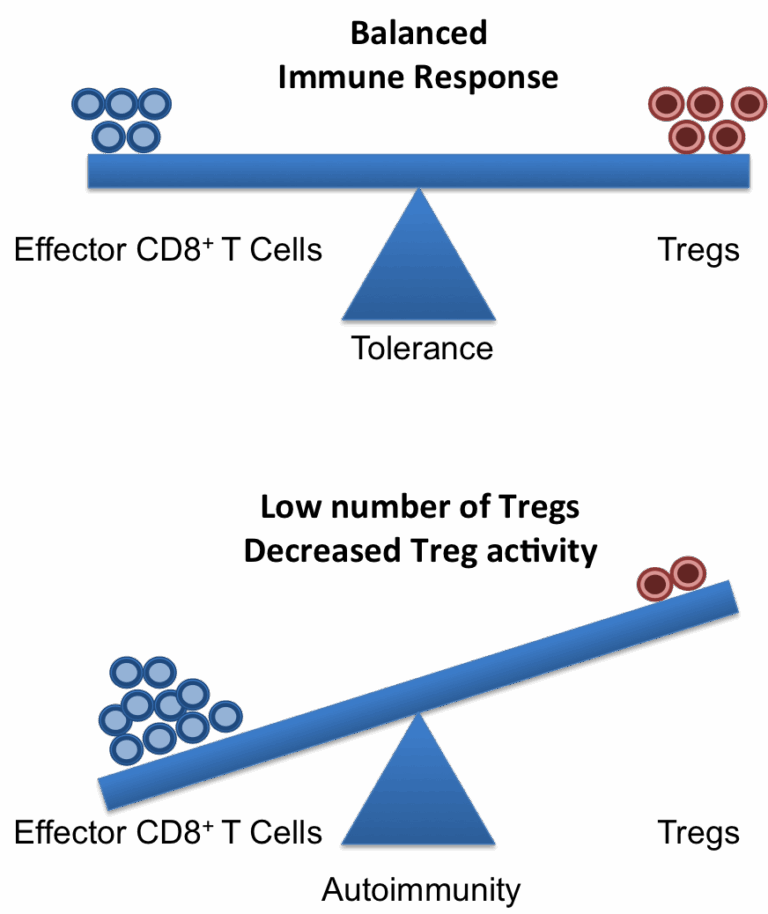
Balancing the Immune Response
A healthy, functional immune system needs a careful balance of pro- and anti-inflammatory signals. It is important to mount a strong immune response against pathogens, but it is just as important to dial that response back down once the pathogen is cleared, returning the immune system to a calm baseline. When this balance breaks down, the result can be a chronic, overwhelming infection on one hand, or an autoimmune response that never shuts off on the other.
The Role of Regulatory T Cells
A key player in controlling excessive immune responses is the regulatory T (Treg) cell. Tregs inhibit the activity of other immune cells, and their importance is clear from what happens when they are missing: mice or humans lacking Tregs develop widespread, lethal autoimmune disease.
Beyond several surface markers, Tregs are best identified by expression of the transcription factor FoxP3. This factor is essential for Treg function, and artificially expressing it in other T cells can give them regulatory potential. So a T cell generally needs to express FoxP3 to have regulatory potential (Buckner; Josefowicz et al.).
However, researchers have long known that in many autoimmune diseases, FoxP3+ Tregs can be found in large numbers at sites of inflammation, yet show little or no regulatory activity. Until recently, this observation was poorly understood (Buckner; Josefowicz et al.).
How TNF Disables FoxP3
In the March 2013 issue of Nature Medicine, Nie and colleagues shed new light on the mechanism that impairs Treg function at sites of inflammation. Studying Treg cells from rheumatoid arthritis (RA) patients, the authors showed that phosphorylation of FoxP3 at serine position 418 (S418) is required for its regulatory action. Without this specific phosphorylation, the Treg cell loses its suppressive ability.
FoxP3 S418 in Tregs is normally phosphorylated, which is why Tregs are regulatory by default. The authors show that the enzyme “protein phosphatase 1” (PP1) can strip away this S418 phosphorylation. Notably, the cytokine TNF increases PP1 expression in Tregs in a dose-dependent way, which in turn de-phosphorylates FoxP3 S418.
To confirm this mechanism, the authors tested Treg cells with a mutant FoxP3 that replaced serine 418 with alanine. These mutant cells kept their suppressive ability even in the presence of TNF, confirming how important S418 phosphorylation is. This links the pro-inflammatory signal (TNF) to a specific internal effect in Tregs (de-phosphorylation of S418) that explains the observed loss of Treg regulatory function.
Therapeutic Implications
The authors also demonstrated real therapeutic potential from this discovery. They monitored RA patients treated with the TNF-blocking antibody infliximab, and found that Tregs from these patients’ PBMCs restored S418 phosphorylation and regained regulatory potential.
This is the second known case of post-transcriptional regulation of FoxP3 affecting Treg function. Deacetylation of FoxP3 has previously been linked to impaired Treg function (Tao et al.). The work of Nie et al. adds mechanistic detail to earlier reports on the negative effect of TNF on Tregs (Valencia et al.; Zanin-Zhorov et al.).
Given how central TNF is to inflammation generally, this mechanism likely applies to many, if not all, cases of ongoing inflammation where Treg function is impaired. The anti-TNF antibody results in RA also suggest similar therapeutic potential in other autoimmune diseases. This report is likely to drive further research in this direction, aiding the development of better treatments for patients with autoimmune diseases.
References:
Bromberg, J., 2013. TNF-α trips up Treg cells in rheumatoid arthritis. Nat Med, 19(3), pp.269–270.
Buckner, J.H., 2010. Mechanisms of impaired regulation by CD4(+)CD25(+)FOXP3(+) regulatory T cells in human autoimmune diseases. Nat Rev Immunol, 10(12), pp.849–859.
Josefowicz, S.Z., Lu, L.-F. & Rudensky, A.Y., 2012. Regulatory T cells: mechanisms of differentiation and function. Annual Review of Immunology, 30, pp.531–564.
Nie, H. et al., 2013. Phosphorylation of FOXP3 controls regulatory T cell function and is inhibited by TNF-α in rheumatoid arthritis. Nat Med, 19(3), pp.322–328.
Tao, R. et al., 2007. Deacetylase inhibition promotes the generation and function of regulatory T cells. Nature Medicine, 13(11), pp.1299–1307.
Valencia, X. et al., 2006. TNF downmodulates the function of human CD4+CD25hi T-regulatory cells. Blood, 108(1), pp.253–261.
Zanin-Zhorov, A. et al., 2010. Protein kinase C-theta mediates negative feedback on regulatory T cell function. Science, 328(5976), pp.372–376.