
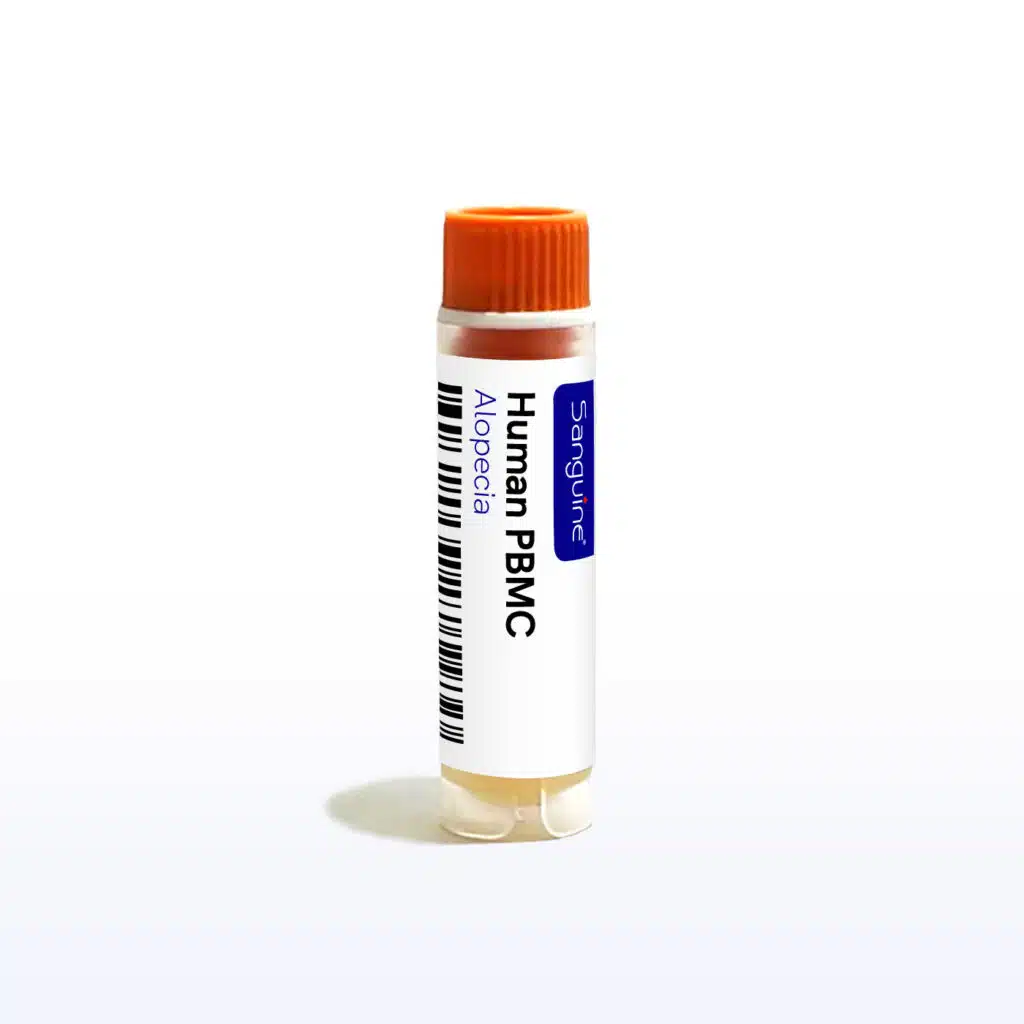
Alopecia PBMC
 Powered by Bioz
About:Alopecia PBMC — cryopreserved PBMCs from consented donors with clinically confirmed alopecia, scoped primarily to alopecia areata. Ideal for CD8+ T-cell and NKG2D profiling, JAK-STAT signalling studies, and subtype-stratified immunology. Subtype is annotated because mechanisms differ: alopecia areata is autoimmune, androgenetic alopecia is androgen-driven.
About Alopecia PBMC
Alopecia PBMC for Autoimmune Hair Loss Research
Alopecia PBMC samples are cryopreserved peripheral blood mononuclear cells isolated from IRB-consented donors with a clinically confirmed diagnosis of alopecia. Cells are processed within 24 hours of collection and cryopreserved in CryoStor® CS10. The cohort is built primarily around alopecia areata, the immune-mediated form of hair loss and the subtype most often studied in translational dermatology and immunology programmes; other subtypes are available and are annotated at the donor level.
Why Subtype Matters: The Immunobiology of Alopecia Areata
“Alopecia” is a descriptive term rather than a single disease, and the mechanisms behind its subtypes are genuinely different. Peripheral blood is most informative for the immune-mediated forms:
- Alopecia areata is autoimmune. Collapse of hair-follicle immune privilege permits CD8+ T cells, including an NKG2D-expressing cytotoxic population, to attack the anagen follicle, producing the characteristic peribulbar lymphocytic infiltrate
- Interferon-gamma and IL-15 signalling sustain that attack through the JAK-STAT pathway — the mechanistic basis for the clinical activity of JAK inhibitors in alopecia areata
- Genetic risk maps to HLA class II and to loci shared with other autoimmune conditions; alopecia areata frequently co-occurs with thyroid autoimmunity and vitiligo
- Androgenetic alopecia is not autoimmune — it is progressive follicular miniaturisation driven by androgen signalling on a polygenic background, and should not be pooled with alopecia areata in immune studies
- Why PBMC: circulating T-cell subsets, NK and NK-like populations, and cytokine responses can be immunophenotyped, sorted, stimulated, and sequenced from the same donor material
- The cryopreserved format supports batched, longitudinal, or multi-site experiments on one defined donor set
Donor Stratification Available
- Subtype: alopecia areata, alopecia totalis, alopecia universalis, or androgenetic alopecia
- Extent and pattern of hair loss, including scalp-limited versus body involvement
- Disease duration and relapsing versus stable or chronic course
- Treatment status: treatment-naive, topical or intralesional corticosteroids, or JAK inhibitor therapy
- Coexisting autoimmune diagnoses such as thyroid disease or vitiligo
- Age, sex assigned at birth, and race/ethnicity
- Matched healthy controls available
Product Features
- Research Use Only (RUO), cryopreserved PBMCs
- Clinically confirmed alopecia donors, with subtype annotated where documented
- Available in cell counts ranging from 5 million to 2 billion
- Processed within 24 hours of collection
- Stored using CryoStor® CS10 freezing media
- IRB-approved protocols and electronic informed consent
- Screen LeukoLot™ available prior to bulk orders
De-identified Donor Data
- Verified alopecia diagnosis, with subtype where documented
- Donor demographics: age, sex assigned at birth, race/ethnicity
- Self-reported allergies and infectious disease history
- Medication history and additional alopecia-specific clinical data available upon request
Applications
- Immunophenotyping of CD8+ and CD4+ T-cell subsets in alopecia areata
- Characterisation of NK and NKG2D+ cytotoxic populations
- JAK-STAT pathway signalling and JAK-inhibitor mechanism-of-action studies
- Interferon-gamma and IL-15 stimulation and cytokine release assays
- Bulk and single-cell RNA sequencing of circulating immune cells
- T-cell receptor repertoire analysis
- Biomarker discovery for disease activity and treatment response
- Comparative studies across alopecia subtypes and against matched healthy controls
Other Alopecia Specimen Types
- Alopecia Leukopak — apheresis-derived, for high cell-number requirements
- Alopecia Whole Blood — fresh, for same-day cellular assays and germline genotyping
- Alopecia Plasma and Alopecia Serum — for circulating cytokine and protein work
- Alopecia Bulk Plasma — larger volumes for assay development
- Alopecia Skin Punch Biopsy — lesional tissue for follicular histology and infiltrate analysis
Compliance and Quality Assurance
- IRB-approved collections and protocols
- 21 CFR Part 11-compliant e-consent system
- HIPAA-compliant donor data protection
Ordering & Customization
Alopecia PBMC samples are shipped on dry ice and available in custom aliquots. For pricing, international orders, or regulatory requirements, please contact learnmore@sanguinebio.com to confirm documentation and compliance needs. To browse healthy-donor controls and the full specimen range, see our human PBMCs collection.
Applications
- Immunology and translational research
- Biomarker discovery and validation
- Drug screening and assay development
- Vaccine and infectious disease research
Product Features
- Research Use Only (RUO), PBMC
- Sourced from screened, consented donors
- Processed under validated SOPs
- QC tested for purity, viability, and sterility
- Processed within 24 hours of collection
- IRB-approved protocols with electronic informed consent
Donor Metadata
- Verified diagnosis and clinical history
- Demographic data: age, sex assigned at birth, race/ethnicity
- Medication and treatment background when available
Compliance and Quality Assurance
- IRB-approved collections and standardized procedures
- 21 CFR Part 11-compliant e-consent system
- HIPAA-compliant data management
Ordering & Customization
Human PBMC are available in customizable aliquot sizes. For international orders or documentation needs, please contact learnmore@sanguinebio.com to confirm requirements and availability. We also work with multiple ordering platforms and distributors, learn more here.
Protocols & Documentation
-
Download
PBMC Isolation from Whole Blood
Standard operating procedure for isolating peripheral blood mononuclear cells from whole blood using density-gradient separation.
-
Download
Immune Cell Isolation
Guidelines for isolating immune cell populations with validated enrichment steps, purity checkpoints, and documentation.
-
Download
Choosing the Right PBMC Configuration
Reference guide comparing PBMC formats, cryopreservation states, and study-fit recommendations for your application.
-
Download
Thawing Cryopreserved PBMC
Validated thawing protocol to recover viable cryopreserved PBMCs while minimizing activation and loss of function.
-
Informed Consent Form (ICF)
Available upon request — confirms donor consent for research use and downstream commercialization.
PBMC
Where can I find your complete catalog?
You can find our full product catalog here.
How long can samples be stored?
Storage depends on sample type but often cryopreserved samples stored in liquid nitrogen can be stored for years.
What customization options are available?
Extensive customization is available. To discuss your project request a quote or email us at learnmore@sanguinebio.com.
Do you offer prospective collections?
Sanguine offers flexible prospective collection services tailored to fit your research. For more information and to request a quote, please see: our prospective biospecimen collection services page.
What is the turnaround time for custom collections?
Timelines depend on condition, sample type, and I/E criteria but we often start collection within 2 weeks of signed agreement.
Do you have samples in stock?
YES - we have in-stock inventory. You can also email us at learnmore@sanguinebio.com as we continually get new samples in our inventory.
What does unique donor mean?
Each sample from a different individual - Unique donor means each sample comes from a different person, ensuring biological diversity in your study.
Are samples collected under IRB-approved protocols?
YES - "IRB-approved collection protocols" and IRB approval documentation available upon request. Sanguine utilizes two internationally-recognized IRBs (Advarra and WCG IRB) for review and approval.
Frequently Asked Questions
Ask a Question
Pair with a Healthy Control
Match your Alopecia PBMC with normal donor samples for comparison
Healthy Donor PBMCs
703 In Stock View InventoryNeed a custom PBMC cohort?
Our scientific team can scope prospective collections with donor-specific I/E criteria, typically starting within 2 weeks of agreement.