
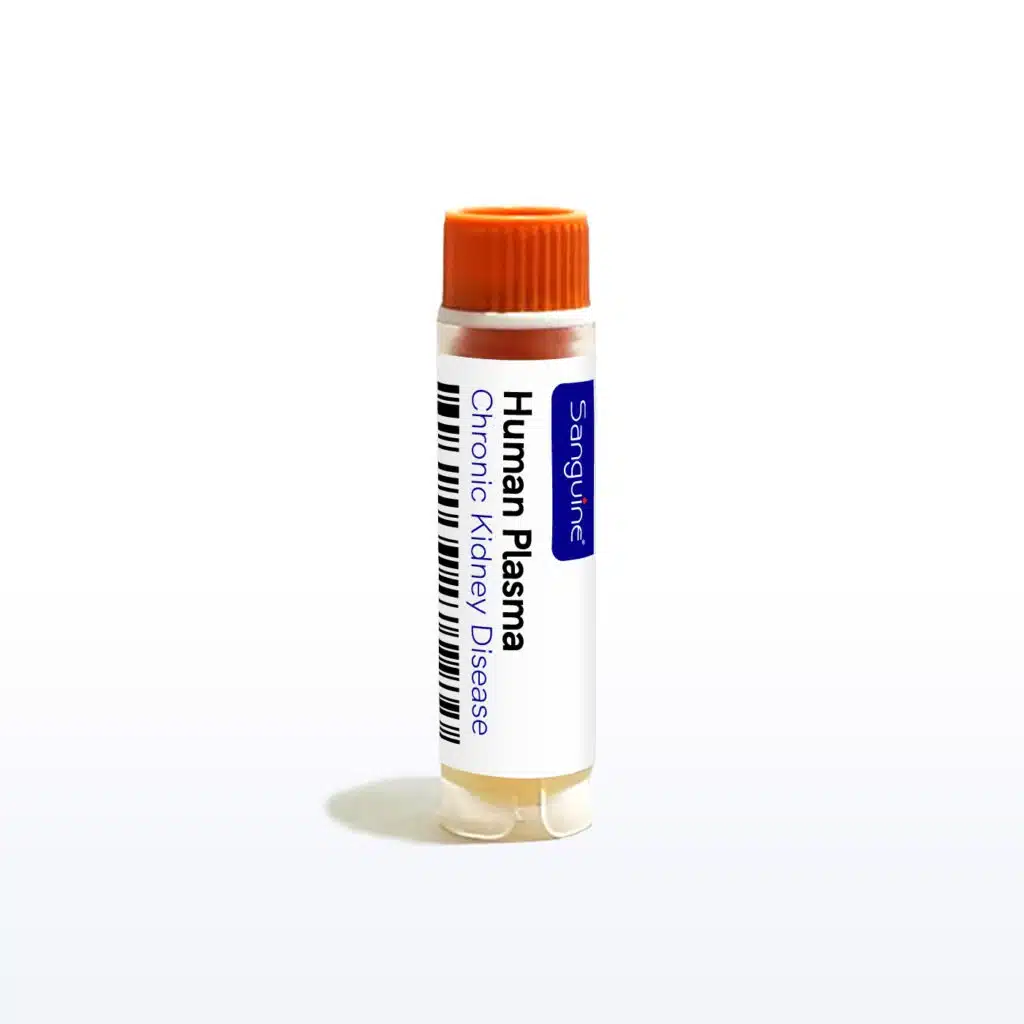
Chronic Kidney Disease Plasma
 Powered by Bioz
About:Human plasma from consented donors with clinically confirmed chronic kidney disease, processed within one day of collection. Supports research on uremic retention solutes, the FGF23/mineral-bone axis, anemia of CKD and the inflammation linking CKD to cardiovascular risk. Stratifiable by KDIGO eGFR stage, dialysis status and primary etiology.
About Chronic Kidney Disease Plasma
Chronic Kidney Disease Plasma for Nephrology and Cardiometabolic Research
Chronic Kidney Disease (CKD) Plasma is collected from IRB-consented donors with a clinically confirmed CKD diagnosis and processed within one day of collection to preserve cytokines, proteins and metabolites. CKD is a progressive loss of kidney function driven most often by diabetes, hypertension or primary glomerular disease — not by autoimmunity — and the resulting retention of solutes reshapes systemic metabolism, mineral handling and vascular biology. This plasma supports biomarker discovery, disease-progression research and therapeutic development.
Why Plasma for Chronic Kidney Disease
CKD is defined and staged by what circulates: reduced glomerular filtration means the plasma compartment directly reflects the failing organ. Anticoagulated plasma is the preferred matrix wherever platelet activation and clot formation would distort the analyte of interest.
- Filtration and injury markers — creatinine, urea and cystatin C are measured directly in plasma, allowing eGFR-based staging to be reconciled against experimental markers of tubular injury.
- Uremic retention solutes — protein-bound solutes such as indoxyl sulfate and p-cresyl sulfate accumulate as filtration falls and are studied as drivers of vascular and cardiac injury; they require a well-controlled, promptly processed matrix.
- Mineral and bone axis — FGF23, PTH, phosphate and vitamin D metabolites shift early and progressively in CKD, and are central to CKD-mineral bone disorder research.
- Anemia axis — erythropoietin, hepcidin and iron indices explain the anemia of CKD and underpin research on HIF-stabilising and ESA therapies.
- Chronic low-grade inflammation — IL-6, TNF receptors and CRP are consistently elevated as function declines and link CKD to its dominant cardiovascular risk.
- Plasma-specific assays — cell-free DNA, coagulation and complement analytes, and untargeted metabolomics are compromised in serum by clotting-cascade activation and platelet release, making EDTA or citrate plasma the correct choice.
Donor Stratification Available
- KDIGO eGFR category (G1 through G5) and albuminuria category where recorded
- Dialysis status: non-dialysis CKD, hemodialysis, peritoneal dialysis, or post-transplant
- Primary etiology: diabetic kidney disease, hypertensive nephrosclerosis, glomerulonephritis, polycystic kidney disease
- Treatment status: RAAS inhibitor, SGLT2 inhibitor, phosphate binder, erythropoiesis-stimulating agent, or treatment-naive
- Cardiometabolic comorbidities: type 2 diabetes, hypertension, heart failure, obesity
- Matched healthy controls available, age- and sex-matched on request
Product Features
- Research Use Only (RUO)
- Chronic Kidney Disease plasma collected from clinically confirmed donors
- Processed within one day of collection
- Anticoagulant of choice (EDTA, sodium citrate, heparin) available on request
- IRB-approved protocols and informed consent
- Custom aliquot volumes available upon request; volumes and lot values reported per lot
De-identified Donor Data
- Verified CKD diagnosis
- Demographic data: age, sex assigned at birth, race/ethnicity
- Donor-reported medications, allergies and comorbidities
- Laboratory values including eGFR and creatinine where available
- Additional CKD-specific metadata available on request
Applications
- Biomarker discovery and validation for CKD progression and prognosis
- Uremic solute and untargeted metabolomics studies
- CKD-mineral bone disorder research (FGF23, PTH, phosphate axis)
- Anemia of CKD research including hepcidin and iron regulation
- Cytokine and inflammation profiling linking CKD to cardiovascular risk
- Proteomic and multiplex immunoassay panel development
- Cell-free DNA and coagulation or complement analyte studies
- Therapeutic response and drug-development research
Other Chronic Kidney Disease Specimen Types
- Chronic Kidney Disease Serum
- Chronic Kidney Disease Whole Blood
- Chronic Kidney Disease PBMC
- Chronic Kidney Disease Leukopak
- Diabetic Nephropathy Whole Blood
Compliance and Quality Assurance
- IRB-approved and HIPAA-compliant protocols
- Electronic informed consent with 21 CFR Part 11 – compliant e-signatures
- Documentation support available for regulatory review
Ordering & Customization
Chronic Kidney Disease plasma is available in standard and custom volumes. For pricing, availability or a specific stratification request, email learnmore@sanguinebio.com; please also contact us for international orders or documentation requirements to ensure compatibility with your country’s regulations. To browse availability across all disease states, visit our human plasma page.
Applications
- Immunology and translational research
- Biomarker discovery and validation
- Drug screening and assay development
- Vaccine and infectious disease research
Product Features
- Research Use Only (RUO), Plasma
- Sourced from screened, consented donors
- Processed under validated SOPs
- QC tested for purity, viability, and sterility
- Processed within 24 hours of collection
- IRB-approved protocols with electronic informed consent
Donor Metadata
- Verified diagnosis and clinical history
- Demographic data: age, sex assigned at birth, race/ethnicity
- Medication and treatment background when available
Compliance and Quality Assurance
- IRB-approved collections and standardized procedures
- 21 CFR Part 11-compliant e-consent system
- HIPAA-compliant data management
Ordering & Customization
Human Plasma are available in customizable aliquot sizes. For international orders or documentation needs, please contact learnmore@sanguinebio.com to confirm requirements and availability. We also work with multiple ordering platforms and distributors, learn more here.
Protocols & Documentation
-
Download
Plasma Isolation
Protocol for plasma separation from anticoagulated whole blood, including processing, storage, and traceability requirements.
-
Informed Consent Form (ICF)
Available upon request — confirms donor consent for research use and downstream commercialization.
Plasma
Where can I find your complete catalog?
You can find our full product catalog here.
How long can samples be stored?
Storage depends on sample type but often cryopreserved samples stored in liquid nitrogen can be stored for years.
What customization options are available?
Extensive customization is available. To discuss your project request a quote or email us at learnmore@sanguinebio.com.
Do you offer prospective collections?
Sanguine offers flexible prospective collection services tailored to fit your research. For more information and to request a quote, please see: our prospective biospecimen collection services page.
What is the turnaround time for custom collections?
Timelines depend on condition, sample type, and I/E criteria but we often start collection within 2 weeks of signed agreement.
Do you have samples in stock?
YES - we have in-stock inventory. You can also email us at learnmore@sanguinebio.com as we continually get new samples in our inventory.
What does unique donor mean?
Each sample from a different individual - Unique donor means each sample comes from a different person, ensuring biological diversity in your study.
Are samples collected under IRB-approved protocols?
YES - "IRB-approved collection protocols" and IRB approval documentation available upon request. Sanguine utilizes two internationally-recognized IRBs (Advarra and WCG IRB) for review and approval.
Frequently Asked Questions
Ask a Question
Pair with a Healthy Control
Match your Chronic Kidney Disease Plasma with normal donor samples for comparison
Healthy Plasma
207 In Stock View InventoryNeed a custom Plasma cohort?
Our scientific team can scope prospective collections with donor-specific I/E criteria, typically starting within 2 weeks of agreement.