
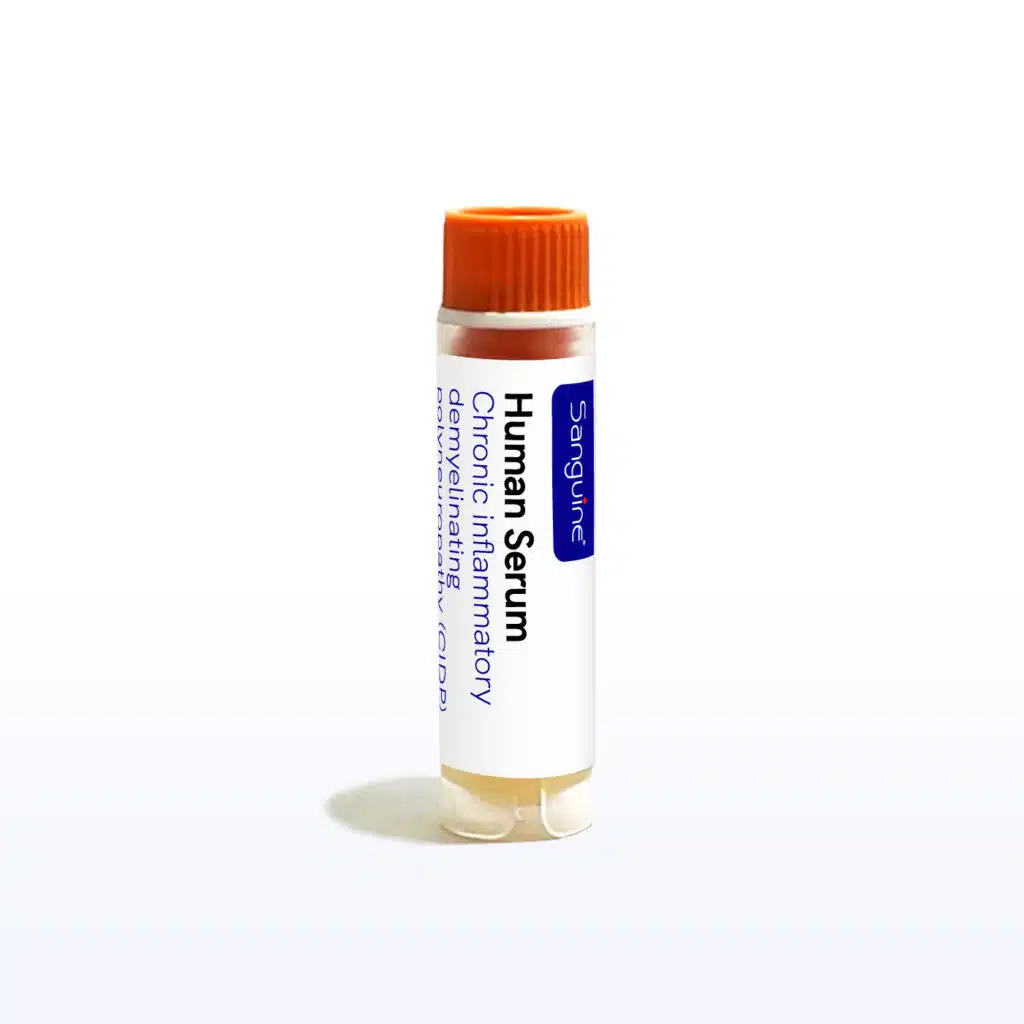
CIDP Serum
 Powered by Bioz
About:CIDP Serum — human serum from consented donors with clinically confirmed chronic inflammatory demyelinating polyradiculoneuropathy, processed and frozen within 24 hours of collection. Serum is the matrix for nodal and paranodal autoantibody detection (NF155, contactin-1, Caspr1), IgG subclass work, complement activity, and neurofilament light chain as a marker of axonal injury. Donors can be stratified by CIDP variant, antibody status and treatment.
About CIDP Serum
Human CIDP Serum for Autoimmune Peripheral Neuropathy Research
Our CIDP Serum is sourced from IRB-consented donors clinically diagnosed with chronic inflammatory demyelinating polyradiculoneuropathy (CIDP, also referred to as chronic inflammatory demyelinating polyneuropathy). Each sample is processed and frozen within 24 hours of collection to ensure consistency and high quality for immunological and neurological research. CIDP is an immune-mediated autoimmune disorder of the peripheral nervous system in which the immune system attacks myelin and the nodal region of peripheral nerves, producing progressive or relapsing weakness and sensory loss with demyelinating features on nerve conduction study.
Why Serum for CIDP Research
- The therapeutic response to plasma exchange and to intravenous immunoglobulin is itself evidence that a circulating humoral factor contributes to CIDP. Serum is the specimen in which that factor is sought.
- A defined subset of patients previously grouped under CIDP carry autoantibodies against nodal and paranodal proteins — neurofascin-155, contactin-1 and Caspr1 — and are now classified separately as autoimmune nodopathies. These antibodies are typically of the IgG4 subclass, are detected in serum, and are associated with a poor response to intravenous immunoglobulin.
- IgG subclass determination matters mechanistically: IgG4 antibodies do not fix complement and act instead by disrupting protein-protein interactions, which distinguishes nodopathy biology from complement-dependent demyelination. This distinction is made serologically.
- Complement activation contributes to macrophage-mediated demyelination in CIDP, and complement components and activation products are measurable in serum — relevant as complement-directed and FcRn-targeted therapeutic approaches are investigated in this disease.
- Neurofilament light chain in serum is an established marker of axonal injury across neurological disease and provides a means of assessing the axonal component of CIDP, which is the principal driver of irreversible disability.
- Serum is anticoagulant-free, which is required for the autoantibody immunoassays, cell-based assays and immunohistochemical binding studies used to characterise neuropathy-associated antibodies.
Donor Stratification Available
- CIDP variant: typical CIDP, distal, multifocal, focal, motor or sensory presentation where classified
- Nodal and paranodal autoantibody status where tested, including neurofascin-155 and contactin-1
- Disability and disease activity by INCAT or comparable instrument where recorded
- Treatment status: treatment-naive, on intravenous or subcutaneous immunoglobulin, on corticosteroids, on plasma exchange, on other immunosuppressant, or in washout
- Treatment responsiveness: immunoglobulin-responsive versus refractory
- Disease course (progressive versus relapsing) and disease duration
- Matched healthy controls available
Product Features
- Collected from clinically confirmed CIDP donors
- Research Use Only (RUO)
- Processed and frozen within 24 hours of collection
- IRB-approved protocols with documented consent
- Custom aliquot volumes available upon request
- Larger volumes and serial collections available by request
De-identified Donor Data
- Diagnosis confirmation
- Age, sex assigned at birth, and race/ethnicity
- Donor-reported medical history and comorbidities
- Treatment history and disease course where available
- Additional CIDP-specific metadata available on request
Applications
- Nodal and paranodal autoantibody detection and assay development
- IgG subclass and antibody characterisation studies
- Complement activation and complement-directed therapeutic research
- Neurofilament light chain measurement for axonal injury research
- Cell-based and tissue binding assays using patient serum as the antibody source
- Serum cytokine and inflammatory protein profiling
- Biomarker discovery for treatment response and immunoglobulin dependence
- Therapeutic candidate screening and target validation in autoimmune neuropathy
Other CIDP Specimen Types
Compliance and Quality Assurance
- IRB-approved and HIPAA-compliant protocols
- Electronic informed consent with 21 CFR Part 11 – compliant e-signatures
- Documentation support available for regulatory review
Ordering & Customization
CIDP serum is available in standard and custom volumes. For pricing, availability, or to discuss a cohort stratified by variant or antibody status, email learnmore@sanguinebio.com. For international orders or documentation requirements, please contact us to ensure compatibility with your country’s regulations. To browse serum across all disease states and healthy donors, visit our human serum page.
Applications
- Immunology and translational research
- Biomarker discovery and validation
- Drug screening and assay development
- Vaccine and infectious disease research
Product Features
- Research Use Only (RUO), Serum
- Sourced from screened, consented donors
- Processed under validated SOPs
- QC tested for purity, viability, and sterility
- Processed within 24 hours of collection
- IRB-approved protocols with electronic informed consent
Donor Metadata
- Verified diagnosis and clinical history
- Demographic data: age, sex assigned at birth, race/ethnicity
- Medication and treatment background when available
Compliance and Quality Assurance
- IRB-approved collections and standardized procedures
- 21 CFR Part 11-compliant e-consent system
- HIPAA-compliant data management
Ordering & Customization
Human Serum are available in customizable aliquot sizes. For international orders or documentation needs, please contact learnmore@sanguinebio.com to confirm requirements and availability. We also work with multiple ordering platforms and distributors, learn more here.
Protocols & Documentation
-
Download
Serum Isolation
Protocol for serum preparation from whole blood, including collection handling, clarification, and quality documentation.
-
Informed Consent Form (ICF)
Available upon request — confirms donor consent for research use and downstream commercialization.
Serum
Where can I find your complete catalog?
You can find our full product catalog here.
How long can samples be stored?
Storage depends on sample type but often cryopreserved samples stored in liquid nitrogen can be stored for years.
What customization options are available?
Extensive customization is available. To discuss your project request a quote or email us at learnmore@sanguinebio.com.
Do you offer prospective collections?
Sanguine offers flexible prospective collection services tailored to fit your research. For more information and to request a quote, please see: our prospective biospecimen collection services page.
What is the turnaround time for custom collections?
Timelines depend on condition, sample type, and I/E criteria but we often start collection within 2 weeks of signed agreement.
Do you have samples in stock?
YES - we have in-stock inventory. You can also email us at learnmore@sanguinebio.com as we continually get new samples in our inventory.
What does unique donor mean?
Each sample from a different individual - Unique donor means each sample comes from a different person, ensuring biological diversity in your study.
Are samples collected under IRB-approved protocols?
YES - "IRB-approved collection protocols" and IRB approval documentation available upon request. Sanguine utilizes two internationally-recognized IRBs (Advarra and WCG IRB) for review and approval.
Frequently Asked Questions
Ask a Question
Pair with a Healthy Control
Match your CIDP Serum with normal donor samples for comparison
Healthy Serum
View InventoryNeed a custom Serum cohort?
Our scientific team can scope prospective collections with donor-specific I/E criteria, typically starting within 2 weeks of agreement.