
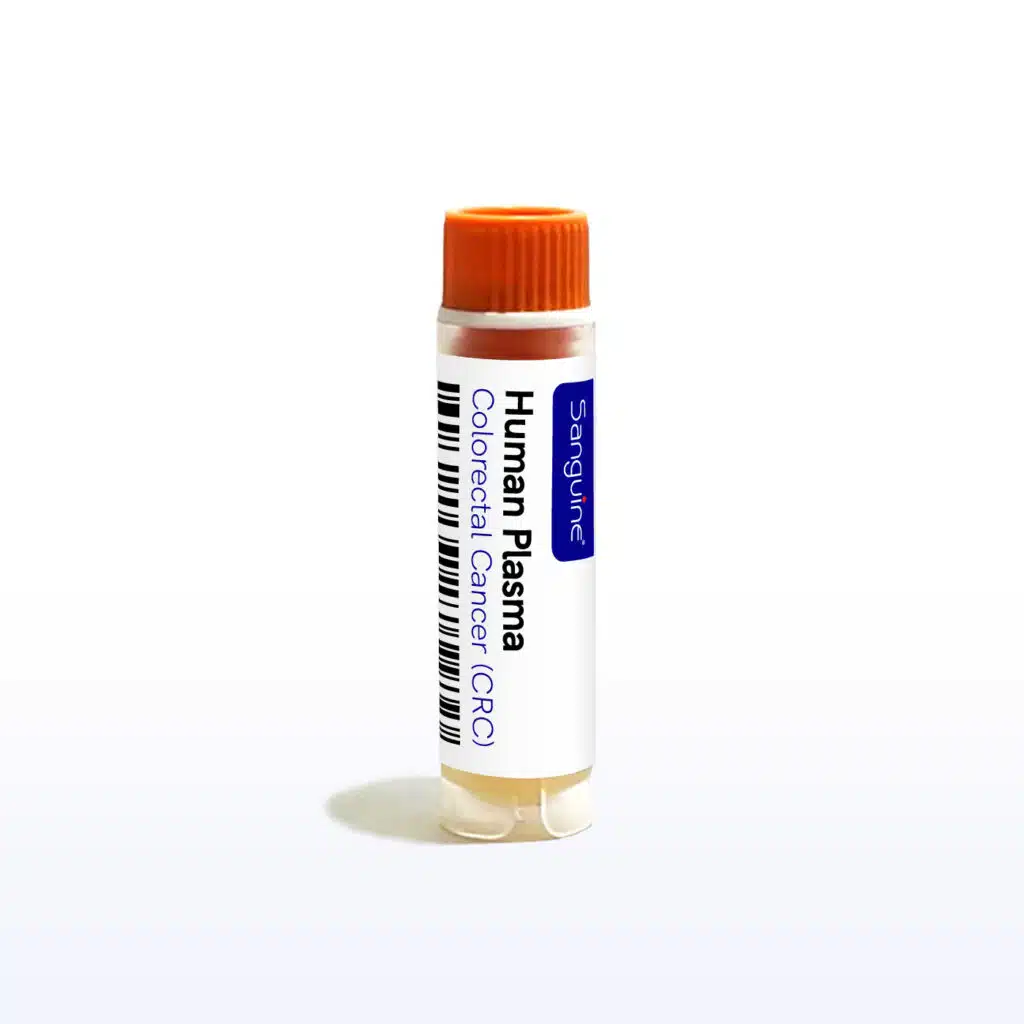
Colorectal Cancer Plasma
 Powered by Bioz
About:Colorectal Cancer Plasma from consented donors diagnosed with colorectal cancer, covering both colon and rectal primaries. Suitable for liquid biopsy development, circulating tumour DNA (ctDNA) analysis, cell-free DNA methylation work, and profiling of CEA and immune-related biomarkers. Stratified by stage, mutation and MMR status.
About Colorectal Cancer Plasma
Colorectal Cancer Plasma for Liquid Biopsy and Tumour Immunology Research
Colorectal Cancer Plasma is collected from IRB-consented donors clinically diagnosed with colorectal cancer and processed within one day of collection to preserve circulating tumour DNA, extracellular vesicles, proteins, cytokines and metabolites. Colorectal cancer is a neoplastic disease that develops through progressive accumulation of somatic alterations — classically involving APC, KRAS, TP53 and mismatch repair genes — with tumour-immune interactions shaping progression and response to therapy. Plasma is acellular and is the standard matrix for liquid biopsy and soluble-analyte work.
Tumour Biology and Why Plasma
- Circulating tumour DNA (ctDNA) enables non-invasive detection of somatic alterations including KRAS, NRAS, BRAF V600E and PIK3CA, and detection of resistance mutations emerging on anti-EGFR therapy.
- Plasma rather than serum for cell-free DNA: serum carries far more background leukocyte-derived genomic DNA generated during clotting, which dilutes the tumour fraction.
- Minimal residual disease and recurrence monitoring after surgery is one of the most active applications of ctDNA in colorectal cancer, and benefits from serial collections.
- Methylation markers such as methylated SEPT9 and related cell-free DNA methylation signatures underpin non-invasive screening research.
- Protein tumour markers including CEA and CA 19-9 support marker validation and combined protein-plus-ctDNA panel development.
- Tumour immunology: microsatellite instability-high and mismatch repair-deficient tumours are immunotherapy-responsive; soluble checkpoint molecules, cytokines and chemokines support immune evasion and response research.
Donor Stratification Available
- Primary tumour site: colon versus rectum, and right- versus left-sided colon where documented
- Stage at collection, including localised versus metastatic disease
- Mutation status where available: KRAS, NRAS, BRAF
- Mismatch repair / microsatellite instability status where available
- Treatment status and line of therapy: treatment-naive, post-surgical, on chemotherapy, on anti-EGFR or anti-VEGF therapy, on immune checkpoint inhibitor, or post-progression
- Hereditary syndrome context where documented, including Lynch syndrome or familial adenomatous polyposis
- Longitudinal or serial collections from the same donor, on request
- Matched healthy controls available
Product Features
- Research Use Only (RUO)
- Plasma collected from clinically confirmed colorectal cancer donors
- Processed within one day of collection
- Anticoagulant selection available on request to match your assay, including cell-free DNA workflows
- IRB-approved protocols and informed consent
- Custom aliquot volumes available upon request
De-identified Donor Data
- Verified colorectal cancer diagnosis, with primary site and stage where available
- Demographic data: age, sex assigned at birth, race/ethnicity
- Donor-reported medications, allergies, and comorbidities
- Molecular and treatment history where available
- Additional colorectal cancer-specific metadata available on request
Applications
- ctDNA extraction, targeted sequencing and mutation detection assay development
- Minimal residual disease and recurrence-monitoring research
- Cell-free DNA methylation and fragmentomics for non-invasive screening
- Extracellular vesicle and exosome isolation and cargo profiling
- CEA and CA 19-9 protein marker validation and combined panel development
- Soluble checkpoint molecule and cytokine profiling for immunotherapy response research
- Plasma proteomic and metabolomic biomarker discovery
- Diagnostic platform validation and liquid biopsy panel development
Other Colorectal Cancer Specimen Types
Colorectal cancer donor material is also available as Colorectal Cancer Serum, Colorectal Cancer PBMC, Colorectal Cancer Whole Blood, and Colorectal Cancer Leukopak. If your study is restricted to colon primaries only, see Colon Cancer Plasma; this colorectal cohort includes both colon and rectal primaries.
Compliance and Quality Assurance
- IRB-approved and HIPAA-compliant protocols
- Electronic informed consent with 21 CFR Part 11 – compliant e-signatures
- Documentation support available for regulatory review
Ordering & Customization
Colorectal cancer plasma is available in standard and custom volumes. For pricing, international orders, or documentation requirements, please email learnmore@sanguinebio.com to ensure compatibility with your country’s regulations. For the full specimen range, see our human plasma collection.
Applications
- Immunology and translational research
- Biomarker discovery and validation
- Drug screening and assay development
- Vaccine and infectious disease research
Product Features
- Research Use Only (RUO), Plasma
- Sourced from screened, consented donors
- Processed under validated SOPs
- QC tested for purity, viability, and sterility
- Processed within 24 hours of collection
- IRB-approved protocols with electronic informed consent
Donor Metadata
- Verified diagnosis and clinical history
- Demographic data: age, sex assigned at birth, race/ethnicity
- Medication and treatment background when available
Compliance and Quality Assurance
- IRB-approved collections and standardized procedures
- 21 CFR Part 11-compliant e-consent system
- HIPAA-compliant data management
Ordering & Customization
Human Plasma are available in customizable aliquot sizes. For international orders or documentation needs, please contact learnmore@sanguinebio.com to confirm requirements and availability. We also work with multiple ordering platforms and distributors, learn more here.
Protocols & Documentation
-
Download
Plasma Isolation
Protocol for plasma separation from anticoagulated whole blood, including processing, storage, and traceability requirements.
-
Informed Consent Form (ICF)
Available upon request — confirms donor consent for research use and downstream commercialization.
Plasma
Where can I find your complete catalog?
You can find our full product catalog here.
How long can samples be stored?
Storage depends on sample type but often cryopreserved samples stored in liquid nitrogen can be stored for years.
What customization options are available?
Extensive customization is available. To discuss your project request a quote or email us at learnmore@sanguinebio.com.
Do you offer prospective collections?
Sanguine offers flexible prospective collection services tailored to fit your research. For more information and to request a quote, please see: our prospective biospecimen collection services page.
What is the turnaround time for custom collections?
Timelines depend on condition, sample type, and I/E criteria but we often start collection within 2 weeks of signed agreement.
Do you have samples in stock?
YES - we have in-stock inventory. You can also email us at learnmore@sanguinebio.com as we continually get new samples in our inventory.
What does unique donor mean?
Each sample from a different individual - Unique donor means each sample comes from a different person, ensuring biological diversity in your study.
Are samples collected under IRB-approved protocols?
YES - "IRB-approved collection protocols" and IRB approval documentation available upon request. Sanguine utilizes two internationally-recognized IRBs (Advarra and WCG IRB) for review and approval.
Frequently Asked Questions
Ask a Question
Pair with a Healthy Control
Match your Colorectal Cancer Plasma with normal donor samples for comparison
Healthy Plasma
207 In Stock View InventoryNeed a custom Plasma cohort?
Our scientific team can scope prospective collections with donor-specific I/E criteria, typically starting within 2 weeks of agreement.