
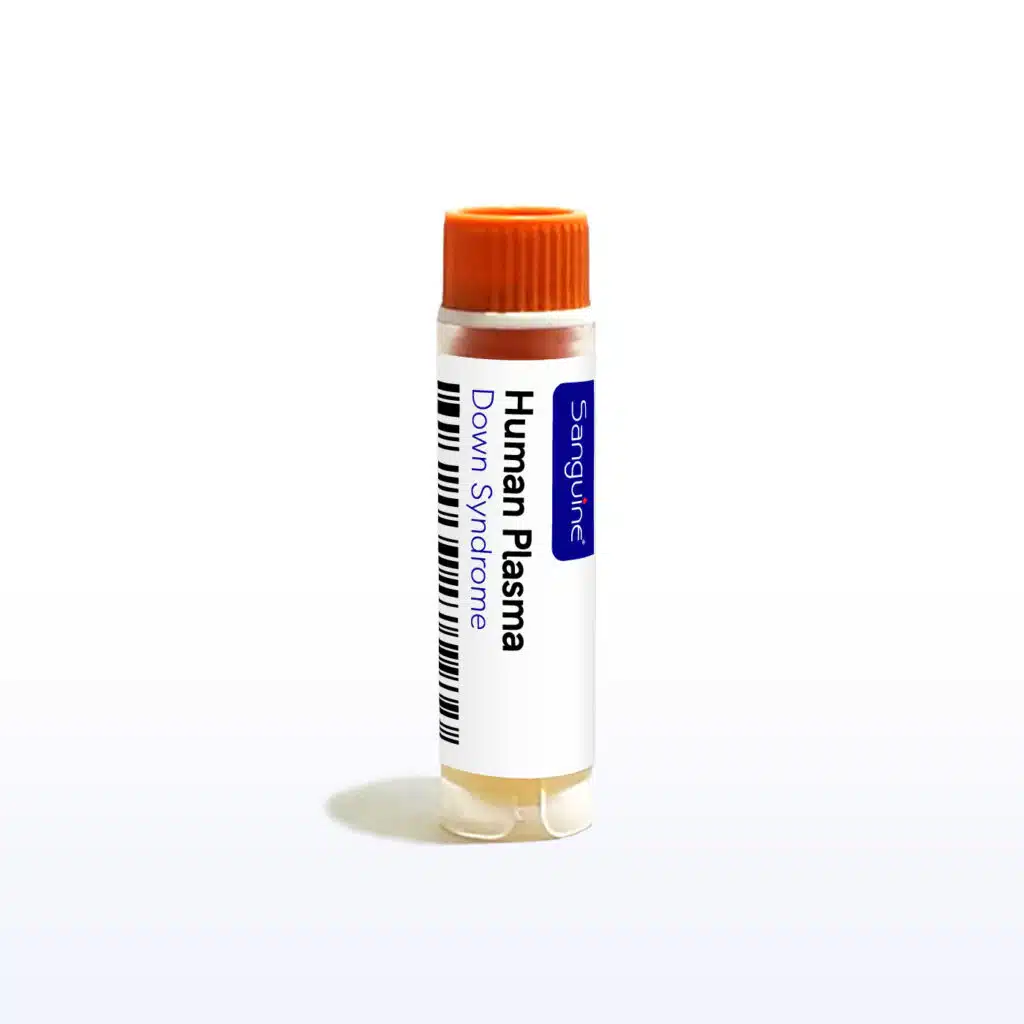
Down Syndrome Plasma
 Powered by Bioz
About:Down Syndrome Plasma is collected from consented donors with Down syndrome under protocols that provide for legally authorized representative consent plus donor assent where capacity is limited. Supports research on trisomy 21 gene-dosage effects, plasma biomarkers of early-onset Alzheimer's disease driven by APP triplication, interferon-pathway activity, and immune function.
About Down Syndrome Plasma
Down Syndrome Plasma for Trisomy 21 and Alzheimer’s Disease Research
Down Syndrome Plasma is collected from IRB-consented donors with Down syndrome and processed within one day of collection to preserve circulating proteins, cytokines, and metabolites. Down syndrome is a genetic condition caused by an extra copy of chromosome 21; the gene-dosage effects of trisomy 21 shape a distinctive health profile across the lifespan. This human plasma supports research aimed at understanding and improving health outcomes for people with Down syndrome, including early-onset Alzheimer’s disease, immune function, and interferon-pathway biology.
Trisomy 21 Biology and Why Plasma
- Gene-dosage mechanism: a third copy of chromosome 21 increases expression of the genes it carries, including APP, DYRK1A, RCAN1, SOD1, and the four chromosome-21 interferon receptor genes (IFNAR1, IFNAR2, IL10RB, IFNGR2).
- Early-onset Alzheimer’s disease: triplication of APP drives lifelong amyloid precursor protein overproduction and a greatly elevated lifetime risk of Alzheimer’s disease. Plasma supports amyloid-beta, phosphorylated-tau, neurofilament light chain, and GFAP immunoassays, and this is the most active research application for the specimen.
- Elevated interferon-pathway activity: extra copies of the interferon receptor genes are associated with heightened interferon signaling, reflected in plasma cytokine and chemokine profiles.
- Altered immune function: increased susceptibility to respiratory infection alongside a higher prevalence of co-occurring autoimmune conditions such as thyroid disease and celiac disease, reflected in circulating immune markers and condition-specific serology.
- Distinctive hematologic and cardiac profile: a characteristic childhood leukemia risk profile and a high prevalence of congenital heart disease define well-characterized clinical subgroups for study.
- Acellular matrix: plasma is the correct specimen for soluble-analyte proteomics, metabolomics, and immunoassay. Cell-based work is supported by our Down syndrome PBMC and whole blood products.
Donor Consent and Capacity
Some donors with Down syndrome have limited capacity to give independent informed consent, and we treat this as a specific ethical requirement rather than a formality. All collections are performed under IRB-approved protocols, with informed consent obtained directly from the donor where capacity allows, or, where appropriate, from a legally authorized representative together with the donor’s own documented assent. A donor’s decision to decline or to withdraw is respected at any point.
Donor Stratification Available
- Karyotype form: full trisomy 21, mosaic trisomy 21, or translocation Down syndrome
- Age band: pediatric, young adult, and older adult cohorts for age-dependent Alzheimer’s disease research
- Cognitive status: cognitively stable versus documented decline or a clinical Alzheimer’s disease diagnosis
- Congenital heart disease history, repaired or unrepaired
- Co-occurring conditions: thyroid disease, celiac disease, obstructive sleep apnea, or prior leukemia history
- Serial or longitudinal draws from the same donor where available
- Matched healthy controls available
Product Features
- Research Use Only (RUO)
- Plasma from donors with a confirmed clinical diagnosis of Down syndrome
- Processed within one day of collection
- Choice of anticoagulant (EDTA, sodium citrate, or heparin) on request
- IRB-approved protocols with informed consent, or representative consent plus donor assent where capacity is limited
- Custom aliquot volumes available upon request
De-identified Donor Data
- Confirmed Down syndrome diagnosis
- Demographic data: age, sex assigned at birth, race/ethnicity
- Karyotype form where documented
- Donor-reported medications, allergies, and co-occurring conditions
- Additional trisomy 21-specific metadata available on request
Applications
- Plasma biomarkers of Alzheimer’s disease onset and progression in Down syndrome
- Amyloid-beta and phosphorylated-tau assay development and cross-cohort validation
- Interferon-pathway and cytokine profiling
- Proteomic and metabolomic characterization of trisomy 21 gene-dosage effects
- Immune-marker studies relevant to respiratory infection susceptibility
- Thyroid and celiac serology in co-occurring autoimmune conditions
- Cardiac and vascular biomarker research within congenital heart disease subgroups
- Comparator material for aging and neurodegeneration studies
Other Down Syndrome Specimen Types
Compliance and Quality Assurance
- IRB-approved and HIPAA-compliant protocols
- Electronic informed consent with 21 CFR Part 11-compliant e-signatures
- Legally authorized representative consent with documented donor assent where capacity is limited
- Documentation support available for regulatory review
Ordering & Customization
Down syndrome plasma is available in standard and custom volumes. For pricing, current availability, international orders, or documentation requirements, please email learnmore@sanguinebio.com to ensure compatibility with your country’s regulations. To browse other conditions and live stock status, visit our human plasma page.
Applications
- Immunology and translational research
- Biomarker discovery and validation
- Drug screening and assay development
- Vaccine and infectious disease research
Product Features
- Research Use Only (RUO), Plasma
- Sourced from screened, consented donors
- Processed under validated SOPs
- QC tested for purity, viability, and sterility
- Processed within 24 hours of collection
- IRB-approved protocols with electronic informed consent
Donor Metadata
- Verified diagnosis and clinical history
- Demographic data: age, sex assigned at birth, race/ethnicity
- Medication and treatment background when available
Compliance and Quality Assurance
- IRB-approved collections and standardized procedures
- 21 CFR Part 11-compliant e-consent system
- HIPAA-compliant data management
Ordering & Customization
Human Plasma are available in customizable aliquot sizes. For international orders or documentation needs, please contact learnmore@sanguinebio.com to confirm requirements and availability. We also work with multiple ordering platforms and distributors, learn more here.
Protocols & Documentation
-
Download
Plasma Isolation
Protocol for plasma separation from anticoagulated whole blood, including processing, storage, and traceability requirements.
-
Informed Consent Form (ICF)
Available upon request — confirms donor consent for research use and downstream commercialization.
Plasma
Where can I find your complete catalog?
You can find our full product catalog here.
How long can samples be stored?
Storage depends on sample type but often cryopreserved samples stored in liquid nitrogen can be stored for years.
What customization options are available?
Extensive customization is available. To discuss your project request a quote or email us at learnmore@sanguinebio.com.
Do you offer prospective collections?
Sanguine offers flexible prospective collection services tailored to fit your research. For more information and to request a quote, please see: our prospective biospecimen collection services page.
What is the turnaround time for custom collections?
Timelines depend on condition, sample type, and I/E criteria but we often start collection within 2 weeks of signed agreement.
Do you have samples in stock?
YES - we have in-stock inventory. You can also email us at learnmore@sanguinebio.com as we continually get new samples in our inventory.
What does unique donor mean?
Each sample from a different individual - Unique donor means each sample comes from a different person, ensuring biological diversity in your study.
Are samples collected under IRB-approved protocols?
YES - "IRB-approved collection protocols" and IRB approval documentation available upon request. Sanguine utilizes two internationally-recognized IRBs (Advarra and WCG IRB) for review and approval.
Frequently Asked Questions
Ask a Question
Pair with a Healthy Control
Match your Down Syndrome Plasma with normal donor samples for comparison
Healthy Plasma
207 In Stock View InventoryNeed a custom Plasma cohort?
Our scientific team can scope prospective collections with donor-specific I/E criteria, typically starting within 2 weeks of agreement.