
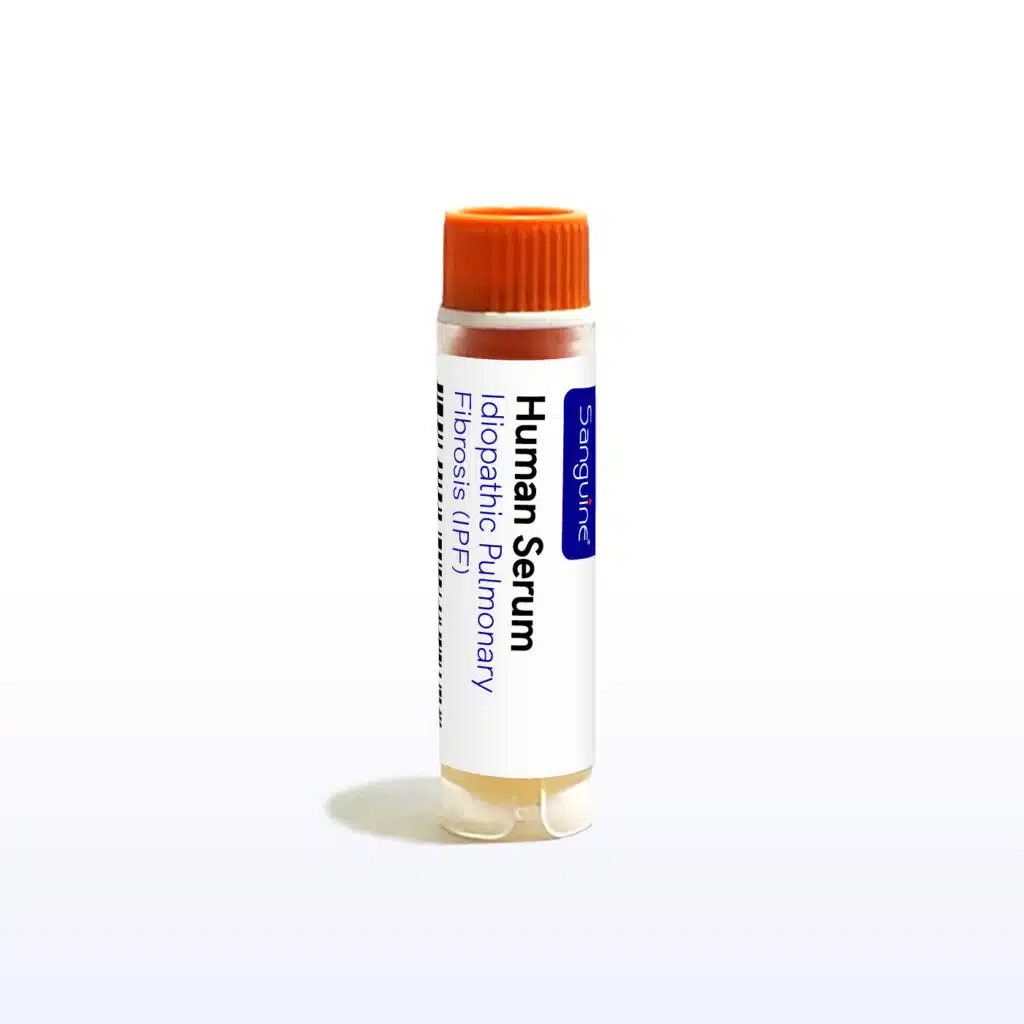
Idiopathic Pulmonary Fibrosis Serum
 Powered by Bioz
About:Idiopathic Pulmonary Fibrosis Serum from clinically confirmed IPF donors, frozen within 24 hours. Framed around progressive fibrosis rather than autoimmunity: alveolar epithelial injury markers such as KL-6 and surfactant proteins, MMP-7 and collagen neoepitope turnover, and TGF-β-axis profibrotic mediators. Stratification by lung function severity, UIP pattern, disease trajectory and antifibrotic treatment, with matched controls.
About Idiopathic Pulmonary Fibrosis Serum
Human Idiopathic Pulmonary Fibrosis Serum for Fibrosis Research
Our Idiopathic Pulmonary Fibrosis (IPF) Serum is sourced from IRB-consented donors clinically diagnosed with idiopathic pulmonary fibrosis. Each sample is processed and frozen within 24 hours of collection to keep labile analytes and matrix-turnover fragments consistent from lot to lot. Serum is acellular and is supplied here for soluble-analyte work: immunoassay, matrix-fragment quantification, proteomics and metabolomics.
Why IPF Serum for Fibrosis Research
IPF is a progressive fibrosing interstitial lung disease, not an autoimmune condition. Repeated injury to the alveolar epithelium in a susceptible, typically ageing lung provokes aberrant repair: fibroblasts are recruited and differentiate into myofibroblasts, which deposit excess collagen and other extracellular matrix, progressively stiffening the lung and destroying gas-exchange architecture. Fragments and mediators of that matrix-remodelling programme reach the circulation and are measurable in serum.
- Epithelial injury markers — surfactant proteins A and D and KL-6/MUC1 are released from damaged or regenerating alveolar epithelium and are among the most studied circulating markers in IPF.
- Matrix remodelling and collagen turnover — matrix metalloproteinases including MMP-7, their tissue inhibitors, and neoepitope collagen fragments report directly on active fibrogenesis.
- Profibrotic mediators — TGF-β is the central profibrotic cytokine, with CTGF, PDGF and the CCL18 macrophage-derived axis contributing to fibroblast recruitment and activation.
- Fibroblast-to-myofibroblast transition — the soluble outputs of this transition are the mechanistic targets of current and investigational antifibrotic agents.
- Progression and acute exacerbation biology — IPF follows a variable course punctuated by acute exacerbations, and serum offers a practical route to markers that distinguish stable from rapidly progressive disease.
- Serum-specific advantage — serum is the conventional matrix for established clinical chemistry and immunoassay platforms, easing comparison with legacy IPF biomarker datasets.
Donor Stratification Available
- Physiological severity — donors graded by forced vital capacity and diffusing capacity where documented
- Radiological or histopathological pattern — definite usual interstitial pneumonia pattern versus probable or indeterminate, subject to documentation
- Disease trajectory — stable, slowly progressive, and rapidly progressive donors; samples drawn during acute exacerbation where available
- Treatment status — treatment-naive donors and donors on antifibrotic therapy, with serial draws where collected
- Comorbidity and exposure — pulmonary hypertension, emphysema-fibrosis overlap, gastro-oesophageal reflux, and smoking history
- Matched healthy controls available, age- and sex-matched; other interstitial lung disease comparator donors also available
Product Features
- Collected from clinically confirmed idiopathic pulmonary fibrosis donors
- Research Use Only (RUO)
- Processed and frozen within 24 hours of collection
- IRB-approved protocols with documented consent
- Standard and custom aliquot volumes; volumes reported per lot
De-identified Donor Data
- Diagnosis confirmation
- Age, sex assigned at birth, and ethnicity
- Donor-reported medical history and comorbidities
- Lung function values and antifibrotic treatment context reported per lot where captured
- Additional IPF-specific clinical fields available on request
Applications
- Epithelial injury marker quantification including KL-6 and surfactant proteins
- MMP-7 and matrix metalloproteinase immunoassay development
- Collagen neoepitope and matrix turnover fragment profiling
- Profibrotic mediator measurement including TGF-β pathway outputs and CCL18
- Progression and acute exacerbation biomarker discovery
- Antifibrotic pharmacodynamic and target engagement readout development
- Serum proteomic and metabolomic discovery in pulmonary fibrosis
- Diagnostic reference and control material sourcing for interstitial lung disease assays
Other Idiopathic Pulmonary Fibrosis Specimen Types
- Idiopathic Pulmonary Fibrosis Plasma
- Idiopathic Pulmonary Fibrosis PBMC
- Idiopathic Pulmonary Fibrosis Whole Blood
- Pulmonary Fibrosis Serum
- Interstitial Lung Disease Whole Blood
Compliance and Quality Assurance
- IRB-approved and HIPAA-compliant protocols
- Electronic informed consent with 21 CFR Part 11-compliant e-signatures
- Documentation support available for regulatory review
Ordering & Customization
Idiopathic pulmonary fibrosis serum is available in standard and custom volumes. For pricing, international orders or documentation requirements, please email learnmore@sanguinebio.com to ensure compatibility with your country’s regulations. To compare collection formats or check wider availability, visit our human serum page.
Applications
- Immunology and translational research
- Biomarker discovery and validation
- Drug screening and assay development
- Vaccine and infectious disease research
Product Features
- Research Use Only (RUO), Serum
- Sourced from screened, consented donors
- Processed under validated SOPs
- QC tested for purity, viability, and sterility
- Processed within 24 hours of collection
- IRB-approved protocols with electronic informed consent
Donor Metadata
- Verified diagnosis and clinical history
- Demographic data: age, sex assigned at birth, race/ethnicity
- Medication and treatment background when available
Compliance and Quality Assurance
- IRB-approved collections and standardized procedures
- 21 CFR Part 11-compliant e-consent system
- HIPAA-compliant data management
Ordering & Customization
Human Serum are available in customizable aliquot sizes. For international orders or documentation needs, please contact learnmore@sanguinebio.com to confirm requirements and availability. We also work with multiple ordering platforms and distributors, learn more here.
Protocols & Documentation
-
Download
Serum Isolation
Protocol for serum preparation from whole blood, including collection handling, clarification, and quality documentation.
-
Informed Consent Form (ICF)
Available upon request — confirms donor consent for research use and downstream commercialization.
Serum
Where can I find your complete catalog?
You can find our full product catalog here.
How long can samples be stored?
Storage depends on sample type but often cryopreserved samples stored in liquid nitrogen can be stored for years.
What customization options are available?
Extensive customization is available. To discuss your project request a quote or email us at learnmore@sanguinebio.com.
Do you offer prospective collections?
Sanguine offers flexible prospective collection services tailored to fit your research. For more information and to request a quote, please see: our prospective biospecimen collection services page.
What is the turnaround time for custom collections?
Timelines depend on condition, sample type, and I/E criteria but we often start collection within 2 weeks of signed agreement.
Do you have samples in stock?
YES - we have in-stock inventory. You can also email us at learnmore@sanguinebio.com as we continually get new samples in our inventory.
What does unique donor mean?
Each sample from a different individual - Unique donor means each sample comes from a different person, ensuring biological diversity in your study.
Are samples collected under IRB-approved protocols?
YES - "IRB-approved collection protocols" and IRB approval documentation available upon request. Sanguine utilizes two internationally-recognized IRBs (Advarra and WCG IRB) for review and approval.
Frequently Asked Questions
Ask a Question
Pair with a Healthy Control
Match your Idiopathic Pulmonary Fibrosis Serum with normal donor samples for comparison
Healthy Serum
102 In Stock View InventoryNeed a custom Serum cohort?
Our scientific team can scope prospective collections with donor-specific I/E criteria, typically starting within 2 weeks of agreement.