
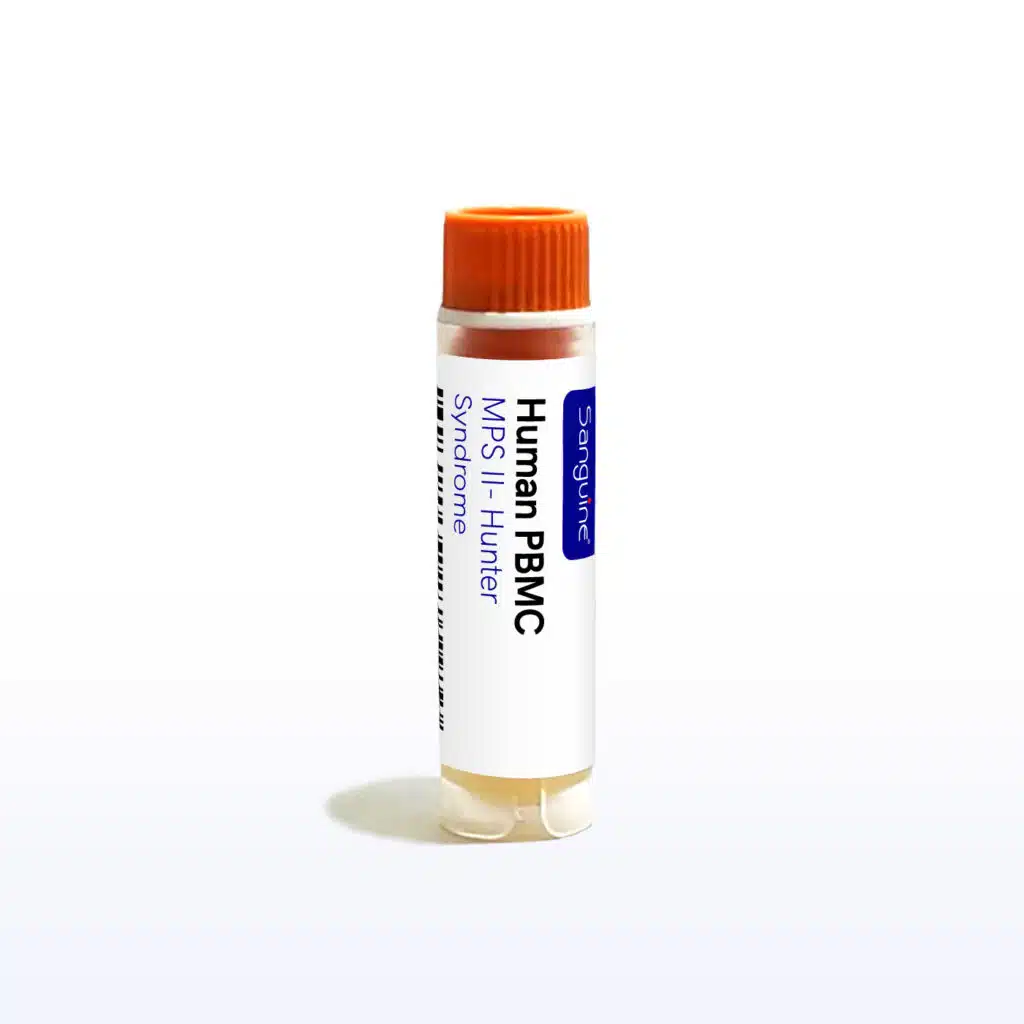
MPS II Hunter Syndrome PBMC
 Powered by Bioz
About:MPS II Hunter Syndrome PBMC from consented donors with confirmed mucopolysaccharidosis type II, an X-linked lysosomal storage disorder caused by iduronate-2-sulfatase (IDS) deficiency. Suitable for enzyme activity assays, IDS variant characterisation, gene therapy proof-of-concept and immunophenotyping.
About MPS II Hunter Syndrome PBMC
MPS II Hunter Syndrome PBMC for Lysosomal Storage Disease Research
MPS II Hunter Syndrome PBMC are isolated from IRB-consented donors with a clinically confirmed diagnosis of mucopolysaccharidosis type II and processed under standardised conditions. MPS II is an X-linked recessive lysosomal storage disorder caused by pathogenic variants in IDS, which encodes iduronate-2-sulfatase. Loss of enzyme activity blocks a required step in glycosaminoglycan catabolism, leading to progressive accumulation of dermatan sulfate and heparan sulfate in lysosomes. These nucleated cells support mechanistic studies, biomarker discovery and therapeutic development.
IDS Deficiency, X-Linked Inheritance and Why PBMCs
- MPS II is monogenic. Deficient iduronate-2-sulfatase activity is the defining defect, and the resulting substrate accumulation drives the multisystem phenotype — this is a genetic enzyme deficiency, not an immune-mediated disease.
- Because IDS is X-linked, the condition affects males almost exclusively, with carrier females typically unaffected. Donor sex and family history are therefore meaningful metadata.
- Peripheral blood mononuclear cells are nucleated and lysosome-containing, which makes them a practical primary cell source for enzyme activity measurement, substrate accumulation studies and lysosomal biology readouts.
- PBMCs carry the donor’s IDS genotype, supporting variant characterisation, genotype–phenotype correlation and residual enzyme activity work.
- As a nucleated cell product PBMCs are appropriate for flow cytometry, immunophenotyping, bulk and single-cell RNA sequencing, and functional cell-based assays.
- Patient-derived PBMCs are widely used to evaluate enzyme replacement uptake, gene therapy and gene editing strategies, and to test cross-correction concepts in a cell system carrying the authentic genetic defect.
Donor Stratification Available
- Attenuated versus severe (neuronopathic) clinical phenotype as characterised by the treating physician
- Documented IDS genotype or variant class where available
- Paediatric versus adult donors
- Treatment status: enzyme replacement therapy, prior haematopoietic stem cell transplant, or treatment-naive
- Anti-drug antibody status where documented
- Matched healthy controls available
Product Features
- Research Use Only (RUO)
- PBMC isolated from clinically confirmed MPS II Hunter syndrome donors
- Rigorous donor screening and sample quality checks
- Standardised collection and processing SOPs
- Suitable for downstream applications such as flow cytometry, RNA-seq, ELISA and qPCR
- Custom aliquot sizes available on request
De-identified Donor Data
- Verified MPS II diagnosis with diagnostic method
- Age, sex, race/ethnicity and medication history
- Documented disease severity or stage
- Genotype and enzyme activity results where available
- Optional: comorbidities, laboratory values and clinical history
Applications
- Iduronate-2-sulfatase enzyme activity assay development and validation
- IDS variant characterisation and genotype–phenotype correlation
- Lysosomal storage and glycosaminoglycan accumulation cell models
- Gene therapy and gene editing proof-of-concept studies in patient-derived cells
- Enzyme replacement uptake and cross-correction research
- Immunophenotyping and immune characterisation by flow cytometry
- Transcriptomic and proteomic profiling
- Biomarker validation and therapeutic screening
Other MPS II Hunter Syndrome Specimen Types
- MPS II Hunter Syndrome Whole Blood
- Mucopolysaccharidosis PBMC
- Mucopolysaccharidosis Plasma
- Mucopolysaccharidosis Serum
Compliance and Quality Assurance
- IRB-approved protocols
- Informed donor consent
- Standardized collection and processing SOPs
- HIPAA-compliant donor data handling
Ordering & Customization
Samples are available in both standard and custom volumes to meet your research needs. For pricing and current availability, or for international shipments and country-specific documentation requirements, please contact us at learnmore@sanguinebio.com to ensure compliance with your local regulations. To browse donor cohorts across our full inventory, visit our human PBMCs page.
Applications
- Immunology and translational research
- Biomarker discovery and validation
- Drug screening and assay development
- Vaccine and infectious disease research
Product Features
- Research Use Only (RUO), PBMC
- Sourced from screened, consented donors
- Processed under validated SOPs
- QC tested for purity, viability, and sterility
- Processed within 24 hours of collection
- IRB-approved protocols with electronic informed consent
Donor Metadata
- Verified diagnosis and clinical history
- Demographic data: age, sex assigned at birth, race/ethnicity
- Medication and treatment background when available
Compliance and Quality Assurance
- IRB-approved collections and standardized procedures
- 21 CFR Part 11-compliant e-consent system
- HIPAA-compliant data management
Ordering & Customization
Human PBMC are available in customizable aliquot sizes. For international orders or documentation needs, please contact learnmore@sanguinebio.com to confirm requirements and availability. We also work with multiple ordering platforms and distributors, learn more here.
Protocols & Documentation
-
Download
PBMC Isolation from Whole Blood
Standard operating procedure for isolating peripheral blood mononuclear cells from whole blood using density-gradient separation.
-
Download
Immune Cell Isolation
Guidelines for isolating immune cell populations with validated enrichment steps, purity checkpoints, and documentation.
-
Download
Choosing the Right PBMC Configuration
Reference guide comparing PBMC formats, cryopreservation states, and study-fit recommendations for your application.
-
Download
Thawing Cryopreserved PBMC
Validated thawing protocol to recover viable cryopreserved PBMCs while minimizing activation and loss of function.
-
Informed Consent Form (ICF)
Available upon request — confirms donor consent for research use and downstream commercialization.
PBMC
Where can I find your complete catalog?
You can find our full product catalog here.
How long can samples be stored?
Storage depends on sample type but often cryopreserved samples stored in liquid nitrogen can be stored for years.
What customization options are available?
Extensive customization is available. To discuss your project request a quote or email us at learnmore@sanguinebio.com.
Do you offer prospective collections?
Sanguine offers flexible prospective collection services tailored to fit your research. For more information and to request a quote, please see: our prospective biospecimen collection services page.
What is the turnaround time for custom collections?
Timelines depend on condition, sample type, and I/E criteria but we often start collection within 2 weeks of signed agreement.
Do you have samples in stock?
YES - we have in-stock inventory. You can also email us at learnmore@sanguinebio.com as we continually get new samples in our inventory.
What does unique donor mean?
Each sample from a different individual - Unique donor means each sample comes from a different person, ensuring biological diversity in your study.
Are samples collected under IRB-approved protocols?
YES - "IRB-approved collection protocols" and IRB approval documentation available upon request. Sanguine utilizes two internationally-recognized IRBs (Advarra and WCG IRB) for review and approval.
Frequently Asked Questions
Ask a Question
Pair with a Healthy Control
Match your MPS II Hunter Syndrome PBMC with normal donor samples for comparison
Healthy Donor PBMCs
133 In Stock View InventoryNeed a custom PBMC cohort?
Our scientific team can scope prospective collections with donor-specific I/E criteria, typically starting within 2 weeks of agreement.