
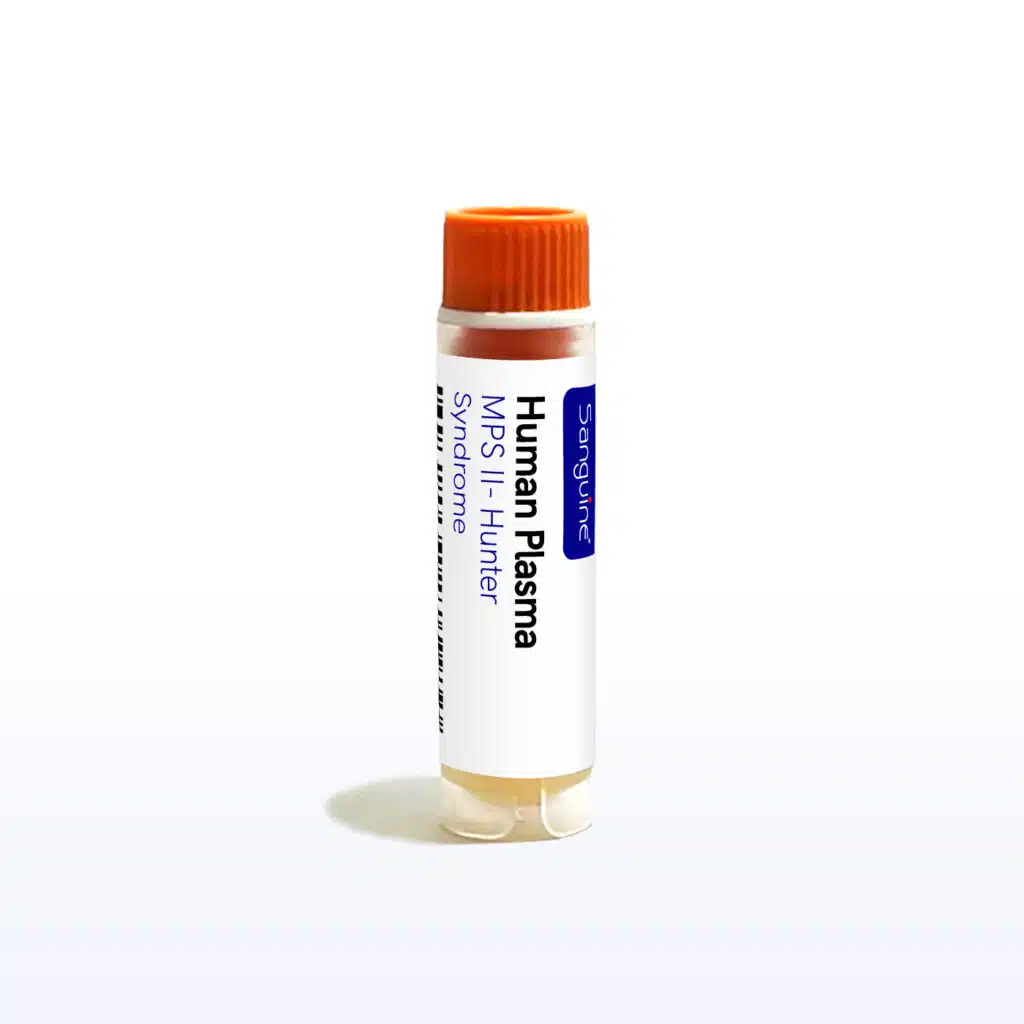
MPS II Hunter Syndrome Plasma
 Powered by Bioz
About:MPS II Hunter Syndrome Plasma is collected from consented donors with confirmed mucopolysaccharidosis type II, an X-linked iduronate-2-sulfatase (IDS) deficiency. Suitable for enzyme activity assays, glycosaminoglycan substrate quantification, plasma proteomics, and enzyme replacement therapy response research. Matched healthy controls available.
About MPS II Hunter Syndrome Plasma
MPS II Hunter Syndrome Plasma for Lysosomal Storage Disease Research
MPS II Hunter Syndrome Plasma is collected from IRB-consented donors with a clinically confirmed diagnosis of mucopolysaccharidosis type II and processed under standardised SOPs. Plasma is an acellular matrix and is intended for soluble-analyte work; cell-based assays should use the PBMC or whole blood product instead.
The IDS Gene Defect and Why Plasma
MPS II is a monogenic, X-linked recessive lysosomal storage disorder caused by pathogenic variants in IDS, which encodes the lysosomal enzyme iduronate-2-sulfatase. It is a genetic enzyme deficiency, not an autoimmune or inflammatory condition.
- Loss of iduronate-2-sulfatase activity blocks a step in glycosaminoglycan catabolism, so partially degraded dermatan sulfate and heparan sulfate accumulate in lysosomes across many tissues
- Undegraded glycosaminoglycans spill into the circulation and urine, which is why circulating GAG and derived-GAG measurement is a standard research readout for this disease
- Because inheritance is X-linked recessive, affected donors are predominantly male; carrier females are typically unaffected or mildly affected
- Presentation spans a broad spectrum, from attenuated somatic disease to severe forms with progressive neurological involvement, and genotype does not fully predict phenotype
- Enzyme replacement therapy is established clinical practice, so anti-drug antibody and treatment-response research is an active area that plasma directly supports
- Plasma allows enzyme activity assays, substrate quantification by mass spectrometry, proteomics, and immunoassay work from a single acellular matrix
Donor Stratification Available
- Attenuated versus severe (neuronopathic) clinical phenotype
- Enzyme replacement therapy status: treatment-naive, currently treated, or previously treated
- Age at diagnosis and current age band, including paediatric where available
- Method of diagnostic confirmation: enzyme activity assay, molecular IDS genotyping, or both
- Documented organ involvement, such as cardiac, respiratory, skeletal, or CNS
- Matched healthy controls available
Product Features
- Research Use Only (RUO)
- Plasma isolated from clinically confirmed MPS II Hunter syndrome donors
- Rigorous donor screening and sample quality checks
- Standardised collection and processing SOPs
- Suitable for acellular downstream applications such as ELISA, mass spectrometry, and enzyme activity assays
- Standard and custom volumes available
De-identified Donor Data
- Age, sex, race, medication, diagnosis method, disease severity/stage
- Genotype information where available
- Optional: comorbidities, lab values, and clinical history
Applications
- Iduronate-2-sulfatase enzyme activity measurement
- Glycosaminoglycan and derived-GAG substrate quantification
- Biomarker discovery and validation in lysosomal storage disease
- Plasma proteomics and metabolomics
- Enzyme replacement therapy response and anti-drug antibody research
- Gene therapy and substrate reduction therapy preclinical support
- Diagnostic and newborn-screening assay development
- Rare disease natural history and reference range studies
Other MPS II Hunter Syndrome Specimen Types
Compliance and Quality Assurance
- IRB-approved protocols
- Informed donor consent
- Standardized collection and processing SOPs
- HIPAA-compliant donor data handling
Ordering & Customization
Samples are available in both standard and custom volumes to meet your research needs. For pricing, availability, international shipments, or country-specific documentation requirements, please contact us at learnmore@sanguinebio.com to ensure compliance with your local regulations. To browse plasma from other disease states, visit our human plasma page.
Applications
- Immunology and translational research
- Biomarker discovery and validation
- Drug screening and assay development
- Vaccine and infectious disease research
Product Features
- Research Use Only (RUO), Plasma
- Sourced from screened, consented donors
- Processed under validated SOPs
- QC tested for purity, viability, and sterility
- Processed within 24 hours of collection
- IRB-approved protocols with electronic informed consent
Donor Metadata
- Verified diagnosis and clinical history
- Demographic data: age, sex assigned at birth, race/ethnicity
- Medication and treatment background when available
Compliance and Quality Assurance
- IRB-approved collections and standardized procedures
- 21 CFR Part 11-compliant e-consent system
- HIPAA-compliant data management
Ordering & Customization
Human Plasma are available in customizable aliquot sizes. For international orders or documentation needs, please contact learnmore@sanguinebio.com to confirm requirements and availability. We also work with multiple ordering platforms and distributors, learn more here.
Protocols & Documentation
-
Download
Plasma Isolation
Protocol for plasma separation from anticoagulated whole blood, including processing, storage, and traceability requirements.
-
Informed Consent Form (ICF)
Available upon request — confirms donor consent for research use and downstream commercialization.
Plasma
Where can I find your complete catalog?
You can find our full product catalog here.
How long can samples be stored?
Storage depends on sample type but often cryopreserved samples stored in liquid nitrogen can be stored for years.
What customization options are available?
Extensive customization is available. To discuss your project request a quote or email us at learnmore@sanguinebio.com.
Do you offer prospective collections?
Sanguine offers flexible prospective collection services tailored to fit your research. For more information and to request a quote, please see: our prospective biospecimen collection services page.
What is the turnaround time for custom collections?
Timelines depend on condition, sample type, and I/E criteria but we often start collection within 2 weeks of signed agreement.
Do you have samples in stock?
YES - we have in-stock inventory. You can also email us at learnmore@sanguinebio.com as we continually get new samples in our inventory.
What does unique donor mean?
Each sample from a different individual - Unique donor means each sample comes from a different person, ensuring biological diversity in your study.
Are samples collected under IRB-approved protocols?
YES - "IRB-approved collection protocols" and IRB approval documentation available upon request. Sanguine utilizes two internationally-recognized IRBs (Advarra and WCG IRB) for review and approval.
Frequently Asked Questions
Ask a Question
Pair with a Healthy Control
Match your MPS II Hunter Syndrome Plasma with normal donor samples for comparison
Healthy Plasma
207 In Stock View InventoryNeed a custom Plasma cohort?
Our scientific team can scope prospective collections with donor-specific I/E criteria, typically starting within 2 weeks of agreement.