
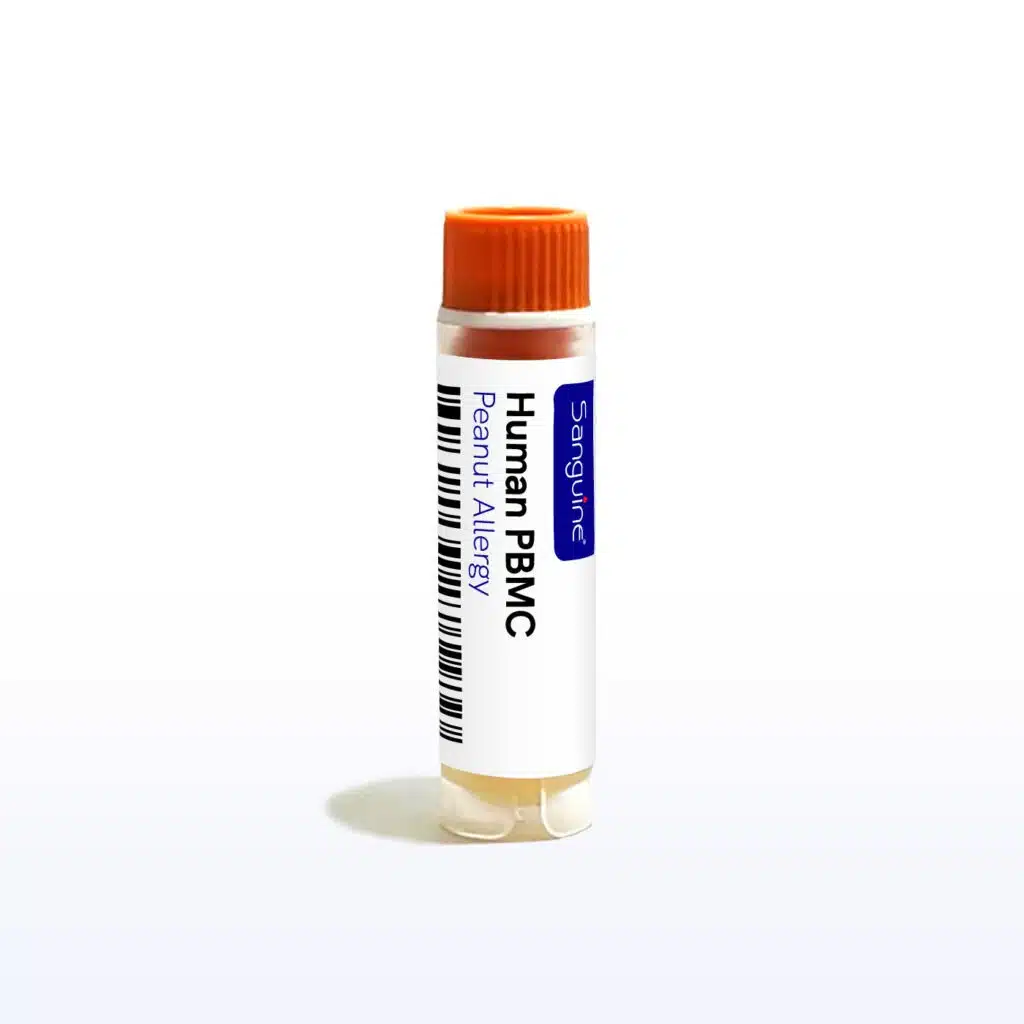
Peanut Allergy PBMC
 Powered by Bioz
About:Peanut Allergy PBMC from consented donors with clinically confirmed peanut allergy, processed within 24 hours and cryopreserved in CryoStor CS10. Allergen-specific T-cell responses need live antigen-presenting cells and T cells together, which is what PBMC uniquely provide: peanut extract or Ara h component stimulation, Th2 cytokine readouts, rare allergen-specific CD4 detection and basophil activation testing. Donors can be stratified by challenge-proven versus sensitised status, Ara h 2 specific IgE, reaction severity and immunotherapy status.
About Peanut Allergy PBMC
Peanut Allergy PBMC for Type 2 Immunity and Food Allergy Research
Peanut Allergy Human PBMC products are sourced from IRB-consented donors clinically diagnosed with peanut allergy, processed within 24 hours of collection and cryopreserved in CryoStor CS10 freezing media. Peanut allergy is an IgE-mediated type 2 allergic disease, driven by allergen-specific Th2 responses rather than by autoimmunity, and PBMC are the specimen that makes the cellular arm of that response experimentally accessible.
Why PBMC for Peanut Allergy Research
- Allergen-specific T-cell responses cannot be measured in serum. They require live antigen-presenting cells and T cells together in the same well, which is precisely what a PBMC preparation provides: peanut extract or peptide pools can be added directly to autologous APC-plus-T-cell cultures.
- The pathogenic axis runs through Th2 cells producing IL-4, IL-5 and IL-13, which drive IgE class switching and arm effector cells. PBMC support ex vivo stimulation with cytokine readout by ELISA, multiplex, ELISpot or intracellular staining in the disease-relevant cell population.
- Allergen-specific CD4 T cells are rare in circulation, so their detection depends on enrichment or activation-induced marker approaches such as CD154 upregulation, or on MHC class II tetramers. Both require substantial viable PBMC input, and the pathogenic CD4 subset described in food allergy carries a distinctive terminally differentiated Th2 phenotype identifiable by surface markers.
- Basophils are present at low frequency within PBMC preparations, which allows basophil activation testing and FcepsilonRI cross-linking studies on autologous cells rather than on passively sensitised donor cells.
- Sensitisation in peanut allergy is component-resolved: reactivity to the 2S albumin Ara h 2 is the most predictive of clinical reactivity, while Ara h 8 reactivity often reflects birch pollen cross-reactivity in donors who tolerate peanut. Stimulating PBMC with individual components rather than crude extract separates genuine effector responses from cross-reactive ones.
- Oral immunotherapy and anti-IgE therapy have changed the treatment landscape, and both act on mechanisms best interrogated in cells: regulatory T-cell induction, Th2 anergy and effector-cell desensitisation. Cryopreserved PBMC from donors at different treatment stages support that mechanistic work.
Donor Stratification Available
- Diagnostic basis: oral food challenge-proven reactivity versus sensitisation established by specific IgE or skin prick test
- Peanut-specific IgE level and component-resolved results where documented, including Ara h 2 specific IgE, plus skin prick test wheal size
- Reaction severity and history of anaphylaxis or epinephrine use
- Treatment status: immunotherapy-naive, on oral immunotherapy, post-desensitisation maintenance, or receiving anti-IgE or type 2 targeted biologic therapy
- Atopic comorbidities: asthma, atopic dermatitis, allergic rhinitis, eosinophilic oesophagitis, and other food allergies including tree nut
- Age group, including paediatric and adult donors where available, with matched non-allergic healthy controls
Product Features
- Research Use Only (RUO), cryopreserved PBMCs
- Clinically confirmed peanut allergy donors
- Available in cell counts ranging from 5 million to 2 billion
- Processed within 24 hours of collection
- Stored using CryoStor CS10 freezing media
- Viability and cell counts reported per lot
- IRB-approved protocols and electronic informed consent
- Screen LeukoLot available prior to bulk orders
De-identified Donor Data
- Verified peanut allergy diagnosis
- Donor demographics: age, sex assigned at birth, race/ethnicity
- Self-reported allergies and infectious disease history
- Additional peanut allergy-specific data, including specific IgE and reaction history, available upon request
Applications
- Allergen-specific T-cell stimulation with peanut extract or Ara h component peptides
- Th2 cytokine profiling by ELISpot, multiplex or intracellular cytokine staining
- Rare allergen-specific CD4 T-cell detection by activation-induced marker or tetramer approaches
- Basophil activation testing on autologous cells
- Regulatory T-cell function and suppression assays
- Oral immunotherapy and anti-IgE mechanism-of-action research
- Single-cell RNA sequencing and high-parameter immunophenotyping of the type 2 compartment
- Therapeutic screening and target validation in food allergy
Other Peanut Allergy Specimen Types
- Peanut Allergy Serum
- Peanut Allergy Plasma
- Peanut Allergy Whole Blood
- Peanut Allergy Leukopak
- Peanut Allergy Bulk Plasma
- Allergy Serum
Quality and Compliance
- IRB-approved collections and protocols
- 21 CFR Part 11 – compliant e-consent system
- HIPAA-compliant donor data protection
Ordering & Customization
Peanut Allergy PBMC samples are shipped on dry ice and available in custom aliquots. For pricing, current availability, or a quote on a stratified donor cohort, contact learnmore@sanguinebio.com; email us as well for international orders or regulatory documentation. To browse other disease states in this specimen type, visit our human PBMC page.
Applications
- Immunology and translational research
- Biomarker discovery and validation
- Drug screening and assay development
- Vaccine and infectious disease research
Product Features
- Research Use Only (RUO), PBMC
- Sourced from screened, consented donors
- Processed under validated SOPs
- QC tested for purity, viability, and sterility
- Processed within 24 hours of collection
- IRB-approved protocols with electronic informed consent
Donor Metadata
- Verified diagnosis and clinical history
- Demographic data: age, sex assigned at birth, race/ethnicity
- Medication and treatment background when available
Compliance and Quality Assurance
- IRB-approved collections and standardized procedures
- 21 CFR Part 11-compliant e-consent system
- HIPAA-compliant data management
Ordering & Customization
Human PBMC are available in customizable aliquot sizes. For international orders or documentation needs, please contact learnmore@sanguinebio.com to confirm requirements and availability. We also work with multiple ordering platforms and distributors, learn more here.
Protocols & Documentation
-
Download
PBMC Isolation from Whole Blood
Standard operating procedure for isolating peripheral blood mononuclear cells from whole blood using density-gradient separation.
-
Download
Immune Cell Isolation
Guidelines for isolating immune cell populations with validated enrichment steps, purity checkpoints, and documentation.
-
Download
Choosing the Right PBMC Configuration
Reference guide comparing PBMC formats, cryopreservation states, and study-fit recommendations for your application.
-
Download
Thawing Cryopreserved PBMC
Validated thawing protocol to recover viable cryopreserved PBMCs while minimizing activation and loss of function.
-
Informed Consent Form (ICF)
Available upon request — confirms donor consent for research use and downstream commercialization.
PBMC
Where can I find your complete catalog?
You can find our full product catalog here.
How long can samples be stored?
Storage depends on sample type but often cryopreserved samples stored in liquid nitrogen can be stored for years.
What customization options are available?
Extensive customization is available. To discuss your project request a quote or email us at learnmore@sanguinebio.com.
Do you offer prospective collections?
Sanguine offers flexible prospective collection services tailored to fit your research. For more information and to request a quote, please see: our prospective biospecimen collection services page.
What is the turnaround time for custom collections?
Timelines depend on condition, sample type, and I/E criteria but we often start collection within 2 weeks of signed agreement.
Do you have samples in stock?
YES - we have in-stock inventory. You can also email us at learnmore@sanguinebio.com as we continually get new samples in our inventory.
What does unique donor mean?
Each sample from a different individual - Unique donor means each sample comes from a different person, ensuring biological diversity in your study.
Are samples collected under IRB-approved protocols?
YES - "IRB-approved collection protocols" and IRB approval documentation available upon request. Sanguine utilizes two internationally-recognized IRBs (Advarra and WCG IRB) for review and approval.
Frequently Asked Questions
Ask a Question
Pair with a Healthy Control
Match your Peanut Allergy PBMC with normal donor samples for comparison
Healthy Donor PBMCs
704 In Stock View InventoryNeed a custom PBMC cohort?
Our scientific team can scope prospective collections with donor-specific I/E criteria, typically starting within 2 weeks of agreement.