
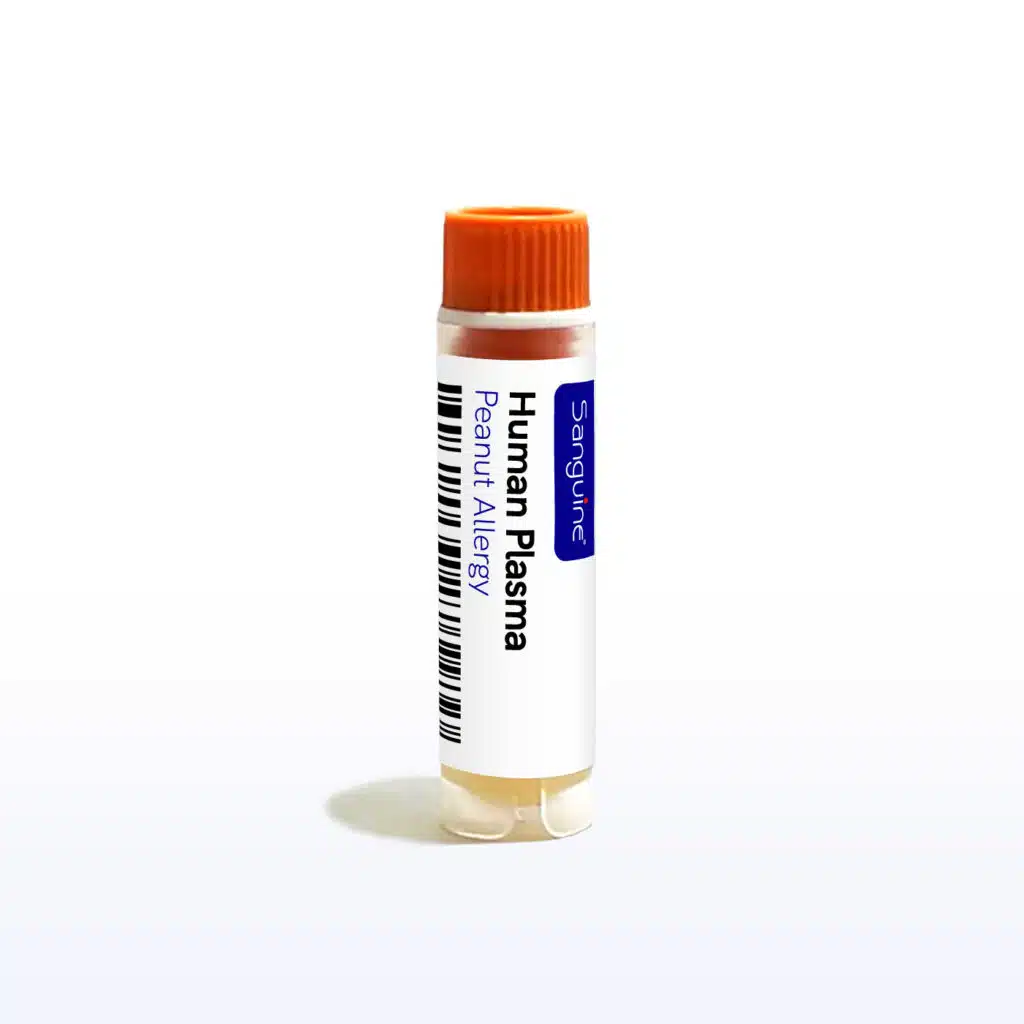
Peanut Allergy Plasma
 Powered by Bioz
About:Peanut Allergy Plasma — cryopreserved human plasma from consented donors with clinically confirmed peanut allergy, processed within one day of collection. Suited to mast cell mediator work, type 2 cytokine multiplexing, and proteomic and metabolomic biomarker discovery in IgE-mediated food allergy. Donors can be stratified by peanut-specific IgE level, reaction severity, and oral immunotherapy status.
About Peanut Allergy Plasma
Peanut Allergy Plasma for IgE-Mediated Food Allergy Research
Peanut Allergy Plasma is collected from IRB-consented donors clinically diagnosed with peanut allergy and processed within one day of collection to preserve cytokines, proteins, and metabolites. Peanut allergy is a type I, IgE-mediated hypersensitivity: allergen-specific IgE bound to FcepsilonRI on mast cells and basophils is cross-linked by peanut proteins, triggering immediate degranulation. It is an allergic disease of the type 2 immune axis, not an autoimmune one, and plasma supports research into the soluble mediators and systemic changes involved.
Why Plasma for Peanut Allergy Research
- The effector step in peanut allergy is mast cell and basophil degranulation. Plasma is a practical matrix for measuring histamine metabolites, tryptase and other released mediators, and for interrogating the systemic footprint of an allergic reaction.
- The type 2 cytokines that sustain IgE production — IL-4, IL-13 and IL-5 — and the epithelial alarmins upstream of them are measurable in plasma by multiplex immunoassay.
- Plasma is separated without a clotting step, which avoids the ex vivo platelet degranulation that inflates platelet-stored chemokines in serum. This matters for chemokine panels in allergy research.
- Oral immunotherapy for peanut allergy reshapes the humoral response, with rising allergen-specific IgG4 and a shifting IgE-to-IgG4 balance being among the best-characterised immunological correlates of desensitisation. Plasma from treated and untreated donors supports this comparison.
- Anti-IgE therapy is now an established approach in food allergy, making free and total IgE and receptor occupancy research directly relevant to plasma-based pharmacodynamic work.
- A technical note on matrix choice: quantitative allergen-specific IgE and component-resolved diagnostics are conventionally performed in serum, where the published reference data sit. Use the serum product for component-resolved IgE work and plasma for mediator, cytokine and omics studies.
Donor Stratification Available
- Peanut-specific IgE level and total IgE where available
- Component sensitisation profile, including Ara h 2 status where tested
- Diagnosis basis: oral food challenge-confirmed, or clinical history with supportive specific IgE or skin prick testing
- Reaction severity and documented history of anaphylaxis or epinephrine use
- Treatment status: oral immunotherapy-naive, currently on oral immunotherapy, maintenance phase, or on anti-IgE therapy
- Co-existing food allergies and atopic comorbidity, including asthma and atopic dermatitis
- Age group, including paediatric and adult donors
- Matched non-allergic healthy controls available
Product Features
- Research Use Only (RUO)
- Plasma collected from clinically confirmed peanut allergy donors
- Processed within one day of collection
- Anticoagulant selection available on request
- IRB-approved protocols and informed consent
- Custom aliquot volumes available upon request
De-identified Donor Data
- Verified peanut allergy diagnosis
- Demographic data: age, sex assigned at birth, race/ethnicity
- Donor-reported medications, allergies, and comorbidities
- Reaction history and immunotherapy status where available
- Additional peanut allergy-specific metadata available on request
Applications
- Mast cell and basophil mediator profiling, including tryptase
- Type 2 cytokine and chemokine multiplex panels
- Biomarker discovery for reaction threshold, severity and natural tolerance acquisition
- Immunological monitoring of oral immunotherapy and desensitisation research
- Free and total IgE measurement for anti-IgE pharmacodynamic studies
- Proteomic and metabolomic profiling of the food-allergic state
- Assay development and validation using disease-state plasma as a clinically relevant matrix
- Comparative study of peanut allergy against other IgE-mediated food allergies
Other Peanut Allergy Specimen Types
- Peanut Allergy Serum
- Peanut Allergy Whole Blood
- Peanut Allergy PBMC
- Peanut Allergy Leukopak
- Peanut Allergy Bulk Plasma
Compliance and Quality Assurance
- IRB-approved and HIPAA-compliant protocols
- Electronic informed consent with 21 CFR Part 11 – compliant e-signatures
- Documentation support available for regulatory review
Ordering & Customization
Peanut allergy plasma is available in standard and custom volumes. For pricing, availability, or to discuss a cohort stratified by specific IgE level or immunotherapy status, email learnmore@sanguinebio.com. For international orders or documentation requirements, please contact us to ensure compatibility with your country’s regulations. To browse plasma across all disease states and healthy donors, visit our human plasma page.
Applications
- Immunology and translational research
- Biomarker discovery and validation
- Drug screening and assay development
- Vaccine and infectious disease research
Product Features
- Research Use Only (RUO), Plasma
- Sourced from screened, consented donors
- Processed under validated SOPs
- QC tested for purity, viability, and sterility
- Processed within 24 hours of collection
- IRB-approved protocols with electronic informed consent
Donor Metadata
- Verified diagnosis and clinical history
- Demographic data: age, sex assigned at birth, race/ethnicity
- Medication and treatment background when available
Compliance and Quality Assurance
- IRB-approved collections and standardized procedures
- 21 CFR Part 11-compliant e-consent system
- HIPAA-compliant data management
Ordering & Customization
Human Plasma are available in customizable aliquot sizes. For international orders or documentation needs, please contact learnmore@sanguinebio.com to confirm requirements and availability. We also work with multiple ordering platforms and distributors, learn more here.
Protocols & Documentation
-
Download
Plasma Isolation
Protocol for plasma separation from anticoagulated whole blood, including processing, storage, and traceability requirements.
-
Informed Consent Form (ICF)
Available upon request — confirms donor consent for research use and downstream commercialization.
Plasma
Where can I find your complete catalog?
You can find our full product catalog here.
How long can samples be stored?
Storage depends on sample type but often cryopreserved samples stored in liquid nitrogen can be stored for years.
What customization options are available?
Extensive customization is available. To discuss your project request a quote or email us at learnmore@sanguinebio.com.
Do you offer prospective collections?
Sanguine offers flexible prospective collection services tailored to fit your research. For more information and to request a quote, please see: our prospective biospecimen collection services page.
What is the turnaround time for custom collections?
Timelines depend on condition, sample type, and I/E criteria but we often start collection within 2 weeks of signed agreement.
Do you have samples in stock?
YES - we have in-stock inventory. You can also email us at learnmore@sanguinebio.com as we continually get new samples in our inventory.
What does unique donor mean?
Each sample from a different individual - Unique donor means each sample comes from a different person, ensuring biological diversity in your study.
Are samples collected under IRB-approved protocols?
YES - "IRB-approved collection protocols" and IRB approval documentation available upon request. Sanguine utilizes two internationally-recognized IRBs (Advarra and WCG IRB) for review and approval.
Frequently Asked Questions
Ask a Question
Pair with a Healthy Control
Match your Peanut Allergy Plasma with normal donor samples for comparison
Healthy Plasma
206 In Stock View InventoryNeed a custom Plasma cohort?
Our scientific team can scope prospective collections with donor-specific I/E criteria, typically starting within 2 weeks of agreement.