
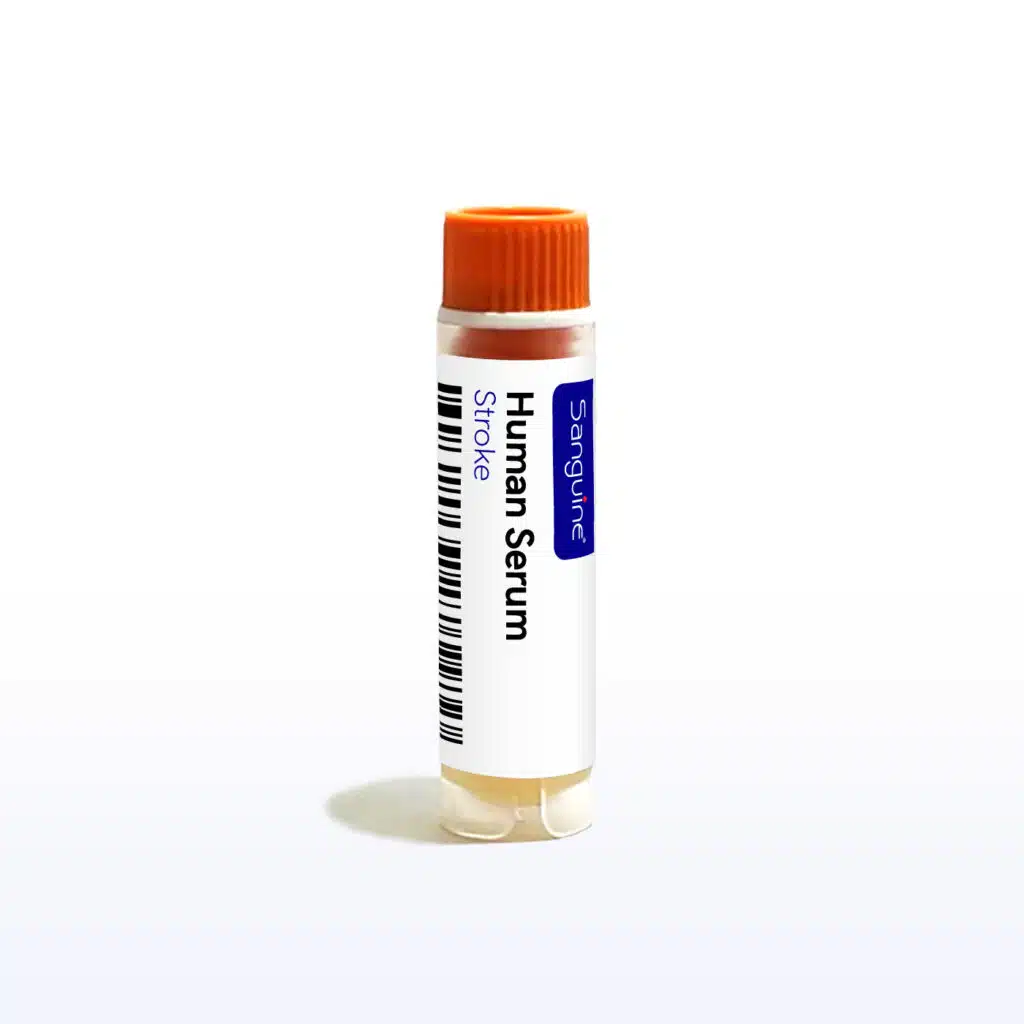
Stroke Serum
 Powered by Bioz
About:Serum from consented donors with clinically confirmed stroke, processed and frozen within 24 hours. Supports research on glial and neuronal injury proteins (GFAP, NfL, S100B), sterile neuroinflammation, and thrombotic and cardioembolic mechanism markers. Stratifiable by ischemic versus haemorrhagic subtype, time from onset, NIHSS and acute treatment received.
About Stroke Serum
Stroke Serum for Cerebrovascular Injury and Biomarker Research
Stroke Human Serum is sourced from IRB-consented donors with a clinically confirmed stroke diagnosis, and each sample is processed and frozen within 24 hours of collection. Stroke is an acute cerebrovascular event, not an autoimmune disease: an artery is occluded or ruptures, brain tissue is injured, and a sterile inflammatory and glial response follows. Serum captures the circulating protein signature of that injury and its systemic consequences.
Why Serum for Stroke
Roughly four in five strokes are ischemic and the remainder haemorrhagic, and the two require opposite emergency treatments. Blood-based markers that distinguish subtype, grade severity or predict outcome are therefore one of the most sought-after goals in cerebrovascular research — and most of the leading candidates are proteins best measured in serum.
- Glial and neuronal injury proteins — GFAP and neurofilament light chain enter the circulation after blood-brain barrier disruption and axonal injury, and are extensively studied as stroke biomarkers, with GFAP of particular interest for discriminating haemorrhagic from ischemic stroke in the hyperacute window.
- Astrocytic damage markers — S100B has a long research history as an indicator of astroglial injury and blood-brain barrier compromise after cerebral insult.
- Sterile neuroinflammation — IL-6, CRP and matrix metalloproteinase-9 rise after ischemic injury and are studied in relation to infarct expansion, oedema and haemorrhagic transformation.
- Thrombotic and cardioembolic mechanism — D-dimer and natriuretic peptides help distinguish cardioembolic from large-artery or small-vessel mechanisms, which matters for secondary prevention research.
- Time from onset is the key variable — these markers follow distinct temporal trajectories, so serum annotated with time from symptom onset to draw is far more valuable than an unannotated sample.
- Serum for immunoassay, plasma for coagulation — use serum for the high-sensitivity protein immunoassays above; for coagulation-cascade and platelet-dependent analytes, the plasma sibling is the correct matrix.
Donor Stratification Available
- Stroke subtype: ischemic versus intracerebral haemorrhage; mechanism classification where recorded
- Time from symptom onset to collection, and acute versus convalescent or chronic timepoint
- Severity at presentation: NIHSS score where recorded
- Functional outcome: modified Rankin Scale where recorded
- Acute treatment received: intravenous thrombolysis, mechanical thrombectomy, or medical management
- Vascular risk factors: atrial fibrillation, hypertension, diabetes, dyslipidaemia, smoking
- Matched healthy controls available, age- and sex-matched on request
Product Features
- Collected from clinically confirmed stroke donors
- Processed and frozen within 24 hours of collection
- Custom aliquot volumes available; volumes reported per lot
- Research Use Only (RUO)
- IRB-approved protocols with documented consent
De-identified Donor Data
- Diagnosis confirmation, including stroke subtype where available
- Age, sex assigned at birth, and race/ethnicity
- Donor-reported medical history, medications and comorbidities
- Time from onset, severity and outcome scores where recorded
Applications
- Biomarker discovery and validation for stroke diagnosis, subtype and prognosis
- GFAP, neurofilament light chain and S100B assay development
- Serum cytokine, CRP and inflammatory mediator profiling
- Matrix metalloproteinase and blood-brain barrier integrity research
- Thrombosis, D-dimer and cardioembolic mechanism research
- Lipid and cardiometabolic risk factor profiling
- Proteomic and multiplex panel development for point-of-care triage research
- Therapeutic candidate screening and neuroprotection research
Other Stroke Specimen Types
Compliance and Quality Assurance
- IRB-approved and HIPAA-compliant protocols
- Electronic informed consent with 21 CFR Part 11 – compliant e-signatures
- Documentation support available for regulatory review
Ordering & Customization
Stroke serum is available in standard and custom volumes. For pricing, availability or a specific stratification request, email learnmore@sanguinebio.com; please also contact us for international orders or documentation requirements to ensure compatibility with your country’s regulations. To browse availability across all disease states, visit our human serum page.
Applications
- Immunology and translational research
- Biomarker discovery and validation
- Drug screening and assay development
- Vaccine and infectious disease research
Product Features
- Research Use Only (RUO), Serum
- Sourced from screened, consented donors
- Processed under validated SOPs
- QC tested for purity, viability, and sterility
- Processed within 24 hours of collection
- IRB-approved protocols with electronic informed consent
Donor Metadata
- Verified diagnosis and clinical history
- Demographic data: age, sex assigned at birth, race/ethnicity
- Medication and treatment background when available
Compliance and Quality Assurance
- IRB-approved collections and standardized procedures
- 21 CFR Part 11-compliant e-consent system
- HIPAA-compliant data management
Ordering & Customization
Human Serum are available in customizable aliquot sizes. For international orders or documentation needs, please contact learnmore@sanguinebio.com to confirm requirements and availability. We also work with multiple ordering platforms and distributors, learn more here.
Protocols & Documentation
-
Download
Serum Isolation
Protocol for serum preparation from whole blood, including collection handling, clarification, and quality documentation.
-
Informed Consent Form (ICF)
Available upon request — confirms donor consent for research use and downstream commercialization.
Serum
Where can I find your complete catalog?
You can find our full product catalog here.
How long can samples be stored?
Storage depends on sample type but often cryopreserved samples stored in liquid nitrogen can be stored for years.
What customization options are available?
Extensive customization is available. To discuss your project request a quote or email us at learnmore@sanguinebio.com.
Do you offer prospective collections?
Sanguine offers flexible prospective collection services tailored to fit your research. For more information and to request a quote, please see: our prospective biospecimen collection services page.
What is the turnaround time for custom collections?
Timelines depend on condition, sample type, and I/E criteria but we often start collection within 2 weeks of signed agreement.
Do you have samples in stock?
YES - we have in-stock inventory. You can also email us at learnmore@sanguinebio.com as we continually get new samples in our inventory.
What does unique donor mean?
Each sample from a different individual - Unique donor means each sample comes from a different person, ensuring biological diversity in your study.
Are samples collected under IRB-approved protocols?
YES - "IRB-approved collection protocols" and IRB approval documentation available upon request. Sanguine utilizes two internationally-recognized IRBs (Advarra and WCG IRB) for review and approval.
Frequently Asked Questions
Ask a Question
Pair with a Healthy Control
Match your Stroke Serum with normal donor samples for comparison
Healthy Serum
102 In Stock View InventoryNeed a custom Serum cohort?
Our scientific team can scope prospective collections with donor-specific I/E criteria, typically starting within 2 weeks of agreement.