
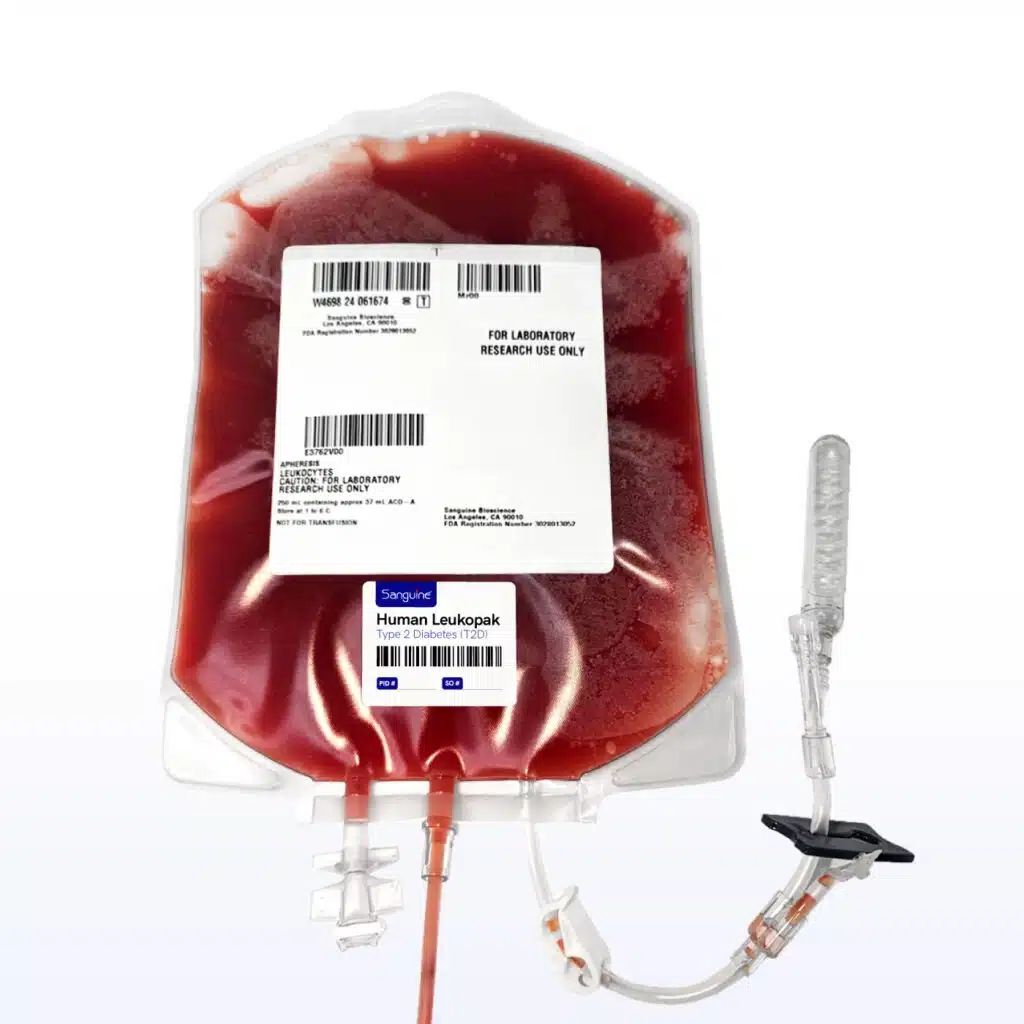
Type 2 Diabetes Leukopak
 Powered by Bioz
About:LeukoCore Type 2 Diabetes Leukopak products contain concentrated immune cells from donors with clinically confirmed Type 2 Diabetes (T2D), collected via apheresis. Ideal for high-yield studies on chronic low-grade inflammation, monocyte polarisation, immunometabolism and immune-metabolic interactions, with stratification by glycaemic control and treatment regimen.
About Type 2 Diabetes Leukopak
LeukoCore Type 2 Diabetes Leukopak for Immunometabolism Research
LeukoCore Type 2 Diabetes Leukopak products are collected from IRB-consented donors with a clinically confirmed diagnosis of type 2 diabetes (T2D) through apheresis. Each leukopak yields large quantities of peripheral blood mononuclear cells, making it suited to studies that need substantial cell numbers from a single well-characterised metabolic donor — immune cell subset isolation, multi-omics, and repeat assays from the same lot.
Metabolic Dysfunction and Immune Cell Biology in Type 2 Diabetes
Type 2 diabetes is a metabolic disease defined by insulin resistance in peripheral tissues together with progressive beta-cell dysfunction, resulting in chronic hyperglycaemia. It is not an autoimmune disease — that distinction belongs to type 1 diabetes — but it is accompanied by a persistent low-grade inflammatory state that meaningfully alters circulating leukocytes.
- Chronic low-grade inflammation is a well-established feature of T2D, with adipose tissue-derived mediators contributing to a systemic inflammatory tone often described as metaflammation.
- Monocytes and macrophages show altered activation and polarisation in T2D, linking metabolic state to innate immune function and to the vascular complications of the disease.
- Sustained hyperglycaemia and dyslipidaemia change leukocyte metabolic substrate availability, which makes T2D leukopaks a natural source for immunometabolism and Seahorse-style bioenergetic work.
- The IL-1 beta and inflammasome axis has been directly implicated in beta-cell dysfunction, providing a mechanistically grounded target for ex vivo stimulation studies.
- Impaired host defence and altered infection risk in diabetes give a functional rationale for characterising phagocytosis, cytokine responsiveness and T cell function in this population.
- High cell yield from apheresis allows several enriched subsets to be derived from the same donor, so metabolic phenotype can be held constant across a panel of cell-based assays.
Donor Stratification Available
- Glycaemic control: HbA1c band where documented
- Treatment regimen: metformin, GLP-1 receptor agonist, SGLT2 inhibitor, insulin, combination therapy, or treatment-naive
- Disease duration since diagnosis
- Diabetic complications: nephropathy, retinopathy, or neuropathy where documented
- Body mass index category and obesity status
- Cardiovascular and metabolic comorbidities, including hypertension and dyslipidaemia
- Matched healthy controls available
Product Features
- Research Use Only (RUO) human leukopaks
- Clinically confirmed T2D donors
- High cell yield for large-scale studies
- Processed and shipped within 24 hours of collection
- Fresh or cryopreserved options available
- IRB-approved and ethically sourced
- Infectious disease testing
- HLA-A typing
- Screen donors with LeukoLot™
De-identified Donor Data
- Verified type 2 diabetes diagnosis from healthcare providers
- Donor demographics: age, sex assigned at birth, race/ethnicity
- Self-reported medication history and allergies
- Glycaemic and metabolic laboratory values where documented
- Relevant clinical data, including comorbidities and complications
Applications
- Immune cell characterisation and immunophenotyping in T2D
- Monocyte and macrophage polarisation studies
- Immunometabolism and cellular bioenergetics assays
- Inflammasome and IL-1 beta pathway stimulation studies
- Cytokine profiling and functional response assays
- Isolation of enriched T, B, NK and monocyte subsets from a single metabolic donor
- Multi-omics studies including single-cell sequencing
- Therapeutic development, screening and pharmacodynamic assay support
Other Type 2 Diabetes Specimen Types
- Type 2 Diabetes PBMC
- Type 2 Diabetes CD3+ T Cells
- Type 2 Diabetes CD19+ B Cells
- Type 2 Diabetes CD56+ NK Cells
- Type 2 Diabetes Plasma
- Type 2 Diabetes Bulk Plasma
- Type 2 Diabetes Serum
- Type 2 Diabetes Whole Blood
Compliance and Quality Assurance
- Collected under IRB oversight with donor e-consent (21 CFR Part 11 compliant)
- HIPAA-compliant handling of donor information
- Rigorous donor screening and documentation
- Documentation support available for regulatory review
Ordering & Customization
Type 2 Diabetes Leukopak products are available fresh or cryopreserved. For pricing, or to check current availability across our full leukopak inventory and browse other disease-state options with live stock status, visit our human leukopak page. For international shipping or regulatory documentation, contact learnmore@sanguinebio.com to confirm regional compliance and shipping availability.
Applications
- Immunology and translational research
- Biomarker discovery and validation
- Drug screening and assay development
- Vaccine and infectious disease research
Product Features
- Research Use Only (RUO), Leukopak
- Sourced from screened, consented donors
- Processed under validated SOPs
- QC tested for purity, viability, and sterility
- Processed within 24 hours of collection
- IRB-approved protocols with electronic informed consent
Donor Metadata
- Verified diagnosis and clinical history
- Demographic data: age, sex assigned at birth, race/ethnicity
- Medication and treatment background when available
Compliance and Quality Assurance
- IRB-approved collections and standardized procedures
- 21 CFR Part 11-compliant e-consent system
- HIPAA-compliant data management
Ordering & Customization
Human Leukopak are available in customizable aliquot sizes. For international orders or documentation needs, please contact learnmore@sanguinebio.com to confirm requirements and availability. We also work with multiple ordering platforms and distributors, learn more here.
Protocols & Documentation
-
Download
Leukopak Cryopreservation
Standard operating procedure for cryopreserving leukopak units with controlled freezing and post-thaw viability targets.
-
Download
Leukopak Thawing
Validated thawing workflow for cryopreserved leukopaks to maximize recovery while maintaining sterility and chain of custody.
-
Download
Choosing the Right PBMC Configuration
Reference guide comparing PBMC formats, cryopreservation states, and study-fit recommendations for your application.
-
Informed Consent Form (ICF)
Available upon request — confirms donor consent for research use and downstream commercialization.
Leukopak
Where can I find your complete catalog?
You can find our full product catalog here.
How long can samples be stored?
Storage depends on sample type but often cryopreserved samples stored in liquid nitrogen can be stored for years.
What customization options are available?
Extensive customization is available. To discuss your project request a quote or email us at learnmore@sanguinebio.com.
Do you offer prospective collections?
Sanguine offers flexible prospective collection services tailored to fit your research. For more information and to request a quote, please see: our prospective biospecimen collection services page.
What is the turnaround time for custom collections?
Timelines depend on condition, sample type, and I/E criteria but we often start collection within 2 weeks of signed agreement.
Do you have samples in stock?
YES - we have in-stock inventory. You can also email us at learnmore@sanguinebio.com as we continually get new samples in our inventory.
What does unique donor mean?
Each sample from a different individual - Unique donor means each sample comes from a different person, ensuring biological diversity in your study.
Are samples collected under IRB-approved protocols?
YES - "IRB-approved collection protocols" and IRB approval documentation available upon request. Sanguine utilizes two internationally-recognized IRBs (Advarra and WCG IRB) for review and approval.
Frequently Asked Questions
Ask a Question
Pair with a Healthy Control
Match your Type 2 Diabetes Leukopak with normal donor samples for comparison
Healthy Donor Leukopaks
7 In Stock View InventoryNeed a custom Leukopak cohort?
Our scientific team can scope prospective collections with donor-specific I/E criteria, typically starting within 2 weeks of agreement.