
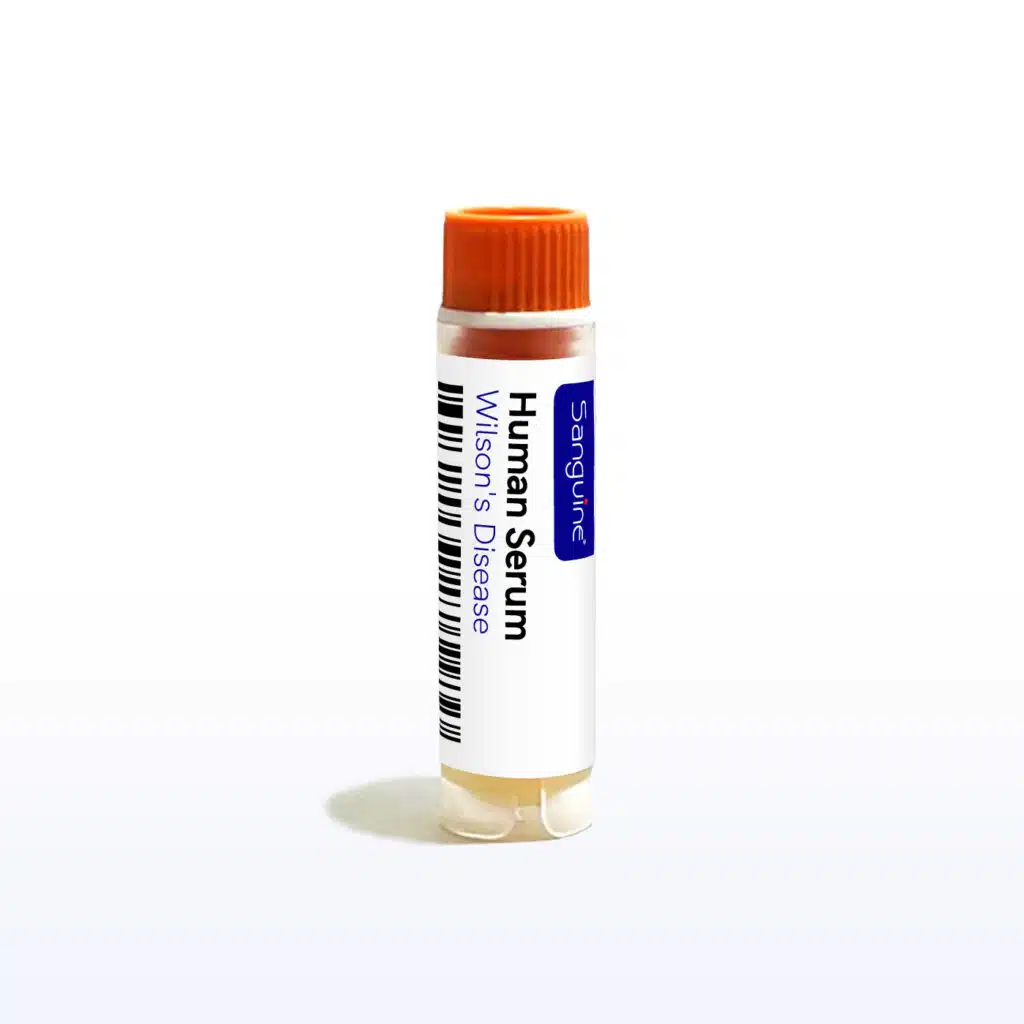
Wilson’s Disease Serum
 Powered by Bioz
About:Wilson's Disease Serum is derived from consented donors with confirmed Wilson's disease, a monogenic ATP7B copper-transport disorder. Ideal for measuring ceruloplasmin, total and non-ceruloplasmin-bound copper, and liver function markers reflecting hepatic and neurologic involvement.
About Wilson’s Disease Serum
Wilson’s Disease Serum for Copper Metabolism and Monogenic Liver Disease Research
Our Wilson’s Disease Serum is sourced from IRB-consented donors clinically diagnosed with Wilson’s disease. Each sample is processed and frozen within 24 hours of collection to preserve copper-handling proteins, liver function analytes, and other labile markers. Wilson’s disease is a monogenic autosomal recessive disorder caused by loss-of-function variants in ATP7B, the copper-transporting ATPase responsible for loading copper onto ceruloplasmin and for biliary copper excretion.
Why Wilson’s Disease Serum
- Defined molecular defect:ATP7B loss of function impairs biliary copper excretion, causing progressive hepatic copper accumulation and, later, release of copper into the circulation and deposition in brain, cornea, and other tissues.
- Serum is the right matrix for the classic biochemical signature: low serum ceruloplasmin together with low total serum copper and an elevated non-ceruloplasmin-bound (“free”) copper fraction is the pattern that defines the disease biochemically.
- Multi-system phenotype: donors present with hepatic disease (steatosis, hepatitis, cirrhosis, or acute liver failure), neurologic disease (tremor, dystonia, parkinsonism, dysarthria), and psychiatric features; Kayser-Fleischer rings reflect corneal copper deposition.
- Liver injury and synthetic function markers — transaminases, bilirubin, albumin, alkaline phosphatase — can be measured in the same serum aliquot alongside copper analytes.
- Haemolysis and oxidative stress from free copper release is a recognised feature and a target for mechanistic serum work.
- Complementary testing: 24-hour urinary copper excretion and hepatic copper quantification are the standard complements to serum testing. Those are separate specimen types and are not included with this product.
Donor Stratification Available
- ATP7B genotype and variant class where available
- Predominant presentation: hepatic, neurologic, psychiatric, or mixed
- Presence of Kayser-Fleischer rings
- Stage of liver disease, including cirrhotic versus non-cirrhotic donors
- Treatment status and modality: chelation (penicillamine, trientine), zinc therapy, treatment-naive, or post-liver transplant
- Age at diagnosis, including paediatric-onset donors
- Matched healthy controls available
Product Features
- Collected from clinically confirmed Wilson’s disease donors
- Research Use Only (RUO)
- Processed and frozen within 24 hours of collection
- IRB-approved protocols with documented consent
- Custom aliquot volumes available upon request
De-identified Donor Data
- Diagnosis confirmation
- ATP7B genotype where available
- Age, sex assigned at birth, and race/ethnicity
- Donor-reported medical history, medications, and comorbidities
- Additional Wilson’s disease-specific metadata available on request
Applications
- Serum ceruloplasmin and total copper measurement, including assay development and cross-platform comparison
- Non-ceruloplasmin-bound (exchangeable or “free”) copper method development and validation
- Liver function and hepatic injury biomarker studies in a monogenic cholestatic/hepatic model
- Biomarker discovery for treatment monitoring and over-chelation detection
- Proteomic and metabolomic profiling of copper dyshomeostasis
- Oxidative stress and haemolysis marker research
- Diagnostic algorithm and reference-interval development for rare metabolic liver disease
- Therapeutic candidate screening, including gene therapy and next-generation chelator programmes
Other Wilson’s Disease Specimen Types
Wilson’s disease donor material is also available as Wilson’s Disease Plasma, Wilson’s Disease PBMC, and Wilson’s Disease Whole Blood.
Compliance and Quality Assurance
- IRB-approved and HIPAA-compliant protocols
- Electronic informed consent with 21 CFR Part 11 – compliant e-signatures
- Documentation support available for regulatory review
Ordering & Customization
Wilson’s disease serum is available in standard and custom volumes. For pricing, international orders, or documentation requirements, please email learnmore@sanguinebio.com to ensure compatibility with your country’s regulations. For the full specimen range, see our human serum collection.
Applications
- Immunology and translational research
- Biomarker discovery and validation
- Drug screening and assay development
- Vaccine and infectious disease research
Product Features
- Research Use Only (RUO), Serum
- Sourced from screened, consented donors
- Processed under validated SOPs
- QC tested for purity, viability, and sterility
- Processed within 24 hours of collection
- IRB-approved protocols with electronic informed consent
Donor Metadata
- Verified diagnosis and clinical history
- Demographic data: age, sex assigned at birth, race/ethnicity
- Medication and treatment background when available
Compliance and Quality Assurance
- IRB-approved collections and standardized procedures
- 21 CFR Part 11-compliant e-consent system
- HIPAA-compliant data management
Ordering & Customization
Human Serum are available in customizable aliquot sizes. For international orders or documentation needs, please contact learnmore@sanguinebio.com to confirm requirements and availability. We also work with multiple ordering platforms and distributors, learn more here.
Protocols & Documentation
-
Download
Serum Isolation
Protocol for serum preparation from whole blood, including collection handling, clarification, and quality documentation.
-
Informed Consent Form (ICF)
Available upon request — confirms donor consent for research use and downstream commercialization.
Serum
Where can I find your complete catalog?
You can find our full product catalog here.
How long can samples be stored?
Storage depends on sample type but often cryopreserved samples stored in liquid nitrogen can be stored for years.
What customization options are available?
Extensive customization is available. To discuss your project request a quote or email us at learnmore@sanguinebio.com.
Do you offer prospective collections?
Sanguine offers flexible prospective collection services tailored to fit your research. For more information and to request a quote, please see: our prospective biospecimen collection services page.
What is the turnaround time for custom collections?
Timelines depend on condition, sample type, and I/E criteria but we often start collection within 2 weeks of signed agreement.
Do you have samples in stock?
YES - we have in-stock inventory. You can also email us at learnmore@sanguinebio.com as we continually get new samples in our inventory.
What does unique donor mean?
Each sample from a different individual - Unique donor means each sample comes from a different person, ensuring biological diversity in your study.
Are samples collected under IRB-approved protocols?
YES - "IRB-approved collection protocols" and IRB approval documentation available upon request. Sanguine utilizes two internationally-recognized IRBs (Advarra and WCG IRB) for review and approval.
Frequently Asked Questions
Ask a Question
Pair with a Healthy Control
Match your Wilson's Disease Serum with normal donor samples for comparison
Healthy Serum
102 In Stock View InventoryNeed a custom Serum cohort?
Our scientific team can scope prospective collections with donor-specific I/E criteria, typically starting within 2 weeks of agreement.