7 Factors to Consider When Isolating Specific Cell Types

Isolating specific cell populations helps answer key questions in translational and clinical research. A common approach is to isolate peripheral blood mononuclear cells (PBMCs) using the Ficoll method. Researchers then purify further to get specific immune cell subsets, like activated T cells, for downstream work. You can also isolate specific cell types directly from whole blood, bone marrow, or cord blood.
There are two basic approaches to separating cells:
- Positive selection: The desired cells are labeled and pulled into a separate fraction. The rest of the sample is discarded.
- Negative selection: The unwanted cells are labeled and removed. The desired cells stay unlabeled in the remaining sample.
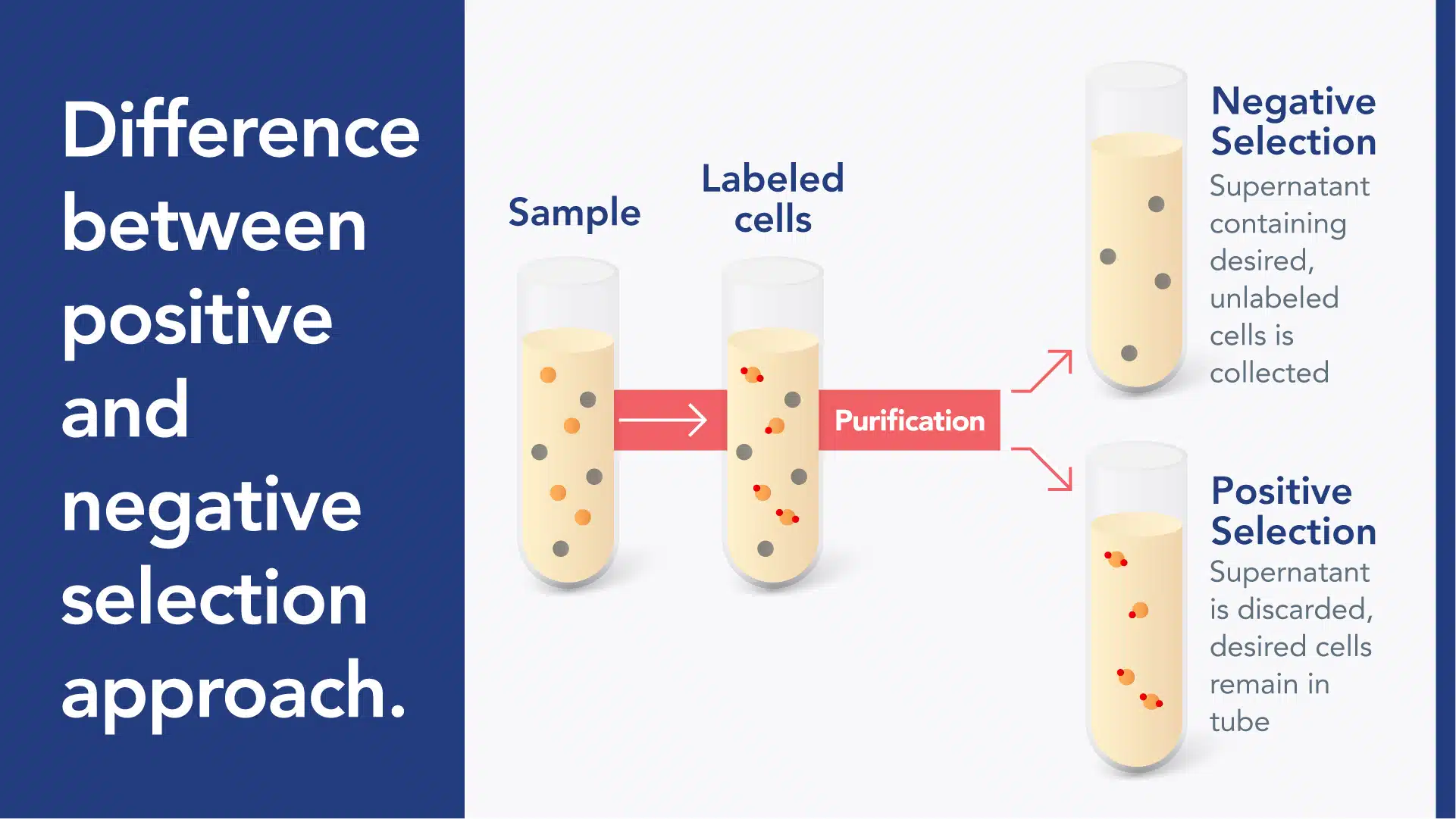
The difference between positive and negative selection approaches.
Choosing the right method takes some planning. Each approach has tradeoffs that can affect your results. Here are seven factors worth thinking through.
1. What are the downstream experiments?
Start with the assays your study needs. A single activated T cell subpopulation calls for a different approach than a general PBMC sample. Also decide early whether you’ll need differentiation, genetic engineering, or cell expansion. These choices affect how you’ll study biomarkers with antibodies, ELISAs, or gene expression profiling. Each downstream use has its own requirements for purity, viability, and function. Matching the isolation method to your study’s needs is the most important first step.
2. Which isolation technique fits your needs?
- Antibody-based approaches:
- Immunomagnetic separation uses magnetic antibodies against specific cell surface markers. It can select for cells (positive selection) or remove them (negative selection). If the antibody targets your cells of interest, they end up in the magnetic fraction and need further purification. If it targets unwanted cells instead, your cells of interest end up in the eluate, ready for analysis.
- Fluorescence-activated cell sorting (FACS) uses fluorophore-tagged antibodies, often several at once, to sort cells into subsets. FACS can target intracellular markers (like GFP) as well as surface markers. It’s the gold standard for precision and diversity. It’s also the slowest and most expensive option.
- Density-based centrifugation is the most common, industry-standard method. It uses a separation medium, such as Ficoll-Paque™, to sort cells by density — the way PBMCs are typically isolated. A variant called rosetting uses antibodies against unwanted cells so they form complexes with red blood cells. Those complexes can then be pelleted out (negative selection).
- Adhesion is simple but slow. It relies on how well different cells stick to a culture surface. Collecting the supernatant isolates suspension cells. Discarding it keeps only the adhered cells. It’s cost-effective, but the result is a mixed cell population that faster-growing cells can dominate.
3. Should you combine multiple techniques?
Sequential methods that remove problem cell types early can improve your final purity. This helps most when a sample has many unwanted cells — blood, for example — where a pre-enrichment step makes later separation easier. This step usually uses density gradients or antibody-based negative selection to clear out most unwanted cells. From there, you can isolate your target subset with antibody-based methods. This saves sorting time and boosts purity.
4. How do you balance purity, recovery, and yield?
Higher purity usually means lower yield. If your study needs a large number of cells, choose a broader cell type. Requesting PBMCs, T cells only, or CD4+ T cells only each requires a different level of separation. Yield drops as you get more specific. Density-based separation gives you a mixed population, so you’ll need antibody-based purification to enrich for markers like CD4. Keep in mind that a marker like CD4 can appear on more than one cell type, including some regulatory T cells and monocytes.1 Positive selection gets you the highest purity, usually with a lower yield and less carryover of unwanted cells.
One factor affects both purity and recovery: making single-cell suspensions before selection. This step cuts down on cell clumping. Clumping can lower purity, since non-target cells get pulled in with your target cells, or target cells get lost in the unwanted fraction. Using fresh samples within 24 hours of collection also helps. Otherwise, dead cells and other debris can contaminate your fraction or release factors that interfere with your results.
5. How do you preserve function and viability?
If preserving cell function matters most, negative selection is usually the safer choice. It leaves your target cells untouched by the labeling process. If you go with positive selection instead, confirm that antibody binding won’t affect the biomarker or phenotype you’re studying. Viability after either method is usually similar to your starting sample. Beyond sample quality, viability mostly comes down to speed and skill during the protocol.
6. Do you need multiple cell types from the same sample?
FACS gives you the most diverse and reliable sorting, but it can be expensive. It isn’t necessary if you only need a few common cell types. A sequential immunomagnetic approach, combining positive and negative selection, often works just as well. Separating each cell type from one sample in sequence — rather than splitting it into separate aliquots — improves yield. It also reduces losses from low volume or cell density. You can run positive selection more than once, but only on cells that haven’t already been labeled. It’s usually best to isolate the rarest or most valuable cell type first, and save the most common types for last. Pick a unique marker for each target cell type to avoid pulling in cells that share the same marker.
7. What about cost and automation?
Every study has to balance its budget against its experimental design. Choosing the simplest, fastest method that still meets your needs for yield, purity, and function can help control costs. Just never do it at the expense of answering your research question. Antibody-based approaches cost more but deliver the highest purity. Many immunomagnetic methods can also be automated, which cuts down on manual handling, lowers cost, and improves reproducibility. Automation works for simultaneous or sequential isolation, and for nearly any cell type. Common cell selection kits are also available commercially. These help keep results consistent across samples and can support higher-throughput workflows.
Choosing the right cell separation method takes some upfront thought, but it pays off. Reducing interference from unwanted cell types lowers experimental complexity and builds confidence in your results — which is exactly what a well-designed translational or clinical study needs.
Related reading: Cryopreserved PBMC considerations and positive vs negative selection for cell isolation. Need cells to start? Buy research-grade human PBMCs.
Reference
1. Tomlinson MJ, Tomlinson S, Yang XB, Kirkham J. Cell separation: Terminology and practical considerations. J Tissue Eng. 2013;4:2041731412472690.