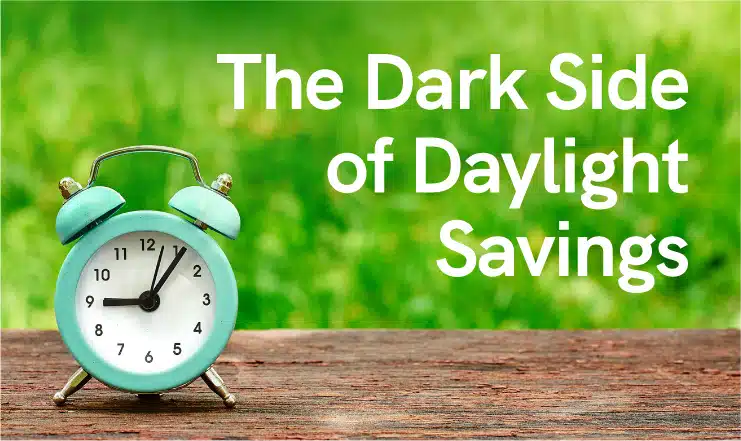
The Dark Side of Daylight Savings
Daylight Savings Time (DST) is a century-old practice meant to conserve energy by making better use of daylight during the spring and summer months, when days are longer. Recent research, though, suggests it has little to no effect on energy cost savings.1 Lately, DST has become a controversial topic, with many regions proposing to end this custom, which about 2 billion people around the world practice, mainly in North America and Europe.
In the United States, DST is estimated to cost the economy over $400 million a year in losses from injuries, lost productivity, and health effects.2 Our biological clocks just aren’t flexible enough for this twice-yearly change, which disrupts our circadian rhythms. The effect is similar to jetlag, though a bit more subtle, as our bodies adjust to the new time.
A large body of research supports the harmful effects of DST. A meta-analysis of seven studies, covering over 115,000 participants total, looked at heart attack risk following DST transitions. It found that the two weeks after the spring transition — but not the autumn one — were linked to a statistically significant, though modest, increase in heart attack risk.3 Similarly, a nationwide study in Finland spanning almost 10 years found that stroke-related hospitalizations increased within the first two days after either DST switch.4 That study found a higher risk in women than men, and in people older than 65 or with other health conditions.
Another recent study, from 2020, analyzed U.S. and Swedish population data and found a greater risk of a whole range of conditions tied to the spring shift specifically — including immune-related and digestive disorders, infections, and injuries.5 Many of these conditions showed roughly a 10% relative risk increase within the first week after the spring DST shift. Based on this, the study’s authors estimated that DST is associated with about 150,000 negative health outcomes in the United States, and over 880,000 cases globally.
Interestingly, the spring time shift seems to affect our health more than the fall change. One possible explanation: the spring shift usually means about one hour less sleep than a normal night, and this brief, mild stressor could trigger or worsen an existing health condition. The spring change can be harder in this way, but the fall time change shortens our daylight hours after work — which leads to less evening activity and, for many people, seasonal affective disorder. Studies have found a short-term increase in depression episodes and male suicide rates following DST.6
It’s also worth remembering that correlation isn’t causation, and each of these observational studies has caveats — DST may not be the direct cause of these effects. Many of these diseases were likely developing in people long before diagnosis, and the mild stressor of DST probably just triggered or worsened a pre-existing condition.
Studies have also shown that more car accidents happen on the first workday after DST.7,8 One study found that eliminating DST would prevent about 28 fatal car accidents a year in the United States.8 There’s even evidence that judges hand out harsher sentences — about 5% longer — on the Monday following DST, likely because of the short-term effects that lost sleep or fatigue have on mood.9 DST has also been linked to lower student SAT scores10 and poor stock market returns.11
The short-term, acute effects of DST are well documented, but we understand its long-term effects on health and well-being far less. All of this data raises the question: do we really need to keep this practice? Many parts of the world don’t observe DST, and legislative efforts to end it are growing. Unfortunately, neighboring states or countries with different practices can complicate this process, which is one key reason for the reluctance to change.
In the meantime, if you have to go through DST twice a year, some small lifestyle changes can lessen the impact of each time shift. The easiest approach is to adjust your alarm by 10-15 minutes a day over the four or five days before the switch. That means going to bed a little later and sleeping in a little later each morning in the fall, or going to sleep earlier and waking up earlier in the spring, before the change happens. Other healthy habits — regular exercise, staying hydrated, and not over-caffeinating — can also ease the transition. Having these tools ready, and staying mindful of the extra fatigue, can help protect you from DST’s impact.

References
- Aries MBC, Newsham GR. Effect of daylight saving time on lighting energy use: A literature review. Energy Policy. 2008;36(6):1858–1866.
- Chmura Economics and Analytics. The Lost Hour Economic Index: Estimating the Economic Loss of Daylight Saving Time for U.S. Metropolitan Statistical Areas. 2013. Available at: https://sleepbetter.org/lost-hour-release/ (Accessed March 4, 2022).
- Manfredini R, Fabbian F, Cappadona R, et al. Daylight Saving Time and Acute Myocardial Infarction: A Meta-Analysis. JCM. 2019;8(3):404.
- Sipilä JOT, Ruuskanen JO, Rautava P, Kytö V. Changes in ischemic stroke occurrence following daylight saving time transitions. Sleep Medicine. 2016;27–28:20–24.
- Zhang H, Dahlén T, Khan A, Edgren G, Rzhetsky A. Measurable health effects associated with the daylight saving time shift. PLoS Comput Biol. 2020;16(6):e1007927.
- Hansen BT, Sønderskov KM, Hageman I, Dinesen PT, Østergaard SD. Daylight Savings Time Transitions and the Incidence Rate of Unipolar Depressive Episodes. Epidemiology. 2017;28(3):346–353.
- Coren S. Daylight Savings Time and Traffic Accidents. N Engl J Med. 1996;334(14):924–925.
- Fritz J, VoPham T, Wright KP, Vetter C. A Chronobiological Evaluation of the Acute Effects of Daylight Saving Time on Traffic Accident Risk. Current Biology. 2020;30(4):729-735.e2.
- Cho K, Barnes CM, Guanara CL. Sleepy Punishers Are Harsh Punishers: Daylight Saving Time and Legal Sentences. Psychol Sci. 2017;28(2):242–247.
- Gaski JF, Sagarin J. Detrimental effects of daylight-saving time on SAT scores. Journal of Neuroscience, Psychology, and Economics. 2011;4(1):44–53.
- Kamstra MJ, Kramer LA, Levi MD. Losing Sleep at the Market: The Daylight Saving Anomaly. American Economic Review. 2000;90(4):1005–1011.