



PBMC Viability & Quality Assurance
PBMC Viability & Quality Assurance
Advantages of Sanguine's Sample Processing
At Sanguine, we recognize that cell viability is crucial for the reliability of downstream applications, including immunophenotyping, cytokine profiling, cell therapy development, and functional assays. Our peripheral blood mononuclear cells (PBMCs) are processed using standardized, IRB-approved protocols designed to preserve cellular integrity from collection to cryopreservation.
Consistently High Viability for Healthy Donors
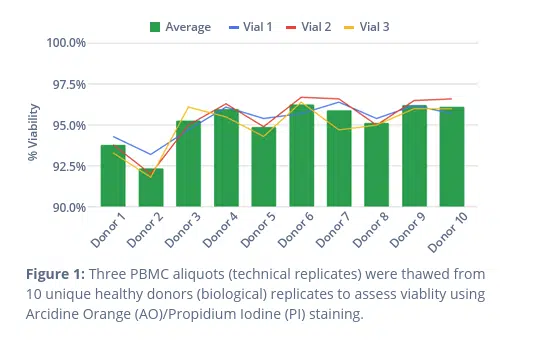
Using our validated isolation and cryopreservation workflow, healthy donor PBMCs consistently achieve over 90% post-thaw viability, with many batches isolated from leukopaks exceeding 95%. This high viability ensures that cells retain their normal morphology, surface marker expression, and responsiveness in culture—delivering reproducible results across experiments and time points.
Key steps for PBMC isolation and thawing:
- Processed within 24 hours of collection
- Cryopreservation method using controlled-rate freezing (–1°C/min)
- Storage in vapor-phase liquid nitrogen until shipment
- Average post-thaw viability >90%
- Viability determined using Arcidine Orange (AO)/Propidium Iodine (PI) staining
Standardized Protocols Across All Donor Types

While viability can vary more significantly in disease-state samples, due to disease pathology, treatment history, or immune cell activation; the same robust, standardized isolation and cryopreservation protocols are applied to every collection. This ensures optimal recovery and minimizes preanalytical variability, even in challenging disease contexts such as autoimmune disorders, oncology, and infectious diseases.
Every sample is processed under controlled temperature and timing windows to preserve physiological function and avoid activation or apoptosis.
Ready to Start Your Study?
Explore our inventory of healthy and disease-state PBMCs available for immediate shipment, or contact our team to design a custom collection with defined viability, volume, or matched sample requirements.