
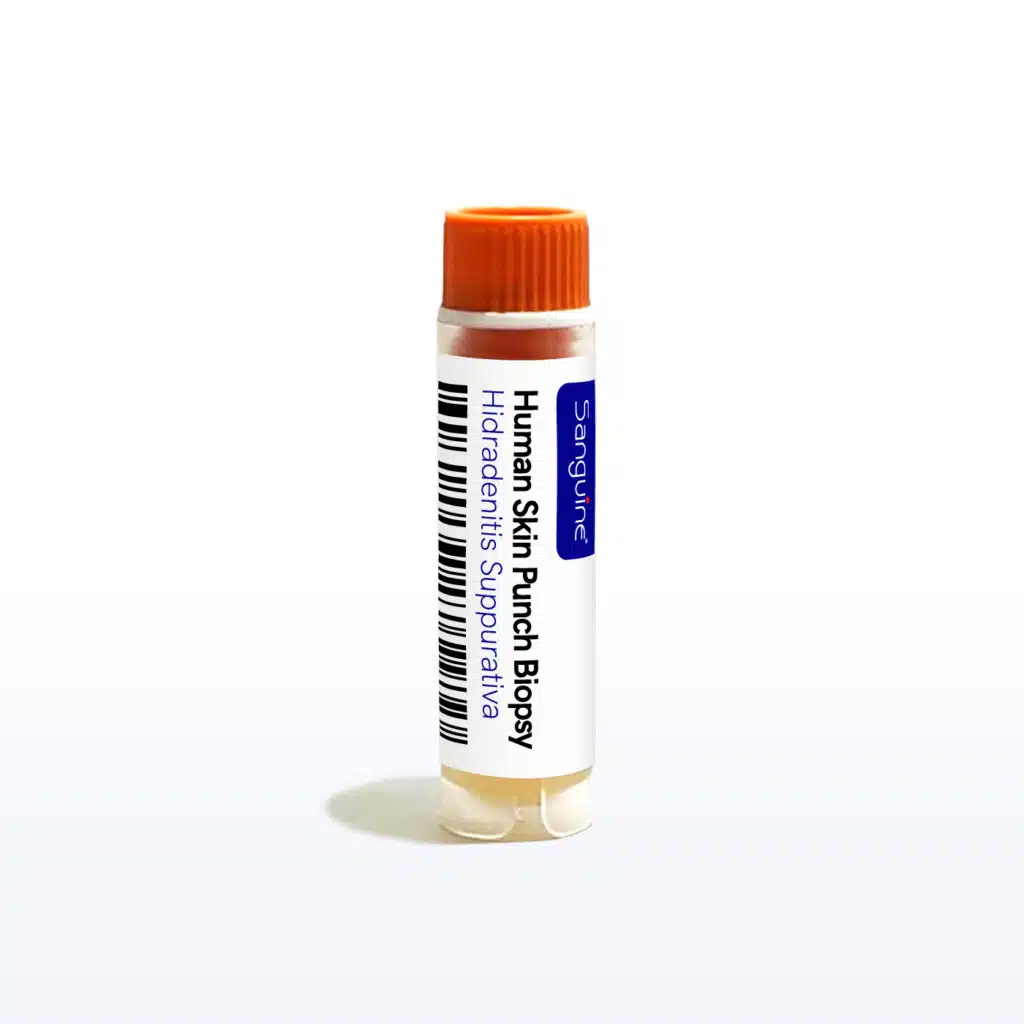
Hidradenitis Suppurativa Skin Punch Biopsy
About:Hidradenitis Suppurativa Skin Punch Biopsy samples are collected from consented donors with clinically confirmed HS, a chronic immune-mediated inflammatory skin disease. Enables examination of follicular occlusion and rupture, neutrophilic and plasma cell infiltrates, epithelialised tunnels, and fibrosis, plus TNF and IL-17 pathway quantification at the site of action. Stratification by Hurley stage, lesion type, and biologic treatment status available, with matched healthy controls.
About Hidradenitis Suppurativa Skin Punch Biopsy
Hidradenitis Suppurativa Skin Punch Biopsy for Chronic Inflammatory Skin Disease Research
Hidradenitis Suppurativa Skin Punch Biopsy samples are collected from IRB-consented donors with a clinically confirmed diagnosis of hidradenitis suppurativa (HS). Biopsies are taken by licensed clinicians under aseptic conditions and, where frozen material is requested, are frozen within 4 hours of collection. Lesional, perilesional, and clinically uninvolved sites can be requested. These specimens support histopathological, immunological, and molecular research into follicle-centred inflammation, tunnel formation, and fibrosis.
Why Skin Tissue for Hidradenitis Suppurativa Research
HS is a chronic immune-mediated inflammatory skin disease, not an autoimmune one: there is no defining autoantibody, and the pathology is driven by follicular occlusion followed by a powerful innate and type 17 inflammatory response. Its defining structural lesions exist only in tissue, which makes biopsy the specimen that carries the mechanism.
- The disease begins at the terminal hair follicle in apocrine gland-bearing intertriginous skin, with follicular hyperkeratosis, occlusion, dilatation and rupture — a sequence assessable only with intact follicular architecture.
- Follicular rupture spills keratin and commensal microorganisms into the dermis, provoking dense neutrophilic and lymphohistiocytic infiltration and abscess formation that is spatially organised around the ruptured unit.
- Epithelialised sinus tracts, or tunnels, are the architectural hallmark of established HS and the substrate of chronic drainage and scarring; they cannot be observed in any blood-derived specimen.
- Lesional HS tissue shows high expression of TNF and IL-17 family cytokines, which is the mechanistic basis for the TNF and IL-17 inhibitors used in the disease, and tissue allows target engagement to be assessed at the site of action.
- Lesional HS skin is notable for prominent B cell and plasma cell infiltration alongside neutrophils and myeloid cells, an unusual immune composition for an inflammatory dermatosis and an active area of research.
- Paired lesional and clinically uninvolved biopsies from the same donor allow established inflammation, early subclinical change, and fibrotic remodelling to be distinguished within one individual.
Donor Stratification Available
- Hurley stage I, II, or III
- Lesion type biopsied: inflammatory nodule, abscess, draining tunnel or sinus tract, scar, perilesional, or clinically uninvolved skin
- Anatomical site: axillary, inguinal, inframammary, gluteal, or perianal
- Disease severity assessment and lesion counts where recorded
- Treatment status: topical or systemic antibiotic, TNF inhibitor, IL-17 inhibitor, retinoid, hormonal therapy, prior surgery, or treatment-naive
- Smoking status and body mass index, both established HS risk factors, plus age of onset and family history
- Matched healthy controls available
Product Features
- Research Use Only (RUO), fresh or frozen skin punch biopsies
- Samples are frozen (if requested) within 4 hours of collection
- Clinically confirmed hidradenitis suppurativa donors
- Collected by licensed clinicians under aseptic conditions
- Lesional and uninvolved sites available from the same donor on request
- Processed and shipped same-day where applicable
- IRB-approved protocols and electronic informed consent
De-identified Donor Data
- Verified diagnosis of hidradenitis suppurativa and Hurley stage where documented
- Donor demographics: age, sex assigned at birth, race/ethnicity
- Self-reported medication history and lesion site
- Disease activity, treatment history, and clinical course available upon request
Applications
- Histopathological characterisation of follicular occlusion, abscess, tunnel epithelium, and fibrosis
- Multiplex immunohistochemistry and imaging of neutrophil, myeloid, T cell, and plasma cell infiltrates
- Spatial and single-cell transcriptomic profiling of lesional versus uninvolved skin
- TNF and IL-17 pathway quantification and target engagement research
- Target validation for IL-1 family, IL-17, IL-23, and JAK-directed therapeutic programmes
- Tissue microbiome and dysbiosis sequencing in tunnels and lesional dermis
- Fibrosis, wound healing, and scarring mechanism research
- Biomarker discovery for disease progression, tunnel formation, and treatment response
Other Hidradenitis Suppurativa Specimen Types
- Hidradenitis Suppurativa Serum
- Hidradenitis Suppurativa Plasma
- Hidradenitis Suppurativa Whole Blood
- Hidradenitis Suppurativa PBMC
- Hidradenitis Suppurativa Leukopak
- Hidradenitis Suppurativa Bulk Plasma
Compliance and Quality Assurance
- IRB-approved collections and SOP-driven processing
- 21 CFR Part 11-compliant electronic informed consent
- HIPAA-compliant donor data management
Ordering & Customization
Hidradenitis Suppurativa Skin Punch Biopsy samples can be shipped ambient, refrigerated, or on dry ice. For pricing, availability, orders outside the United States, or regulatory documentation, please contact learnmore@sanguinebio.com. To browse other disease states and biopsy formats, visit our human skin punch biopsy page.
Applications
- Immunology and translational research
- Biomarker discovery and validation
- Drug screening and assay development
- Vaccine and infectious disease research
Product Features
- Research Use Only (RUO), Skin Punch Biopsy
- Sourced from screened, consented donors
- Processed under validated SOPs
- QC tested for purity, viability, and sterility
- Processed within 24 hours of collection
- IRB-approved protocols with electronic informed consent
Donor Metadata
- Verified diagnosis and clinical history
- Demographic data: age, sex assigned at birth, race/ethnicity
- Medication and treatment background when available
Compliance and Quality Assurance
- IRB-approved collections and standardized procedures
- 21 CFR Part 11-compliant e-consent system
- HIPAA-compliant data management
Ordering & Customization
Human Skin Punch Biopsy are available in customizable aliquot sizes. For international orders or documentation needs, please contact learnmore@sanguinebio.com to confirm requirements and availability. We also work with multiple ordering platforms and distributors, learn more here.
Where can I find your complete catalog?
You can find our full product catalog here.
How long can samples be stored?
Storage depends on sample type but often cryopreserved samples stored in liquid nitrogen can be stored for years.
What customization options are available?
Extensive customization is available. To discuss your project request a quote or email us at learnmore@sanguinebio.com.
Do you offer prospective collections?
Sanguine offers flexible prospective collection services tailored to fit your research. For more information and to request a quote, please see: our prospective biospecimen collection services page.
What is the turnaround time for custom collections?
Timelines depend on condition, sample type, and I/E criteria but we often start collection within 2 weeks of signed agreement.
Do you have samples in stock?
YES - we have in-stock inventory. You can also email us at learnmore@sanguinebio.com as we continually get new samples in our inventory.
What does unique donor mean?
Each sample from a different individual - Unique donor means each sample comes from a different person, ensuring biological diversity in your study.
Are samples collected under IRB-approved protocols?
YES - "IRB-approved collection protocols" and IRB approval documentation available upon request. Sanguine utilizes two internationally-recognized IRBs (Advarra and WCG IRB) for review and approval.
Frequently Asked Questions
Ask a Question
Pair with a Healthy Control
Match your Hidradenitis Suppurativa Skin Punch Biopsy with normal donor samples for comparison
Healthy Skin Punch Biopsy
View InventoryNeed a custom Skin Punch Biopsy cohort?
Our scientific team can scope prospective collections with donor-specific I/E criteria, typically starting within 2 weeks of agreement.