
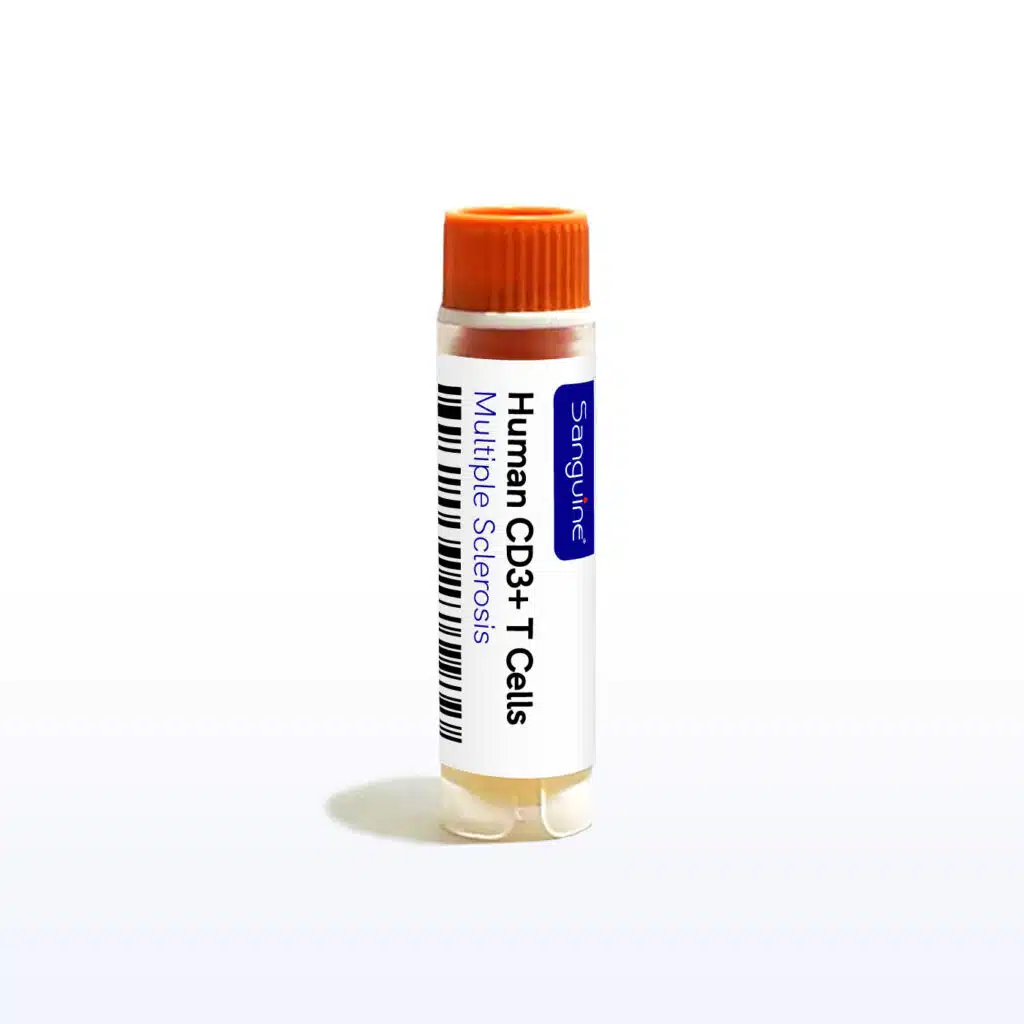
Multiple Sclerosis CD3+ T Cells
 Powered by Bioz
About:Multiple Sclerosis CD3+ T Cells are isolated from peripheral blood of consented donors with clinically confirmed multiple sclerosis, an autoimmune demyelinating disease of the central nervous system. Pre-enriched pan-T cells suit trafficking and adhesion work on VLA-4 and S1P receptors, TCR repertoire sequencing, Th17 and exhaustion phenotyping, and disease-modifying therapy mechanism studies. Purity and viability reported per lot.
About Multiple Sclerosis CD3+ T Cells
Multiple Sclerosis CD3+ T Cells for Autoimmune Demyelination Research
Multiple Sclerosis CD3+ T Cells are isolated from the peripheral blood of IRB-consented adult donors diagnosed with multiple sclerosis (MS). Multiple sclerosis is an autoimmune disease in which lymphocytes cross the blood-brain barrier and attack myelin in the central nervous system, producing demyelinating lesions and progressive neuroaxonal loss. These CD3+ enriched T lymphocytes support investigation of T cell phenotype, trafficking, cytokine production and exhaustion in the cell type central to that process.
Why CD3+ T Cells for Multiple Sclerosis Research
- T cells are the effector population in MS. Myelin-reactive CD4+ Th1 and Th17 cells initiate lesion formation, while CD8+ T cells predominate numerically within established plaques — a pan-CD3 preparation captures both arms in their donor-native proportions.
- The disease is defined by lymphocyte trafficking into the CNS. Alpha-4 integrin (VLA-4), the target of natalizumab, mediates adhesion and transmigration across the blood-brain barrier, and adhesion and migration assays require intact viable T cells rather than a soluble specimen.
- Sphingosine-1-phosphate receptor modulators act by sequestering lymphocytes in lymphoid tissue, preventing egress into the circulation and the CNS. S1P receptor expression and receptor internalisation assays are performed directly on patient T cells.
- T cell receptor repertoire sequencing in MS addresses clonal expansion and antigen specificity questions; starting from a CD3-enriched population removes B cell and myeloid background and improves depth for a given sequencing budget.
- Th17 polarisation, GM-CSF production and regulatory T cell suppressive capacity are all functional readouts studied in MS that require live cells and defined stimulation, not measurement of circulating cytokines.
- Starting from pre-enriched CD3+ cells removes an isolation step and the associated activation and loss, which matters for phospho-signalling and other time-sensitive functional assays.
Donor Stratification Available
- MS subtype: relapsing-remitting, secondary progressive, or primary progressive where classified
- Disability by EDSS score where recorded
- Clinical state at collection: active relapse versus clinical remission
- Disease-modifying therapy status: treatment-naive, on anti-CD20 therapy, on S1P receptor modulator, on natalizumab, on interferon beta or glatiramer acetate, on oral agent, or in washout
- Disease duration and age at onset
- MRI lesion activity where reported
- Matched healthy controls available
Product Features
- Research Use Only (RUO), CD3+ enriched T cells
- Isolated from clinically confirmed multiple sclerosis donors
- Purity, viability and recovery values reported per lot
- Cryopreserved in CryoStor® CS10 media
- Processed within 24 hours of collection
- Custom aliquot sizes available on request
- IRB-approved collection and HIPAA-compliant handling
De-identified Donor Data
- Confirmed multiple sclerosis diagnosis
- Demographics: age, sex assigned at birth, race/ethnicity
- Clinical history and medication records available
- Subtype, disease duration and therapy status where available
Applications
- T cell subset immunophenotyping and immune profiling in multiple sclerosis
- Adhesion, migration and transmigration assays relevant to blood-brain barrier crossing
- S1P receptor expression and internalisation studies for disease-modifying therapy mechanism
- T cell receptor repertoire sequencing and clonality analysis
- Th17 polarisation, cytokine production and exhaustion marker studies
- Regulatory T cell frequency and suppressive function assays
- Target validation and preclinical drug development in autoimmune neurology
- Cell therapy and immune modulation modelling
Other Multiple Sclerosis Specimen Types
- Multiple Sclerosis PBMC
- Multiple Sclerosis Leukopak
- Multiple Sclerosis Serum
- Multiple Sclerosis Plasma
- Multiple Sclerosis Whole Blood
- Multiple Sclerosis Cerebrospinal Fluid
- Multiple Sclerosis CD4+ T Cells and CD8+ T Cells
Compliance and Quality Assurance
- IRB-approved protocols and 21 CFR Part 11-compliant e-consent
- Standardized isolation and cryopreservation
- HIPAA-compliant data protection and donor confidentiality
Ordering & Customization
Multiple Sclerosis CD3+ T Cells are available in standard or custom aliquot sizes. For pricing, availability, or to discuss a cohort stratified by subtype or therapy status, contact learnmore@sanguinebio.com. For international shipments or documentation, please contact us to confirm regional compliance. To browse PBMCs and isolated cell products across all disease states, visit our human PBMC page.
Applications
- Immunology and translational research
- Biomarker discovery and validation
- Drug screening and assay development
- Vaccine and infectious disease research
Product Features
- Research Use Only (RUO), CD3+ T Cells
- Sourced from screened, consented donors
- Processed under validated SOPs
- QC tested for purity, viability, and sterility
- Processed within 24 hours of collection
- IRB-approved protocols with electronic informed consent
Donor Metadata
- Verified diagnosis and clinical history
- Demographic data: age, sex assigned at birth, race/ethnicity
- Medication and treatment background when available
Compliance and Quality Assurance
- IRB-approved collections and standardized procedures
- 21 CFR Part 11-compliant e-consent system
- HIPAA-compliant data management
Ordering & Customization
Human CD3+ T Cells are available in customizable aliquot sizes. For international orders or documentation needs, please contact learnmore@sanguinebio.com to confirm requirements and availability. We also work with multiple ordering platforms and distributors, learn more here.
Protocols & Documentation
-
Download
Immune Cell Isolation
Guidelines for isolating immune cell populations with validated enrichment steps, purity checkpoints, and documentation.
-
Informed Consent Form (ICF)
Available upon request — confirms donor consent for research use and downstream commercialization.
CD3+ T Cells
Where can I find your complete catalog?
You can find our full product catalog here.
How long can samples be stored?
Storage depends on sample type but often cryopreserved samples stored in liquid nitrogen can be stored for years.
What customization options are available?
Extensive customization is available. To discuss your project request a quote or email us at learnmore@sanguinebio.com.
Do you offer prospective collections?
Sanguine offers flexible prospective collection services tailored to fit your research. For more information and to request a quote, please see: our prospective biospecimen collection services page.
What is the turnaround time for custom collections?
Timelines depend on condition, sample type, and I/E criteria but we often start collection within 2 weeks of signed agreement.
Do you have samples in stock?
YES - we have in-stock inventory. You can also email us at learnmore@sanguinebio.com as we continually get new samples in our inventory.
What does unique donor mean?
Each sample from a different individual - Unique donor means each sample comes from a different person, ensuring biological diversity in your study.
Are samples collected under IRB-approved protocols?
YES - "IRB-approved collection protocols" and IRB approval documentation available upon request. Sanguine utilizes two internationally-recognized IRBs (Advarra and WCG IRB) for review and approval.
Frequently Asked Questions
Ask a Question
Pair with a Healthy Control
Match your Multiple Sclerosis CD3+ T Cells with normal donor samples for comparison
Healthy CD3+ T Cells
16 In Stock View InventoryNeed a custom CD3+ T Cells cohort?
Our scientific team can scope prospective collections with donor-specific I/E criteria, typically starting within 2 weeks of agreement.