
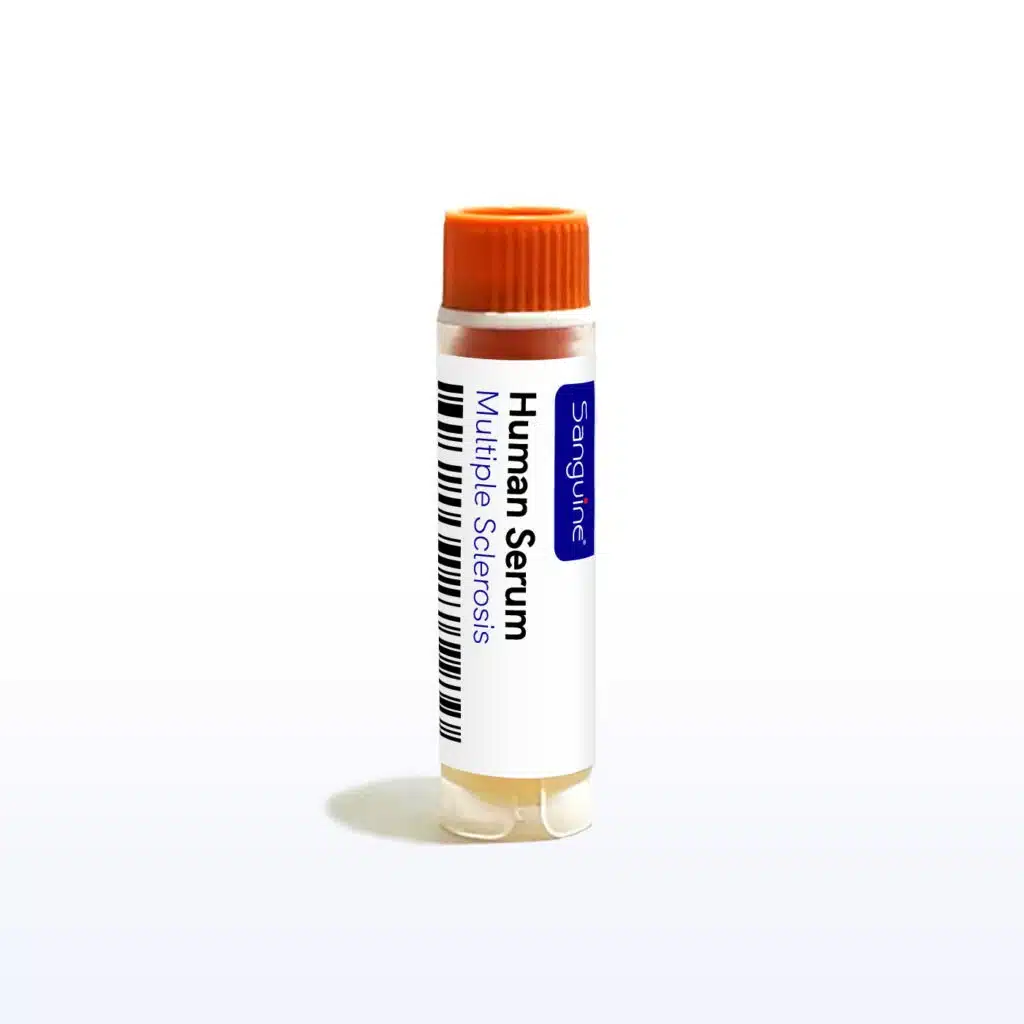
Multiple Sclerosis (MS) Serum
 Powered by Bioz
About:Multiple Sclerosis Serum from consented donors with clinically confirmed MS, stratifiable by disease course, EDSS, and disease-modifying therapy. Ideal for serum neurofilament light chain and GFAP work, AQP4/MOG differential serology, and paired serum–CSF studies.
About Multiple Sclerosis (MS) Serum
Human Multiple Sclerosis Serum for Neuroimmunology and Neurodegeneration Research
Our Multiple Sclerosis Serum is sourced from IRB-consented donors clinically diagnosed with multiple sclerosis (MS). Each sample is processed and frozen within 24 hours of collection to preserve neuroaxonal damage markers, immunoglobulins, cytokines, and viral serology for neuroimmunology research.
Why Serum for Multiple Sclerosis Research
MS is an immune-mediated, autoimmune demyelinating disease of the central nervous system driven by autoreactive T cells and B cells that cross the blood–brain barrier. It is not a classical autoantibody-mediated disease — no single pathogenic autoantibody defines it — and serum is valuable for a different reason: it now carries validated markers of the tissue damage the immune attack produces.
- Serum neurofilament light chain — sNfL is the best-established blood biomarker of ongoing neuroaxonal injury in MS, and its measurement in serum has largely replaced the need for cerebrospinal fluid for this purpose
- Glial injury markers — serum GFAP reflects astroglial pathology and is of particular interest in progressive disease
- Serum is required to exclude MS mimics — anti-aquaporin-4 and anti-MOG antibody testing on serum distinguishes neuromyelitis optica spectrum disorder and MOG antibody–associated disease from MS, which makes serologically characterised MS cohorts genuinely valuable
- Paired serum is needed for intrathecal synthesis — oligoclonal bands and the IgG index are cerebrospinal fluid findings that can only be interpreted against a simultaneous serum sample, so serum is not optional in CSF-based MS work
- Epstein–Barr virus serology — anti-EBNA1 antibody responses are among the most strongly established environmental risk associations in MS, and are measured in serum
- Therapy monitoring analytes — anti-drug antibodies against disease-modifying therapies and JC virus antibody status for risk stratification are serum-based measurements central to treatment research
Donor Stratification Available
- Disease course — relapsing-remitting, secondary progressive, or primary progressive MS
- Disability level — EDSS score where recorded
- Clinical state at draw — active relapse versus clinical remission
- Disease-modifying therapy — treatment-naive, or on interferon beta, glatiramer acetate, fumarate, S1P receptor modulator, natalizumab, or anti-CD20 therapy
- Disease duration and radiological activity — time since diagnosis, and MRI lesion activity where available
- Paired specimen availability — matched cerebrospinal fluid from the same donor where collected
- Matched healthy controls available — demographically matched healthy donor serum
Product Features
- Collected from clinically confirmed MS donors
- Processed and frozen within 24 hours of collection
- Research Use Only (RUO)
- Standard and custom aliquot volumes available
- IRB-approved protocols with documented consent
De-identified Donor Data
- Diagnosis confirmation and disease course where classified
- Age, sex assigned at birth, and ethnicity
- Donor-reported allergy, medication, and infectious disease history
- Disease-modifying therapy history and clinical values available on request
Applications
- Serum neurofilament light chain and GFAP measurement and assay development
- Neuroaxonal damage and disease progression biomarker discovery
- Anti-AQP4 and anti-MOG serology for differential diagnosis research
- Paired serum and CSF studies of intrathecal immunoglobulin synthesis
- Epstein–Barr virus and viral risk-factor serology
- Cytokine, chemokine, and inflammatory protein profiling
- Disease-modifying therapy response, anti-drug antibody, and JCV risk research
- Therapeutic candidate screening and validation
Other Multiple Sclerosis Specimen Types
Matched material from the same MS donor pool is available as multiple sclerosis plasma, whole blood, PBMC, leukopak, and cerebrospinal fluid. Course-specific cohorts are available as relapsing-remitting MS serum and secondary progressive MS serum.
Compliance and Quality Assurance
- IRB-approved and HIPAA-compliant protocols
- Electronic informed consent with 21 CFR Part 11 – compliant e-signatures
- Documentation support available for regulatory review
Ordering & Customization
Multiple sclerosis serum is available in standard and custom volumes. For pricing, international orders, or documentation requirements, please email learnmore@sanguinebio.com to ensure compatibility with your country’s regulations. To browse the full specimen range and healthy-donor controls, see our human serum collection.
Applications
- Immunology and translational research
- Biomarker discovery and validation
- Drug screening and assay development
- Vaccine and infectious disease research
Product Features
- Research Use Only (RUO), Serum
- Sourced from screened, consented donors
- Processed under validated SOPs
- QC tested for purity, viability, and sterility
- Processed within 24 hours of collection
- IRB-approved protocols with electronic informed consent
Donor Metadata
- Verified diagnosis and clinical history
- Demographic data: age, sex assigned at birth, race/ethnicity
- Medication and treatment background when available
Compliance and Quality Assurance
- IRB-approved collections and standardized procedures
- 21 CFR Part 11-compliant e-consent system
- HIPAA-compliant data management
Ordering & Customization
Human Serum are available in customizable aliquot sizes. For international orders or documentation needs, please contact learnmore@sanguinebio.com to confirm requirements and availability. We also work with multiple ordering platforms and distributors, learn more here.
Protocols & Documentation
-
Download
Serum Isolation
Protocol for serum preparation from whole blood, including collection handling, clarification, and quality documentation.
-
Informed Consent Form (ICF)
Available upon request — confirms donor consent for research use and downstream commercialization.
Serum
Where can I find your complete catalog?
You can find our full product catalog here.
How long can samples be stored?
Storage depends on sample type but often cryopreserved samples stored in liquid nitrogen can be stored for years.
What customization options are available?
Extensive customization is available. To discuss your project request a quote or email us at learnmore@sanguinebio.com.
Do you offer prospective collections?
Sanguine offers flexible prospective collection services tailored to fit your research. For more information and to request a quote, please see: our prospective biospecimen collection services page.
What is the turnaround time for custom collections?
Timelines depend on condition, sample type, and I/E criteria but we often start collection within 2 weeks of signed agreement.
Do you have samples in stock?
YES - we have in-stock inventory. You can also email us at learnmore@sanguinebio.com as we continually get new samples in our inventory.
What does unique donor mean?
Each sample from a different individual - Unique donor means each sample comes from a different person, ensuring biological diversity in your study.
Are samples collected under IRB-approved protocols?
YES - "IRB-approved collection protocols" and IRB approval documentation available upon request. Sanguine utilizes two internationally-recognized IRBs (Advarra and WCG IRB) for review and approval.
Frequently Asked Questions
Ask a Question
Pair with a Healthy Control
Match your Multiple Sclerosis (MS) Serum with normal donor samples for comparison
Healthy Serum
102 In Stock View InventoryNeed a custom Serum cohort?
Our scientific team can scope prospective collections with donor-specific I/E criteria, typically starting within 2 weeks of agreement.