
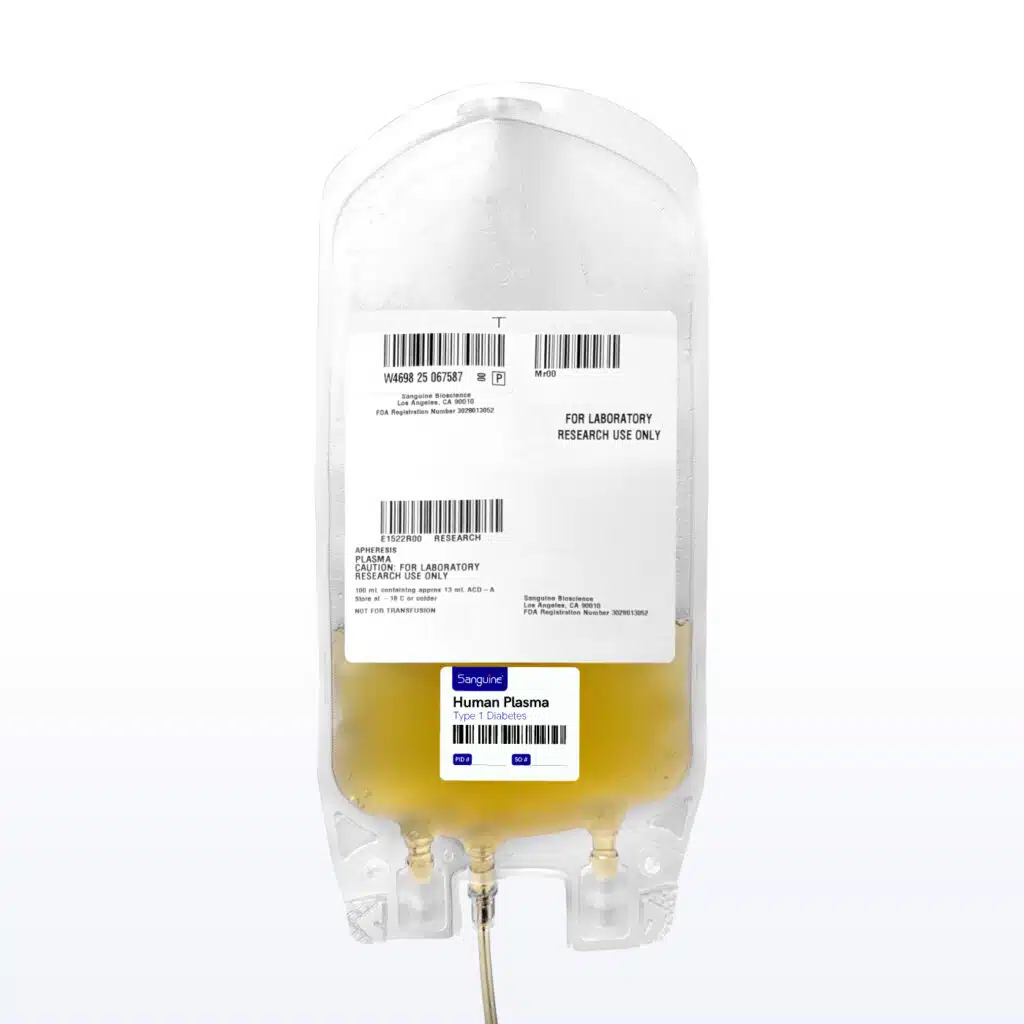
Type 1 Diabetes Bulk Plasma
About:Type 1 Diabetes Bulk Plasma is collected via apheresis using Acid-Citrate-Dextrose Formula A (ACDA) from consented donors with autoimmune type 1 diabetes. Tested negative for HIV, HBV, and HCV, and ideal for islet autoantibody assay development, C-peptide and cytokine profiling, and biomarker discovery.
About Type 1 Diabetes Bulk Plasma
Type 1 Diabetes Bulk Plasma for Autoimmune Diabetes Research
Type 1 Diabetes Bulk Plasma is collected from IRB-consented donors diagnosed with type 1 diabetes (T1D) using apheresis, with ACDA (Acid-Citrate-Dextrose Formula A) as the anticoagulant. Type 1 diabetes is an autoimmune disease in which autoreactive T cells destroy insulin-producing pancreatic beta cells, producing absolute insulin deficiency. High-volume plasma supports islet autoantibody work, metabolic and inflammatory profiling, assay development, and therapeutic discovery. Plasma is acellular and is intended for soluble-analyte measurement rather than cell-based assays.
Disease Biology and Why Bulk Plasma
- Islet autoantibodies are the defining humoral markers of T1D: GAD65, IA-2, insulin (IAA), and ZnT8. Bulk volumes are ideal for developing, calibrating, and standardising these assays.
- Autoreactive T-cell-mediated beta-cell destruction underlies the disease; circulating markers of beta-cell loss and residual function complement the antibody picture.
- C-peptide indexes endogenous insulin secretion and residual beta-cell function, and is central to disease-modifying trial endpoints.
- Metabolic analytes: glucose, HbA1c-related markers, ketones, and lipid panels can be measured alongside immune readouts.
- Large single-donor volumes from apheresis reduce inter-donor variability and are well suited to reference material, control panel, and positive-control production.
- Immune-directed therapeutics: teplizumab-class and other immunomodulatory programmes rely on plasma cytokine, chemokine, and autoantibody pharmacodynamic readouts.
Donor Stratification Available
- Islet autoantibody status and number of positive autoantibodies where available
- Time since diagnosis: new-onset versus long-standing disease
- Age at onset, including paediatric-onset donors
- Insulin delivery method: multiple daily injections, insulin pump, or closed-loop system
- Presence of diabetic complications: retinopathy, nephropathy, or neuropathy
- Coexisting autoimmune conditions such as autoimmune thyroid disease or coeliac disease
- Matched healthy controls available
Product Features
- High-volume plasma collected via apheresis
- Anticoagulated using ACDA
- Tested and confirmed negative for HIV, HBV, and HCV
- Available fresh with custom volumes upon request
- Research Use Only (RUO)
- IRB-approved informed consent and HIPAA-compliant handling
De-identified Donor Data
- Clinically confirmed diagnosis of T1D
- Donor demographics: age, sex assigned at birth, race/ethnicity
- Clinical history and medication data available
- Additional T1D-specific metadata available on request
Applications
- GAD65, IA-2, insulin, and ZnT8 autoantibody assay development and standardisation
- Positive control, calibrator, and reference panel production
- C-peptide and beta-cell function biomarker research
- Cytokine, chemokine, and inflammation profiling
- Proteomic and metabolomic biomarker discovery
- Autoantigen discovery and autoantibody array work
- Diagnostic platform validation and multiplex panel development
- Immunotherapy and disease-modifying therapeutic development and validation
Other Type 1 Diabetes Specimen Types
T1D donor material is also available as Type 1 Diabetes Plasma, Type 1 Diabetes Serum, Type 1 Diabetes Whole Blood, Type 1 Diabetes PBMC, and Type 1 Diabetes Leukopak. Isolated cell subsets are available as CD4+ T cells, CD8+ T cells, CD3+ T cells, CD19+ B cells, and CD56+ NK cells.
Compliance and Quality Assurance
- Screened negative for HIV, HBV, and HCV
- IRB-approved collection with 21 CFR Part 11-compliant consent
- Standardized processing and cryopreservation protocols
- Documentation support available for regulatory review
Ordering & Customization
Type 1 Diabetes Bulk Plasma is available in standard or custom volumes. For pricing, documentation, or international shipping, please contact learnmore@sanguinebio.com. To browse plasma from other disease states, visit our human plasma page.
Applications
- Immunology and translational research
- Biomarker discovery and validation
- Drug screening and assay development
- Vaccine and infectious disease research
Product Features
- Research Use Only (RUO), Bulk Plasma
- Sourced from screened, consented donors
- Processed under validated SOPs
- QC tested for purity, viability, and sterility
- Processed within 24 hours of collection
- IRB-approved protocols with electronic informed consent
Donor Metadata
- Verified diagnosis and clinical history
- Demographic data: age, sex assigned at birth, race/ethnicity
- Medication and treatment background when available
Compliance and Quality Assurance
- IRB-approved collections and standardized procedures
- 21 CFR Part 11-compliant e-consent system
- HIPAA-compliant data management
Ordering & Customization
Human Bulk Plasma are available in customizable aliquot sizes. For international orders or documentation needs, please contact learnmore@sanguinebio.com to confirm requirements and availability. We also work with multiple ordering platforms and distributors, learn more here.
Where can I find your complete catalog?
You can find our full product catalog here.
How long can samples be stored?
Storage depends on sample type but often cryopreserved samples stored in liquid nitrogen can be stored for years.
What customization options are available?
Extensive customization is available. To discuss your project request a quote or email us at learnmore@sanguinebio.com.
Do you offer prospective collections?
Sanguine offers flexible prospective collection services tailored to fit your research. For more information and to request a quote, please see: our prospective biospecimen collection services page.
What is the turnaround time for custom collections?
Timelines depend on condition, sample type, and I/E criteria but we often start collection within 2 weeks of signed agreement.
Do you have samples in stock?
YES - we have in-stock inventory. You can also email us at learnmore@sanguinebio.com as we continually get new samples in our inventory.
What does unique donor mean?
Each sample from a different individual - Unique donor means each sample comes from a different person, ensuring biological diversity in your study.
Are samples collected under IRB-approved protocols?
YES - "IRB-approved collection protocols" and IRB approval documentation available upon request. Sanguine utilizes two internationally-recognized IRBs (Advarra and WCG IRB) for review and approval.
Frequently Asked Questions
Ask a Question
Pair with a Healthy Control
Match your Type 1 Diabetes Bulk Plasma with normal donor samples for comparison
Healthy Bulk Plasma
View InventoryNeed a custom Bulk Plasma cohort?
Our scientific team can scope prospective collections with donor-specific I/E criteria, typically starting within 2 weeks of agreement.