
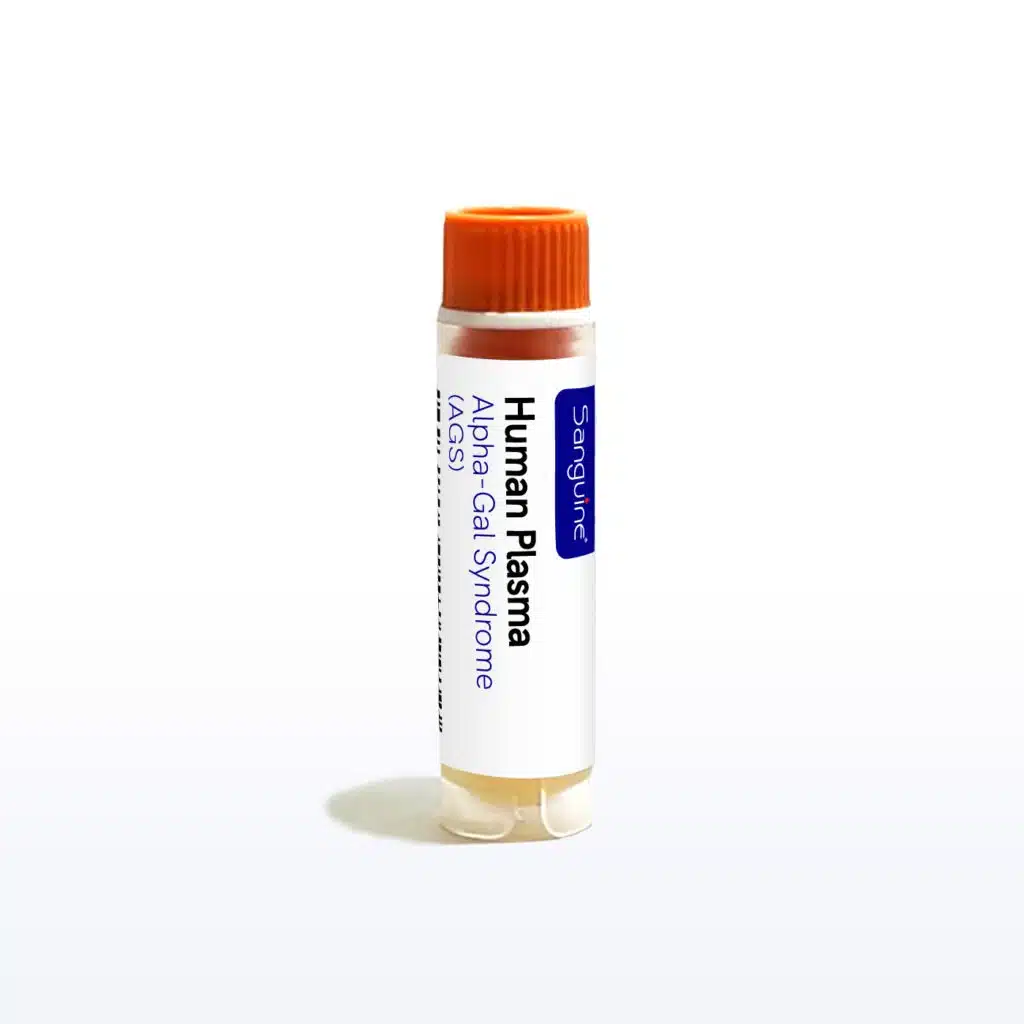
Alpha-Gal Syndrome Plasma
 Powered by Bioz
About:Alpha-Gal Syndrome Plasma - human plasma from clinically confirmed alpha-gal syndrome (AGS) donors. AGS is a tick bite-acquired, IgE-mediated allergy to the mammalian glycan galactose-alpha-1,3-galactose. Ideal for specific IgE and IgG subclass assays, type 2 cytokine profiling, tryptase measurement, and alpha-gal reactivity screening of mammalian-derived biologics. Matched healthy controls available.
About Alpha-Gal Syndrome Plasma
Alpha-Gal Syndrome Plasma for Allergy and Type 2 Immunity Research
Alpha-Gal Syndrome Plasma is collected from IRB-consented donors clinically diagnosed with alpha-gal syndrome (AGS) and processed within one day of collection to preserve immunoglobulins, complement, cytokines, and metabolites. AGS is an IgE-mediated allergic condition driven by type 2 immunity – it is not an autoimmune disease – and plasma is the matrix in which its defining specific IgE and associated mediators are measured.
Alpha-Gal Syndrome Immunology and Why Plasma
- AGS is caused by IgE antibodies directed against galactose-alpha-1,3-galactose (alpha-gal), an oligosaccharide present on glycoproteins and glycolipids of non-primate mammals but absent in humans, who lack a functional alpha-1,3-galactosyltransferase.
- Sensitisation is acquired through tick bites, most strongly associated in the United States with the lone star tick Amblyomma americanum, with related species implicated in other regions. The geographic distribution of cases follows tick distribution closely.
- The response is classical type 2 immunity: allergen-specific IgE production under Th2 and IL-4/IL-13 control, IgE loading of mast cells and basophils via FcepsilonRI, and mediator release on subsequent exposure.
- The hallmark clinical feature is delayed onset – typically two to six hours after eating mammalian meat – which is generally attributed to the time required for digestion and lipid-associated transport of the glycan-bearing allergen into the circulation, distinguishing AGS from immediate food allergy.
- The same epitope explains immediate hypersensitivity to cetuximab, which carries alpha-gal on its Fab region, and has raised questions about alpha-gal on other mammalian-derived biologics, gelatin products, and xenograft materials.
- Plasma is acellular and is the appropriate matrix for alpha-gal-specific IgE and IgG subclass quantification, total IgE, baseline tryptase, and cytokine profiling. Basophil activation testing and other cell-based assays require the paired whole blood or PBMC products.
Donor Stratification Available
- Alpha-gal-specific IgE result where serological testing is documented
- Reaction severity: urticaria and gastrointestinal symptoms only versus documented anaphylaxis
- Documented tick-bite history and time since sensitising exposure
- Total IgE level and concurrent atopy, including asthma, rhinitis, or other food allergy
- Current dietary avoidance status and time since diagnosis, including donors with documented tolerance recovery
- Geographic region of residence and exposure, plus age band and sex
- Matched healthy controls available
Product Features
- Research Use Only (RUO)
- Plasma collected from clinically confirmed AGS donors
- Processed within one day of collection
- Choice of anticoagulant on request
- IRB-approved protocols and informed consent
- Custom aliquot volumes available upon request
De-identified Donor Data
- Verified alpha-gal syndrome (AGS) diagnosis
- Demographic data: age, sex assigned at birth, race/ethnicity
- Donor-reported medications, allergies, and comorbidities
- Specific IgE results, reaction history, and tick-exposure history where documented
- Additional AGS-specific metadata available on request
Applications
- Alpha-gal-specific IgE assay development, calibration, and platform bridging
- Total IgE and alpha-gal-specific IgG and IgG4 subclass quantification
- Component-resolved diagnostics and glycan epitope-specificity mapping
- Baseline tryptase and mediator measurement in relation to reaction severity
- Type 2 cytokine profiling, including IL-4, IL-5, IL-13, and TSLP
- Immunogenicity and safety screening of mammalian-derived biologics, excipients, and xenograft materials for alpha-gal reactivity
- Longitudinal studies of IgE decline and tolerance recovery after exposure avoidance
- Diagnostic assay development and reference-range establishment for allergy testing panels
Other Alpha-Gal Syndrome Specimen Types
- Alpha-Gal Syndrome Serum
- Alpha-Gal Syndrome Whole Blood
- Alpha-Gal Syndrome PBMC
- Alpha-Gal Syndrome Leukopak
- Alpha-Gal Syndrome Bulk Plasma
Compliance and Quality Assurance
- IRB-approved and HIPAA-compliant protocols
- Electronic informed consent with 21 CFR Part 11-compliant e-signatures
- Documentation support available for regulatory review
Ordering & Customization
Alpha-gal syndrome plasma is available in standard and custom volumes. For pricing, international orders, or documentation requirements, please email learnmore@sanguinebio.com to ensure compatibility with your country’s regulations. To compare donor availability across conditions, visit our human plasma page.
Applications
- Immunology and translational research
- Biomarker discovery and validation
- Drug screening and assay development
- Vaccine and infectious disease research
Product Features
- Research Use Only (RUO), Plasma
- Sourced from screened, consented donors
- Processed under validated SOPs
- QC tested for purity, viability, and sterility
- Processed within 24 hours of collection
- IRB-approved protocols with electronic informed consent
Donor Metadata
- Verified diagnosis and clinical history
- Demographic data: age, sex assigned at birth, race/ethnicity
- Medication and treatment background when available
Compliance and Quality Assurance
- IRB-approved collections and standardized procedures
- 21 CFR Part 11-compliant e-consent system
- HIPAA-compliant data management
Ordering & Customization
Human Plasma are available in customizable aliquot sizes. For international orders or documentation needs, please contact learnmore@sanguinebio.com to confirm requirements and availability. We also work with multiple ordering platforms and distributors, learn more here.
Protocols & Documentation
-
Download
Plasma Isolation
Protocol for plasma separation from anticoagulated whole blood, including processing, storage, and traceability requirements.
-
Informed Consent Form (ICF)
Available upon request — confirms donor consent for research use and downstream commercialization.
Plasma
Where can I find your complete catalog?
You can find our full product catalog here.
How long can samples be stored?
Storage depends on sample type but often cryopreserved samples stored in liquid nitrogen can be stored for years.
What customization options are available?
Extensive customization is available. To discuss your project request a quote or email us at learnmore@sanguinebio.com.
Do you offer prospective collections?
Sanguine offers flexible prospective collection services tailored to fit your research. For more information and to request a quote, please see: our prospective biospecimen collection services page.
What is the turnaround time for custom collections?
Timelines depend on condition, sample type, and I/E criteria but we often start collection within 2 weeks of signed agreement.
Do you have samples in stock?
YES - we have in-stock inventory. You can also email us at learnmore@sanguinebio.com as we continually get new samples in our inventory.
What does unique donor mean?
Each sample from a different individual - Unique donor means each sample comes from a different person, ensuring biological diversity in your study.
Are samples collected under IRB-approved protocols?
YES - "IRB-approved collection protocols" and IRB approval documentation available upon request. Sanguine utilizes two internationally-recognized IRBs (Advarra and WCG IRB) for review and approval.
Frequently Asked Questions
Ask a Question
Pair with a Healthy Control
Match your Alpha-Gal Syndrome Plasma with normal donor samples for comparison
Healthy Plasma
207 In Stock View InventoryNeed a custom Plasma cohort?
Our scientific team can scope prospective collections with donor-specific I/E criteria, typically starting within 2 weeks of agreement.