
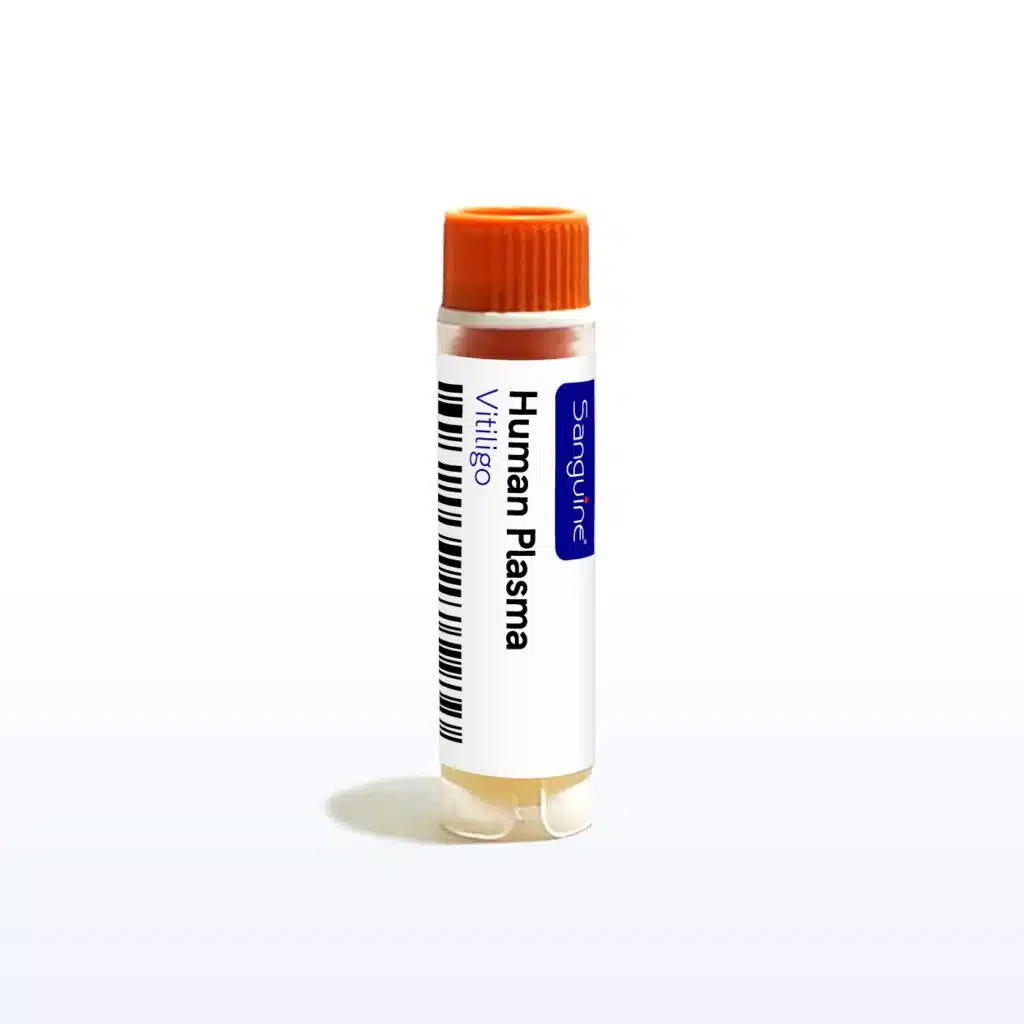
Vitiligo Plasma
 Powered by Bioz
About:Vitiligo Plasma is collected from clinically confirmed vitiligo donors and processed within one day. Centred on the interferon-gamma-driven CXCL9/CXCL10 chemokine axis that recruits melanocyte-specific CD8+ T cells, plus melanocyte antigen autoantibodies and oxidative stress markers. Stratification by subtype, disease activity, extent, associated autoimmunity and treatment, with matched healthy controls available.
About Vitiligo Plasma
Vitiligo Plasma for Autoimmune Depigmentation Research
Vitiligo Plasma is collected from IRB-consented donors with a clinically confirmed diagnosis of vitiligo and processed within one day of collection to preserve labile analytes such as cytokines, chemokines, proteins and metabolites. Plasma is acellular, so it is supplied for soluble-analyte work — multiplex chemokine quantification, autoantibody serology, proteomics and metabolomics — in standard or custom aliquot volumes with de-identified clinical annotation.
Why Vitiligo Plasma for Autoimmune Research
Vitiligo is an autoimmune disease in which melanocytes are destroyed, producing well-demarcated depigmented macules. Melanocyte-specific CD8+ cytotoxic T cells are the principal effectors, recruited into skin by an interferon-gamma-driven chemokine axis. Although the effector cells act in the epidermis, the mediators that recruit and sustain them circulate, which makes plasma a genuinely mechanistic specimen for this disease rather than a generic inflammation matrix.
- Interferon-gamma-induced chemokines — CXCL9 and CXCL10 are the best-characterised soluble mediators in vitiligo, recruiting CXCR3-positive cytotoxic T cells to the skin, and they track with disease activity.
- The IFN-γ/JAK/STAT axis — this pathway is the mechanistic rationale for JAK inhibition in vitiligo, and its circulating outputs are directly measurable in plasma.
- Melanocyte antigen autoantibodies — antibodies against tyrosinase, TYRP1 and other melanocyte differentiation antigens are detectable in the acellular compartment.
- Oxidative stress mediators — melanocytes carry a high intrinsic oxidative burden from melanin synthesis, and markers of redox stress and damage-associated molecular patterns link cellular stress to immune activation.
- Associated autoimmune serology — vitiligo commonly co-occurs with other autoimmune conditions, and thyroid and related autoantibodies can be measured in the same sample.
- Acellular by design — plasma is the right input for immunoassay, multiplex and mass spectrometry workflows; melanocyte-specific T cell assays require a cellular product instead.
Donor Stratification Available
- Clinical subtype — non-segmental (generalised) vitiligo, segmental vitiligo, acrofacial, and universal disease
- Disease activity — actively spreading or unstable disease versus stable disease at the time of draw
- Extent of involvement — limited versus extensive body surface area affected, where documented
- Associated autoimmunity — donors with concurrent autoimmune thyroid disease, type 1 diabetes, alopecia areata, or pernicious anaemia
- Treatment status — treatment-naive, topical corticosteroid or calcineurin inhibitor, phototherapy, or JAK inhibitor-treated donors; Fitzpatrick skin type available on request
- Matched healthy controls available, drawn on the same protocol and matched for age, sex and ethnicity
Product Features
- Research Use Only (RUO)
- Plasma collected from clinically confirmed vitiligo donors
- Processed within one day of collection
- IRB-approved protocols and informed consent
- Custom aliquot volumes available upon request
- Volumes and anticoagulant options reported per lot
De-identified Donor Data
- Verified vitiligo diagnosis
- Demographic data: age, sex assigned at birth, race/ethnicity
- Donor-reported medications, allergies, and comorbidities
- Subtype, activity and treatment context reported per lot where captured
- Additional vitiligo-specific metadata available on request
Applications
- CXCL9 and CXCL10 quantification and disease-activity biomarker qualification
- Interferon-gamma pathway output profiling for JAK inhibitor programmes
- Melanocyte antigen autoantibody detection and serology development
- Multiplex cytokine and chemokine profiling in active versus stable disease
- Oxidative stress and damage-associated molecular pattern marker studies
- Associated autoimmune serology screening within vitiligo cohorts
- Plasma proteomic and metabolomic discovery in autoimmune depigmentation
- Therapeutic pharmacodynamic and target engagement readout development
Other Vitiligo Specimen Types
Compliance and Quality Assurance
- IRB-approved and HIPAA-compliant protocols
- Electronic informed consent with 21 CFR Part 11-compliant e-signatures
- Documentation support available for regulatory review
Ordering & Customization
Vitiligo plasma is available in standard and custom volumes. For pricing, international orders or documentation requirements, please email learnmore@sanguinebio.com to ensure compatibility with your country’s regulations. To compare collection formats or check wider availability, visit our human plasma page.
Applications
- Immunology and translational research
- Biomarker discovery and validation
- Drug screening and assay development
- Vaccine and infectious disease research
Product Features
- Research Use Only (RUO), Plasma
- Sourced from screened, consented donors
- Processed under validated SOPs
- QC tested for purity, viability, and sterility
- Processed within 24 hours of collection
- IRB-approved protocols with electronic informed consent
Donor Metadata
- Verified diagnosis and clinical history
- Demographic data: age, sex assigned at birth, race/ethnicity
- Medication and treatment background when available
Compliance and Quality Assurance
- IRB-approved collections and standardized procedures
- 21 CFR Part 11-compliant e-consent system
- HIPAA-compliant data management
Ordering & Customization
Human Plasma are available in customizable aliquot sizes. For international orders or documentation needs, please contact learnmore@sanguinebio.com to confirm requirements and availability. We also work with multiple ordering platforms and distributors, learn more here.
Protocols & Documentation
-
Download
Plasma Isolation
Protocol for plasma separation from anticoagulated whole blood, including processing, storage, and traceability requirements.
-
Informed Consent Form (ICF)
Available upon request — confirms donor consent for research use and downstream commercialization.
Plasma
Where can I find your complete catalog?
You can find our full product catalog here.
How long can samples be stored?
Storage depends on sample type but often cryopreserved samples stored in liquid nitrogen can be stored for years.
What customization options are available?
Extensive customization is available. To discuss your project request a quote or email us at learnmore@sanguinebio.com.
Do you offer prospective collections?
Sanguine offers flexible prospective collection services tailored to fit your research. For more information and to request a quote, please see: our prospective biospecimen collection services page.
What is the turnaround time for custom collections?
Timelines depend on condition, sample type, and I/E criteria but we often start collection within 2 weeks of signed agreement.
Do you have samples in stock?
YES - we have in-stock inventory. You can also email us at learnmore@sanguinebio.com as we continually get new samples in our inventory.
What does unique donor mean?
Each sample from a different individual - Unique donor means each sample comes from a different person, ensuring biological diversity in your study.
Are samples collected under IRB-approved protocols?
YES - "IRB-approved collection protocols" and IRB approval documentation available upon request. Sanguine utilizes two internationally-recognized IRBs (Advarra and WCG IRB) for review and approval.
Frequently Asked Questions
Ask a Question
Pair with a Healthy Control
Match your Vitiligo Plasma with normal donor samples for comparison
Healthy Plasma
180 In Stock View InventoryNeed a custom Plasma cohort?
Our scientific team can scope prospective collections with donor-specific I/E criteria, typically starting within 2 weeks of agreement.